European Green Deal: The Roadmap to Climate Neutrality by 2050
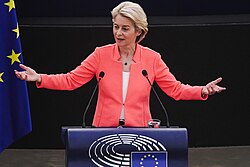
The European Green Deal, approved in 2020, represents a comprehensive set of policy initiatives designed by the European Commission to transform the European Union (EU) into the first climate-neutral continent by 2050. Described by Commission President Ursula von der Leyen as Europe's "man on the moon moment," the deal seeks to decouple economic growth from resource usage, ensuring that the economy develops without increasing its environmental footprint.
To achieve this ambitious goal, the EU is reviewing all existing laws based on their climate merits while introducing new legislation focused on the circular economy (a model of production and consumption that involves sharing, leasing, reusing, and recycling existing materials), biodiversity, building renovation, and sustainable farming.
Key Facts
- Primary Goal: Achieve full climate neutrality across the EU by 2050.
- Interim Target: Reduce greenhouse gas emissions by 55% by 2030 compared to 1990 levels.
- Automotive Shift: All new cars sold in the EU must be zero-emission vehicles by 2035.
- Nature Restoration: Binding targets to restore 30% of degraded habitats by 2030, 60% by 2040, and 90% by 2050.
- Funding: Part of the €750 billion Next Generation EU recovery package, with 25% of funding dedicated to climate change mitigation.
Legislative Framework and Governance

The transition is guided by the European Climate Law, which legally binds the EU to its emission targets. To implement these goals, the Commission introduced the Fit for 55 package, a detailed set of legislative proposals to align EU policy with the 55% emission reduction target for 2030.
A pivotal component of this framework is the ETS2 (Emissions Trading System 2), set to enter force in 2027. This system will introduce carbon pricing for fuels used in road transport and buildings for the first time.
Leadership and Evolution
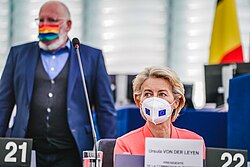
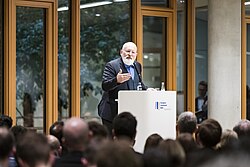
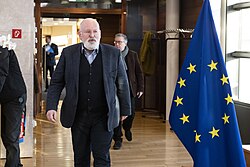
The execution of the Green Deal has been led by the Executive Vice President of the European Commission for the European Green Deal. This role was held by Frans Timmermans from 2019, followed by Maroš Šefčovič in 2023, and Teresa Ribera in 2024.
Core Policy Areas
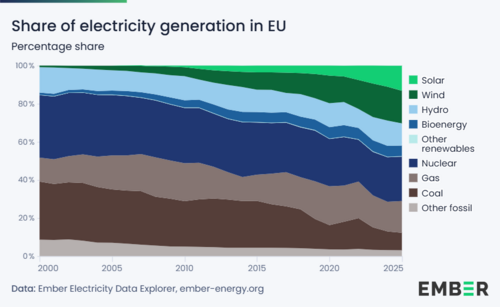
Clean Energy and Sustainable Industry
The EU aims to prioritize energy efficiency and develop a power sector based largely on renewable resources. The goal is to create a fully integrated, digitalized energy market that ensures an affordable supply for all member states.
Sustainable Mobility and Infrastructure
Under the sustainable and smart mobility strategy, the EU is pushing for a rapid transition in transport. A key mandate is that all new cars sold within the union must be zero-emission by 2035.
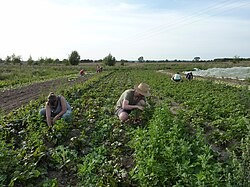
Farm to Fork and Biodiversity
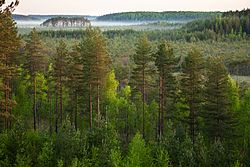
The Farm to Fork strategy focuses on making food systems fair, healthy, and environmentally friendly. Parallel to this, the EU Biodiversity Strategy for 2030 and the Nature Restoration Law (Regulation (EU) 2024/1991) make the restoration of nature binding. Member states must develop national restoration plans by 2026 to recover habitats in poor ecological state.
Economic Impact and the Just Transition
![Geographical distribution of the global battery supply chain[111]: 58](/images/05/4f/054f239263d6aa50d864159e9e763a1d1464291ad1bee7521e29f9b5d1d17025.png)
Recognizing that the shift to a green economy creates winners and losers, the EU has integrated the Green Deal into its COVID-19 recovery efforts. The Next Generation EU package provides funding for projects meeting strict green criteria, explicitly excluding fossil fuels and nuclear power.
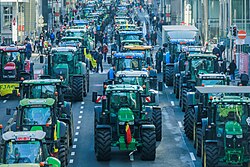
However, the transition has faced significant challenges. Between 2019 and 2023, the EU saw over 853,000 job losses in manufacturing, particularly in the automotive sector. The hardest-hit regions include Poland, the Czech Republic, Romania, and Germany. Trade unions have warned that up to 11 million jobs could be at risk, with 180,000 coal mining jobs potentially disappearing by 2030.
Global Context and Statistics
![The German chemical company BASF was forced to cut production[140]](/images/37/96/3796ea743dac1e9f7bc4024a20516ccacd0eee3d807523c1e8ecc76e5a1cdb66.jpg)
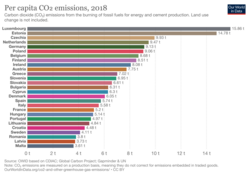
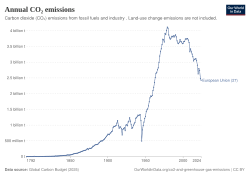
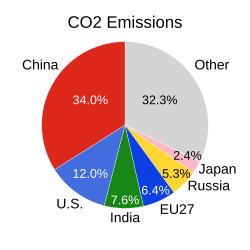
While the EU is leading in policy, it remains a smaller contributor to global emissions compared to other major economies. The following table outlines the distribution of global carbon dioxide emissions by jurisdiction for 2023.
| Jurisdiction | Percentage Share |
|---|---|
| China | 31.8% |
| United States | 14.4% |
| India | 9.5% |
| Russia | 5.8% |
| European Union | 4.9% |
| Japan | 3.5% |
| Other | 30.1% |
Frequently Asked Questions
What is the main goal of the European Green Deal?
The primary objective is to make the European Union climate neutral by 2050, meaning that the EU will balance the greenhouse gases it emits with the amount it removes from the atmosphere.
What is the "Fit for 55" package?
Fit for 55 is a set of legislative proposals designed to ensure that the EU reaches its target of reducing net greenhouse gas emissions by at least 55% by 2030 compared to 1990 levels.
How does the Nature Restoration Law work?
This law makes nature restoration binding for EU member states. They must create national plans by 2026 to restore 30% of habitats in poor condition by 2030, increasing to 90% by 2050.
Which sectors will be affected by the new ETS2 system?
Starting in 2027, the ETS2 will set a price on CO2 emissions specifically from fuels used in the road transport and building sectors.
What are the economic risks associated with the Green Deal?
The transition poses risks of job losses in traditional manufacturing and fossil fuel industries, particularly in coal mining and the automotive sector, leading to concerns about inflation and regional economic instability.