WiMAX Technology: Standards, Architecture, and Implementation
WiMAX (Worldwide Interoperability for Microwave Access) represents a pivotal step in the evolution of 4G broadband wireless networking. Designed to provide high-speed data access over long distances, it bridges the gap between local wireless networks and wide-area cellular coverage. By leveraging advanced radio frequency techniques, WiMAX enables scalable internet connectivity for both fixed and mobile environments.
The IEEE 802.16 Standard
The foundation of WiMAX is the IEEE 802.16 standard. Specifically, modern WiMAX is based on IEEE 802.16e-2005, which serves as a supplement to the original IEEE 802.16-2004. To fully understand the technical specifications, these two documents must be viewed together.
The transition to 802.16e-2005 introduced several critical enhancements over the 2004 version:
- Mobility Support: The introduction of soft and hard handovers between base stations, forming the basis of Mobile WiMAX.
- Scalable OFDMA (SOFDMA): This allows the Fast Fourier Transform (FFT) to scale with channel bandwidth, maintaining a constant carrier spacing of 10.94 kHz. This improves spectrum efficiency in wide channels and reduces costs in narrow ones.
- Advanced Antenna Systems: Integration of MIMO (Multiple-Input Multiple-Output) and Adaptive Antenna Systems (AAS).
- Improved Penetration: Denser sub-channelization to enhance indoor signal strength.
- Error Correction: Implementation of Low-Density Parity Check (LDPC) and hybrid automatic repeat-request (HARQ).
- QoS Enhancements: A dedicated Quality of Service (QoS) class specifically for Voice over IP (VoIP) applications.
It is important to note that SOFDMA (802.16e-2005) is not compatible with the older OFDM256 (802.16d). Consequently, operators upgrading from Fixed WiMAX to Mobile WiMAX must replace their equipment.
Physical and MAC Layer Architecture
The Physical Layer
The physical layer defines the radio frequency range and modulation techniques. While the original standard operated between 10 and 66 GHz, later updates expanded this to include the 2 to 11 GHz range. WiMAX is recognized as one of the most energy-efficient pre-4G techniques when compared to LTE and HSPA+.
The use of MIMO technology provides significant advantages in coverage, power consumption, frequency re-use, and overall bandwidth efficiency.
Media Access Control (MAC) Layer
The WiMAX MAC layer utilizes a sophisticated scheduling algorithm. Unlike contention-based systems, a subscriber station competes for network entry only once. Once admitted, the base station allocates a specific access slot that can expand or contract based on need but remains assigned to that user.
This approach ensures stability during network overload and allows the base station to manage QoS parameters by balancing time-slot assignments according to the application's requirements.
Technical Specifications and Deployment
WiMAX employs a dynamic burst algorithm that adapts modulation based on the physical RF environment. When the Carrier to Noise plus Interference Ratio (CINR) is high, the system uses more spectrally efficient modulation to increase throughput. In unfavorable environments, it automatically switches to a more robust burst profile, increasing power per bit to ensure accurate signal processing.
Because throughput is largely determined by distance, the most robust settings are used for maximum range. However, deployment is complex; engineers must track signal strength, CINR, and dynamic frequency assignments to avoid cluttered frequencies and lost frames.
Network Integration and Spectrum
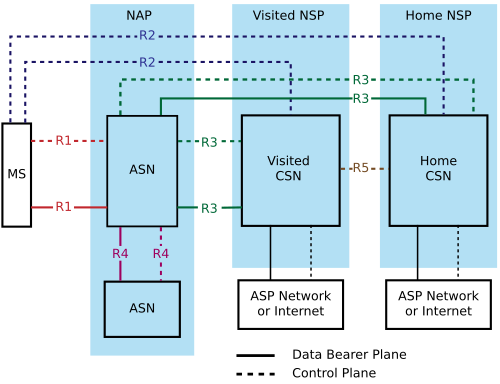
The WiMAX Forum defines a flexible architecture for connecting WiMAX networks to IP-based core networks, typically used by Internet Service Providers (ISPs). This architecture supports various hardware scales, from femto and pico base stations to macro stations.
Integration with LTE and 5G
WiMAX is not an isolated technology. WiMAX 2.1 and later versions can integrate with LTE TDD networks, allowing for seamless handovers. Furthermore, WiMAX 3 expands this integration to include 5G NR (New Radio).
Spectrum Allocation
There is no single global licensed spectrum, but the WiMAX Forum promotes three primary profiles: 2.3 GHz, 2.5 GHz, and 3.5 GHz. In the US, the 2.5 GHz band was primarily used by Sprint Nextel and Clearwire, while 2.3 GHz is more prevalent in Asia.
| Profile Type | Duplex Mode | Supported Channel Sizes |
|---|---|---|
| Fixed | TDD and FDD | 3.5 MHz, 5 MHz, 7 MHz, 10 MHz |
| Mobile | TDD Only | 5 MHz, 8.75 MHz, 10 MHz |
Key Facts
- Standard: Based on IEEE 802.16e-2005 (supplementing 802.16-2004).
- Core Technology: Uses Scalable OFDMA (SOFDMA) for efficient spectrum use.
- Carrier Spacing: Fixed at 10.94 kHz.
- Range vs. Speed: Maximum range is approximately 50 km, but bitrate decreases as distance increases.
- Market Presence: The Asia-Pacific region has historically surpassed North America in 4G broadband wireless subscribers.
- Compatibility: WiMAX 2.1+ integrates with LTE TDD; WiMAX 3 integrates with 5G NR.
WiMAX vs. Wi-Fi
While often confused, WiMAX and Wi-Fi serve different purposes. Wi-Fi is a short-range local area network (LAN) technology using 2.4 GHz and 5 GHz bands. WiMAX is a long-range system covering many kilometers using licensed or unlicensed spectrum.
The primary technical difference lies in the MAC layer: Wi-Fi uses CSMA/CA (connectionless and contention-based), where devices compete for the access point's attention. WiMAX uses a connection-oriented MAC with scheduled slots, providing more reliable QoS.
These technologies are complementary. A common setup involves a WiMAX Subscriber Unit acting as the wide-area gateway, which then provides a local Wi-Fi hotspot for devices within a home or office.
Frequently Asked Questions
Can WiMAX provide high speeds over very long distances?
No. There is a trade-off between range and bitrate. While WiMAX can reach up to 50 km, the bitrate drops significantly at that distance. High bitrates are only achievable at shorter ranges (typically under 1 km).
What is the difference between SOFDMA and OFDM?
SOFDMA (Scalable Orthogonal Frequency-Division Multiple Access) allows the FFT to scale according to the channel bandwidth, keeping carrier spacing constant. Standard OFDM uses a fixed number of sub-carriers, which is less flexible across different bandwidths.
Is WiMAX compatible with LTE?
Directly, the original versions were competitors. However, WiMAX 2.1 and above are designed to integrate with LTE TDD networks and support handovers between the two.
How does WiMAX handle multiple users in one sector?
Bandwidth is shared among users in a radio sector. To prevent performance degradation, WiMAX uses QoS mechanisms and scheduling algorithms to guarantee a minimum throughput for each subscriber.
Does WiMAX support peer-to-peer networking?
Yes, IEEE 802.16 defines P2P and ad hoc networks, but unlike Wi-Fi, WiMAX end-user devices must remain within range of a base station to communicate.