Willapa Bay Steamers: A History of Early Maritime Vessels
The maritime history of the Pacific Northwest is deeply intertwined with the development of steam-powered vessels. In the late 19th and early 20th centuries, the waters of Willapa Bay served as a critical artery for commerce, mail delivery, and the booming timber industry. From specialized mail boats to powerful log tugs, these vessels were the lifelines of coastal communities like South Bend and Astoria.
Early Steamers and Mail Service
The era of steam power in the region gained momentum in the late 1800s. In 1875, the steamer General Canby was launched at South Bend, featuring George A. Whitcomb—a member of a well-known steamboating family—serving as her mate.
As the need for reliable communication grew, the Shoalwater Bay Transportation Company launched the Montesano in 1882 at Astoria. This vessel was specifically tasked with transporting mail from Willapa to Sealand, Washington, located on the Long Beach Peninsula.
The Rise of the Steam Propellers
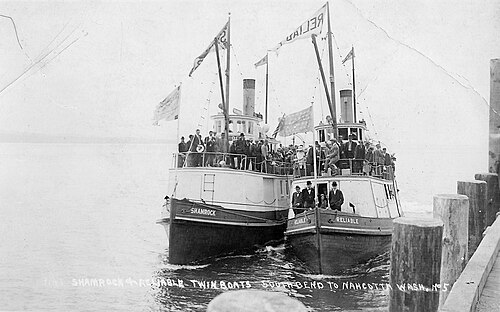
By the turn of the century, more specialized steam propellers—vessels propelled by a screw propeller rather than a paddle wheel—began to dominate the bay. In 1902, the Reliable was built in Astoria, Oregon, for the Willapa Bay Transportation Company. Under the command of Captain A.W. Reed, the 99-ton, 73-foot vessel served the region for decades. However, as passenger demand declined, the Reliable was converted into a tug in 1925 by removing her upper works.
A near twin to the Reliable, the Shamrock was built in 1905 by R.M. Leathers in Astoria. Also weighing 99 tons and measuring 72 feet, the Shamrock was powered by a 225 horsepower (168 kW) compound steam engine—an engine design that reused steam in multiple cylinders to increase efficiency. Like the Reliable, the Shamrock was eventually converted into a towboat for the Knappton Towing Co. of Astoria.
Industrial Workhorses: Towboats and Log Boats
Beyond passenger and mail service, the bay required heavy-duty vessels to support the logging industry. In 1903, Lauderback & Taylor of Willapa constructed the Laurel for C.A. and James S. Coulter. The Laurel was equipped with a Morgan-type pipe boiler and a steeple compound engine, a high-pressure steam configuration. She operated as a tow and log boat in Willapa Bay before being sold to the Hubble concern in Grays Harbor and eventually abandoned in 1938.
Other notable industrial vessels included the Agnes, a steam tug built in Hoquiam in 1905 and later operated in Willapa Bay by T.H. Bell, and the Flora Brown, which was dedicated to towing logs to the mills located at South Bend.
Key Facts
- General Canby: Launched in 1875 at South Bend.
- Montesano: Launched in 1882 for mail service between Willapa and Sealand.
- Reliable & Shamrock: Twin 99-ton steam propellers built in Astoria; both were later converted to towboats.
- Laurel: A log boat featuring a steeple compound engine, abandoned in 1938.
- Industrial Support: Vessels like the Agnes and Flora Brown were essential for moving logs to South Bend mills.
| Vessel Name | Year Launched | Type/Role | Key Feature/Fate |
|---|---|---|---|
| General Canby | 1875 | Steamer | Launched at South Bend |
| Montesano | 1882 | Mail Boat | Served Willapa to Sealand |
| Reliable | 1902 | Steam Propeller | Converted to tug in 1925 |
| Laurel | 1903 | Tow/Log Boat | Abandoned in 1938 |
| Shamrock | 1905 | Steam Propeller | 225 hp compound engine |
| Agnes | 1905 | Steam Tug | Built at Hoquiam |
Frequently Asked Questions
What was the primary purpose of the Montesano?
The Montesano was launched in 1882 by the Shoalwater Bay Transportation Company to run mail from Willapa to Sealand, Washington, on the Long Beach Peninsula.
How were the Reliable and Shamrock related?
The Shamrock was a near twin to the Reliable; both were 99-ton steam propellers built in Astoria and both were eventually converted into towboats as passenger traffic declined.
What technical specifications did the Laurel possess?
The Laurel was equipped with a Morgan-type pipe boiler and a steeple compound engine, serving as a tow and log boat until its abandonment in 1938.
Which vessels were used specifically for the timber industry?
The Laurel, the Agnes, and the Flora Brown were all used for towing logs to mills, particularly those located in South Bend.
Who operated the Willapa Bay Transportation Company?
The company operated vessels such as the Reliable and the Shamrock, with A.W. Reed serving as a commander and operator.