Wild Turkey: Biology, Subspecies, and Conservation
The wild turkey (Meleagris gallopavo) is a large bird native to North America, known for its distinctive appearance and complex social behaviors. As a member of the order Galliformes—a group of heavy-bodied, ground-feeding birds—the wild turkey is among the heaviest flying birds in the world. While once pushed to the brink of extinction in several regions, successful conservation and reintroduction efforts have allowed these birds to reclaim much of their ancestral range.
Key Facts
- Scientific Name: Meleagris gallopavo
- Conservation Status: Least Concern (IUCN 3.1)
- Weight: Males average 7.6 kg (17 lb); females average 4.26 kg (9.4 lb)
- Subspecies: Six recognized subspecies across North America
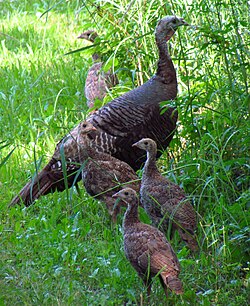
- Reproduction: Hens lay 10–14 eggs; poults are precocial (born relatively mature and mobile)
- Range: From southern Canada through the United States to central Mexico
Physical Characteristics
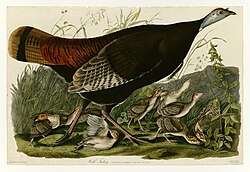
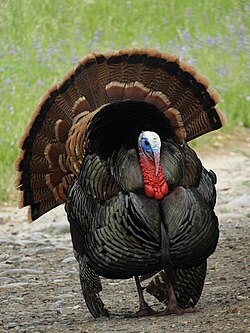
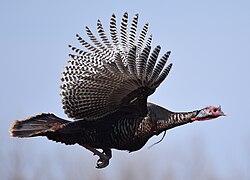
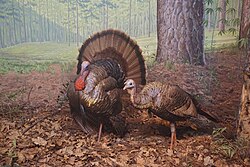
There is significant sexual dimorphism between males and females. An adult male, often called a tom or gobbler, typically weighs between 5 and 11 kg (11 to 24 lb) and measures 100–125 cm (39–49 in) in length. The record-sized male has reached 16.85 kg (37.1 lb). In contrast, the female, or hen, is smaller, typically weighing 2.5–5.4 kg (5.5–11.9 lb) and measuring 76 to 95 cm (30 to 37 in) in length.
Their anatomy is specialized for a ground-dwelling lifestyle. They possess sturdy tarsi (lower leg bones) measuring 9.7 to 19.1 cm (3.8 to 7.5 in) and relatively small wings with a span of 1.25 to 1.44 m (4 ft 1 in to 4 ft 9 in). Their bills are small, with a culmen (the upper ridge of the bill) length of 2 to 3.2 cm (0.79 to 1.26 in).
Subspecies and Distribution
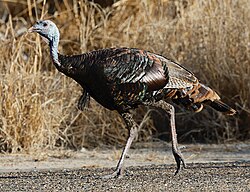
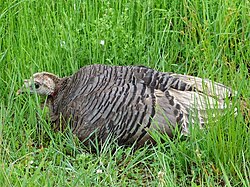
![Smoke-morph wild turkey (right), a relatively rare color morph almost exclusively manifested in females.[68]](/images/0f/62/0f6279f6c019338053bf35f5ec37daec27110c3525787189985d4688efe595cb.jpg)
Taxonomists recognize six distinct subspecies of Meleagris gallopavo, each adapted to specific regional environments.
Eastern Wild Turkey (M. g. silvestris)
The most populous subspecies, numbering between 5.1 and 5.3 million, the Eastern wild turkey ranges from southeastern Canada through the eastern United States. They can grow up to 4 ft (1.2 m) tall, and males may reach 30 lb (14 kg). They are characterized by chestnut brown tips on their upper tail coverts.
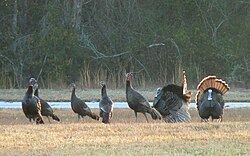
Osceola Wild Turkey (M. g. osceola)
Found primarily in the Florida peninsula, this is the smallest subspecies, weighing 16 to 18 pounds (7 to 8 kg). They are darker than the Eastern variety, featuring iridescent green-purple plumage and very dark wing feathers with minimal white barring.
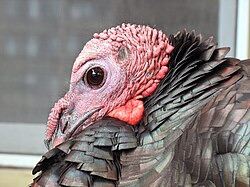
Rio Grande Wild Turkey (M. g. intermedia)
Native to the central plain states from Texas to Colorado and introduced to California and Hawaii, this subspecies is highly gregarious. They possess relatively long legs adapted for prairie habitats and feathers with a green-coppery sheen.
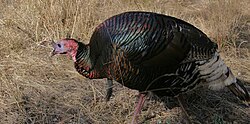
Merriam's Wild Turkey (M. g. merriami)
Inhabiting the Rocky Mountains and high mesa country, Merriam's turkey is found in ponderosa pine and mountainous regions. Their tail and lower back feathers feature white tips with bronze and purple reflections.
Other Subspecies
The Gould's wild turkey (M. g. mexicana) and the South Mexican wild turkey (M. g. gallopavo) complete the recognized subspecies, primarily residing in various regions of Mexico.
Reproduction and Life Cycle
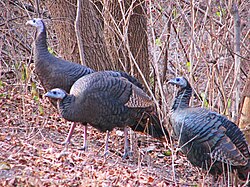
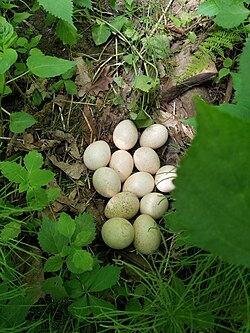
After mating, hens seek out nest sites, which are typically shallow dirt depressions hidden by woody vegetation. A hen lays a clutch of 10–14 eggs, usually at a rate of one per day. These eggs are incubated for at least 28 days.
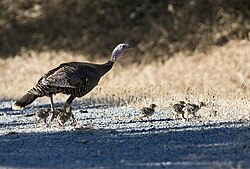
The offspring, known as poults, are both precocial and nidifugous, meaning they are developed enough to leave the nest within 12 to 24 hours after hatching. Because they nest on the ground, wild turkeys face high predation rates, which can lower the annual survival rate of reproductively active birds.
Conservation and Population History
The wild turkey has experienced a dramatic population recovery. By the late 1930s, U.S. populations had plummeted to approximately 30,000 birds. By the 1940s, they were nearly extirpated from Canada and restricted to small pockets in the U.S., such as the Appalachians. The species became extinct in 18 different U.S. states, including New York and Vermont in the 1850s.
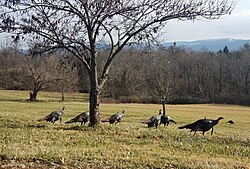
It is important to note that the current population in California is not descended from the indigenous Meleagris californica, which went extinct roughly 10,000 years ago. Instead, the modern Californian population stems from birds introduced by game officials during the 1960s and 1970s.
Summary of Wild Turkey Subspecies
| Subspecies | Common Name | Primary Distribution | Distinguishing Feature |
|---|---|---|---|
| M. g. silvestris | Eastern Wild Turkey | East USA, SE Canada | Chestnut brown tail tips; largest population |
| M. g. osceola | Osceola/Florida Turkey | Florida Peninsula | Smallest size; iridescent green-purple plumage |
| M. g. intermedia | Rio Grande Turkey | Central Plains, TX to CO | Long legs for prairie habitat; coppery sheen |
| M. g. merriami | Merriam's Turkey | Rocky Mountains | White-tipped tail feathers; mountain habitat |
| M. g. mexicana | Gould's Turkey | Northwest/Central Mexico | Regional Mexican distribution |
| M. g. gallopavo | South Mexican Turkey | South Mexico | Regional Mexican distribution |
Frequently Asked Questions
What is the difference between a tom and a hen?
A tom (or gobbler) is an adult male, which is significantly larger and heavier than the female hen. Toms typically weigh between 5 and 11 kg, while hens usually weigh between 2.5 and 5.4 kg.
Are wild turkeys endangered?
No, the wild turkey is currently listed as Least Concern by the IUCN. While they faced severe population declines in the early 20th century, reintroduction efforts have been highly successful.
What does it mean that poults are precocial and nidifugous?
Precocial means the young are born in an advanced state, and nidifugous means they leave the nest shortly after hatching. Wild turkey poults typically leave the nest within 12 to 24 hours.
Which subspecies is the smallest?
The Osceola wild turkey (M. g. osceola), found in Florida, is the smallest subspecies, typically weighing between 16 and 18 pounds (7 to 8 kg).
Where do wild turkeys build their nests?
Wild turkeys are ground-nesting birds. They create shallow depressions in the dirt, which are then concealed by surrounding woody vegetation to protect the eggs from predators.