Silver Pheasant
The silver pheasant (Lophura nycthemera) is a striking member of the Phasianidae family, primarily inhabiting the mountain forests of mainland Southeast Asia and southern and eastern China. Known for the dramatic contrast in plumage between the sexes, this species is a favorite in aviculture and remains common across much of its native range.
While the species as a whole is categorized as Least Concern, certain localized subspecies face significant threats. Beyond its native Asian habitats, the silver pheasant has been introduced to Vancouver Island in Canada and Victoria Island in Argentina's Nahuel Huapi Lake.
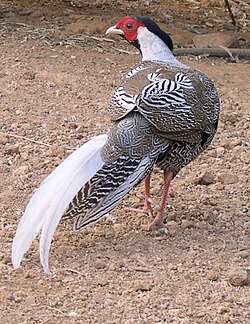
Both males and females are characterized by a bare red face and red legs. The red legs are a key identifying feature that distinguishes the silver pheasant from the similarly colored kalij pheasant, which possesses greyish legs.
Key Facts
- Scientific Name: Lophura nycthemera
- Conservation Status: Least Concern (IUCN 3.1)
- Native Range: Southeast Asia and Southern/Eastern China
- Distinctive Feature: Bare red face and red legs in both sexes
- Sexual Dimorphism: Males are black and white; females are primarily brown
- Taxonomy: One of 11 species in the genus Lophura
Taxonomy and Classification
The silver pheasant was first described in 1758 by Carl Linnaeus in the tenth edition of Systema Naturae. Originally placed in the genus Phasianus as Phasianus nycthemerus, it was later moved to the genus Lophura, established by John Fleming in 1822. The specific epithet nycthemerus is derived from the Ancient Greek words for "night" (nux) and "day" (hēmera).
Taxonomic history has seen significant debate regarding the relationship between the silver pheasant and the kalij pheasant. Because the two species can hybridize, certain taxa like L. n. lineata and L. n. crawfurdi were previously disputed. However, mitochondrial DNA (mtDNA) analysis has recently confirmed that these two should be classified as subspecies of the kalij pheasant.
Interestingly, the imperial pheasant, once thought to be a rare distinct species, is now recognized as a naturally occurring hybrid between the silver pheasant and Edward's pheasant.
Physical Description
The silver pheasant exhibits significant variation in size and color depending on the subspecies and sex.
Male Characteristics
Males are relatively large, with the largest subspecies reaching a total length of 120 to 125 cm (including a tail up to 75 cm), while the smallest barely reach 70 cm. Their body mass typically ranges from 1.13 to 2.00 kg. Adult plumage is achieved in the second year.
- Northern Subspecies: Feature white upperparts and tails (often with black markings) and glossy bluish-black underparts and crests.
- Southern Subspecies: Possess greyer upperparts and tails with more extensive black markings, resulting in a darker overall appearance.
Female Characteristics
Females are notably smaller and more understated, ranging from 55 to 90 cm in length with tails between 24 and 32 cm. Their body mass ranges from 1.0 to 1.3 kg. Their plumage is primarily brown, though some subspecies exhibit whitish underparts with strong black patterning.
Subspecies and Distribution
There are currently 15 recognized subspecies of the silver pheasant. While some are distinct, others are believed to be part of a cline (a gradual change in a character or feature across a geographical area), which may eventually lead to them being reclassified as synonyms of the nominate subspecies.
| Subspecies | Primary Region |
|---|---|
| L. n. nycthemera | South China (Guangxi, Guangdong) and Northeast Vietnam |
| L. n. whiteheadi | Hainan Island, China (Rare/Threatened) |
| L. n. engelbachi | South Laos (Rare/Threatened) |
| L. n. annamensis | Central South Vietnam (Rare/Threatened) |
| L. n. omeiensis | Central, South Sichuan, China |
| L. n. lewisi | Southwest Cambodia and Southeast Thailand |
Frequently Asked Questions
How can you tell a silver pheasant apart from a kalij pheasant?
The most reliable physical distinction is the color of the legs; silver pheasants have red legs, whereas kalij pheasants have greyish legs.
What is the conservation status of the silver pheasant?
Overall, the species is listed as Least Concern by the IUCN. However, specific subspecies such as L. n. whiteheadi, L. n. engelbachi, and L. n. annamensis are considered rare and threatened.
Are silver pheasants found outside of Asia?
Yes, they have been introduced to Vancouver Island in Canada and Victoria Island in Argentina.
What is the relationship between the silver pheasant and the imperial pheasant?
The imperial pheasant is not a separate species but is actually a naturally occurring hybrid of the silver pheasant and Edward's pheasant.
How does the plumage differ between male and female silver pheasants?
Males are highly ornamental with black and white (or grey) plumage and long tails, while females are primarily brown with shorter tails for better camouflage.