Wembley Stadium: The History of Football's Cathedral
For nearly eight decades, the original Wembley Stadium—originally known as the Empire Stadium—stood as the most iconic sporting venue in the world. Described by the legendary Pelé as the "cathedral of football," it served as the heart of English sport and a global stage for historic triumphs and cultural milestones. From its groundbreaking in 1922 to its demolition in 2002, Wembley was more than just a stadium; it was a symbol of national identity.
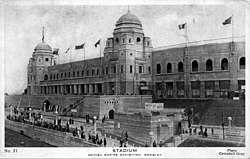
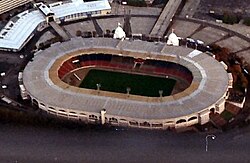
Designed by architects Sir John William Simpson and Maxwell Ayrton, with engineering by Sir Owen Williams, the stadium opened on April 28, 1923. Its most defining architectural features were the famous Twin Towers, which became synonymous with the prestige of playing on its hallowed turf.
Key Facts
- Record Attendance: 126,047 spectators during the 1923 FA Cup final.
- Major Events: Hosted the 1966 FIFA World Cup Final and the 1948 Summer Olympics.
- Capacity Evolution: Started with a standing capacity of 125,000, later reduced to 100,000, and finally became all-seated at 82,000 in 1990.
- Construction Cost: £750,000 (approximately £49.81 million in 2023).
- Final Closure: Closed on October 7, 2000, and demolished between 2002 and 2003.
The Pinnacle of Football
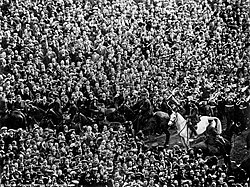
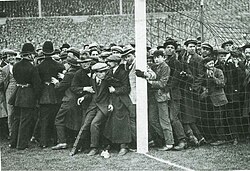
Wembley is most famous for its association with football. It hosted the FA Cup final and League Cup final annually for decades. One of its earliest legendary moments was the "White Horse Final" of 1923, where crowds spilled onto the pitch, necessitating the help of a policeman on a white horse to clear the way.
The 1966 World Cup Triumph
The stadium's crowning achievement came during the 1966 FIFA World Cup. After a series of group and knockout matches, England faced West Germany in the final on July 30, 1966. In front of 96,924 fans, England secured a 4–2 victory after extra time, claiming their first and only World Cup title.
European and International Success
Beyond the World Cup, Wembley was a preferred venue for the European Cup (now the UEFA Champions League), hosting five finals between 1963 and 1992. It also served as the centerpiece for UEFA Euro 1996, culminating in a final where Germany defeated the Czech Republic 2–1.
The Final Whistle
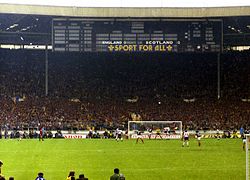
The end of an era arrived in 2000. The final FA Cup final at the old stadium saw Chelsea defeat Aston Villa 1–0. The very last international match took place on October 7, 2000, where Germany defeated England 1–0. Dietmar Hamann scored the final goal ever recorded at the original Wembley, while Tony Adams set a record with his 60th appearance at the venue.
A Multi-Sport Powerhouse
While football was king, Wembley was a versatile arena for various sports. It hosted the 1948 Summer Olympics and became a stronghold for Rugby League, hosting the Challenge Cup Final from 1929 onwards. The 1985 final between Wigan and Hull F.C. drew a massive crowd of 99,801.
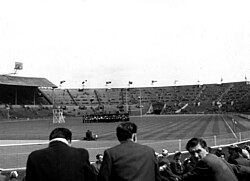
The stadium also had a rich history in other disciplines:
- Speedway: Hosted the first 15 Speedway World Championship finals (1936–1960). The track record of 66.8 seconds was set by Erik Gundersen in 1981.
- Greyhound Racing: Home to the St Leger and Trafalgar Cup until 1998, featuring the famous Mick the Miller in 1931.
- Other Sports: Hosted American football, Gaelic football, and women's field hockey, including a record-breaking match between England and the USA in 1978 with 65,165 attendees.
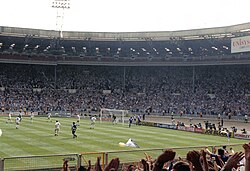
Cultural Impact and Music
Wembley's scale made it a premier destination for global music icons. It hosted the historic 1985 Live Aid charity concert and the first major professional wrestling pay-per-view outside North America, SummerSlam 1992.
Major artists such as Genesis, who played four sold-out shows in 1987, and Tina Turner, who performed four sold-out concerts across 1996 and 2000, cemented the venue's status as a musical mecca. Bon Jovi holds the distinction of being the last musical act to perform at the old stadium in August 2000.
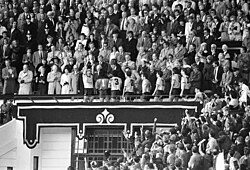
Stadium Summary
| Feature | Details |
|---|---|
| Original Name | Empire Stadium |
| Opened/Closed | 1923 / 2000 |
| Peak Capacity | 125,000 (Standing) |
| Architects | Sir John William Simpson & Maxwell Ayrton |
| Key Tenants | England National Football Team |
| Replacement | New Wembley Stadium (2007) |
Frequently Asked Questions
What was the record attendance at the original Wembley Stadium?
The record attendance was 126,047, set during the 1923 FA Cup final between Bolton Wanderers and West Ham United.
When was the original Wembley Stadium demolished?
The stadium was closed on October 7, 2000, and demolished between 2002 and 2003 to make way for the new stadium.
Which major international football tournament final was won by England at Wembley?
England won the 1966 FIFA World Cup final at Wembley, defeating West Germany 4–2 after extra time.
Was Wembley used for sports other than football?
Yes, it hosted the 1948 Summer Olympics, numerous Rugby League World Cup finals, Speedway World Championships, and greyhound racing.
Who was the last musical act to perform at the old Wembley?
Bon Jovi was the final musical act to perform at the original stadium, playing on August 19 and 20, 2000.