Welsh Dragon: The Evolution of a National Symbol
The dragon is more than just a mythical creature in Wales; it is a potent symbol of identity, leadership, and resistance. From its origins as a Roman military standard to its current status as a national emblem, the dragon has evolved through centuries of conflict and legend to represent the spirit of the Celtic Britons.
The Roman Origins of the Draco
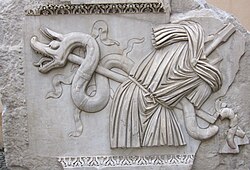
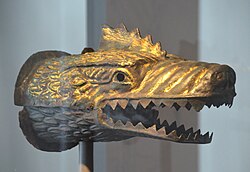
The military use of the term draco (Latin for dragon, serpent, or snake) dates back to the Roman period. This symbol was likely inspired by the cultures of the Scythians, Indians, Persians, Dacians, or Parthians. Historian Franz Altheim suggests that the Romans adopted the draco when they began recruiting nomad troops from south and central Asia during the reign of Marcus Aurelius.
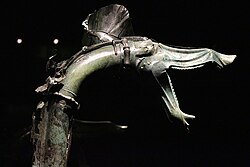
By the third century, the draco served as a military standard for cohorts, mirroring how the Aquila (eagle) represented the legions. The standard bearer, known as a draconarius, carried a gilded staff topped with a dragon. This tradition was adopted by various groups; for example, Gallic cohorts used the dragon to distinguish themselves from Roman legions. In Britain, the Sarmatians—who served in cavalry units in Ribchester from the 2nd to 4th centuries—may have specifically influenced the later Welsh dragon.
From Military Standard to Leadership Symbol
Following the Roman withdrawal from Britain, resistance against Saxon incursions was led by Romans or Romanised Britons, such as Ambrosius Aurelianus and Artorius. This transition explains how Roman military terminology was absorbed into British culture. By approximately 540, the writer Gildas referred to the Briton chieftain Maglocunus (Maelgwn Gwynedd) as the insularis draco.
Early Brythonic poets like Taliesin and Aneirin further cemented the dragon as a metaphor for power. In the 6th-century poems Y Gododdin and those regarding Urien Rheged, the term was used to describe war leaders and princes. For instance, Mynyddog Mwynfawr was associated with the "feast of the dragon," and Owain ap Urien was called Owain ben draic (the chief dragon). This linguistic evolution continued into the medieval period, with leaders like Owain Gwynedd and Llywelyn ap Gruffudd being referred to as dragons.
Mythology and Prophecy: The Red and White Dragons
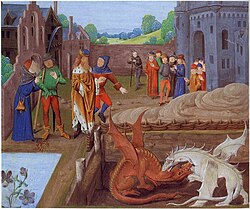
The dragon's role shifted from a title of leadership to a symbol of national destiny in Welsh mythology. In the Mabinogion story of Lludd and Llefelys, a red dragon battles an invading white dragon, eventually being confined at Dinas Emrys.
This narrative was expanded in the Historia Brittonum (c. 828), written by Nennius. Here, the dragon became a symbol of a future deliverer from the Saxons, and the color red was explicitly linked to the Celtic Britons, while the white dragon represented the Saxons. The text describes a prophecy given to the tyrant Vortigern by a boy named Emrys (Ambrosius Aurelianus), who revealed that two dragons were fighting in a hidden pool beneath Vortigern's collapsing citadel. Emrys predicted that although the white dragon was currently winning, the Welsh red dragon would ultimately prevail.
Geoffrey of Monmouth later repeated this story in his 12th-century History of the Kings of Britain, framing the red dragon as a prophecy for the arrival of King Arthur. However, Geoffrey also attributed a golden dragon banner to Arthur, which served as a rallying point and a haven for wounded soldiers during battle.
![Welsh: "Ythr Ben Dragwn" (translated: Uther, Chief Dragon) in "Dares Phrygius & Brut Tysilio" held at Jesus College, Oxford[b]](/images/fa/9d/fa9dfed96ddd098d3ce5ec52708b2694b44c3e85c12730a31d8bad4ceea8b322.png)
Owain Glyndŵr and the Golden Dragon
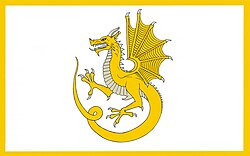
In 1401, Owain Glyndŵr adopted Y Ddraig Aur (The Golden Dragon) as his royal standard. Raised over Caernarfon during the Battle of Tuthill, the banner featured a golden dragon on a white background. Glyndŵr claimed this was the traditional standard of Uther Pendragon and King Arthur. Historian John Davies notes that this was a symbol of victory for the Celtic Britons, and Adam of Usk records it as the first use of a dragon standard by Welsh troops in war on November 1, 1401.
The House of Tudor and Royal Heraldry
The dragon motif was integrated into the heraldry of the House of Tudor. Henry VII used a red dragon on a white and green background upon his entry into St Paul's after the Battle of Bosworth Field. While the red dragon appeared on the standards of Henry VII and Henry VIII and served as a supporter on the royal arms of Tudor sovereigns, it was used primarily as a family heraldic device rather than a national symbol of Wales.
Official Recognition and the Royal Badge
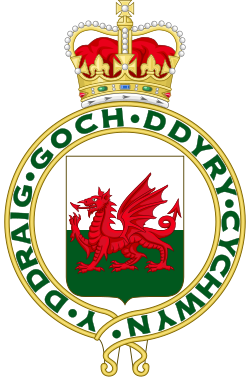
The red dragon did not become an official royal heraldic badge until 1800, when George III issued a royal warrant. In 1901, the red dragon was included in the Prince of Wales badge, distinguished from the monarch's badge by a label of three points Argent. In 1953, this was augmented with the motto Y DDRAIG GOCH DDYRY CYCHWYN ("the red dragon inspires action").
This 1953 design was famously loathed by Prime Minister Winston Churchill, who described it in a Cabinet minute as an "odious design expressing nothing but spite, malice, ill-will and monstrosity." Despite the controversy, the badge remained in use by the Wales Office and the National Assembly for Wales until it was replaced by a new official Royal badge in 2008, which removed the red dragon entirely.
Early Modern and Social Use
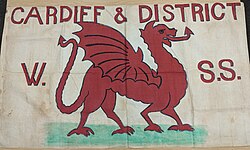
Before the standardization of the Welsh flag, the dragon appeared in various forms. In the 1909 national pageant of Wales and on Captain Scott's Terra Nova, the dragon was depicted upright on white and green backgrounds. Interestingly, the dragon was also used by the Cardiff & District Women's Suffrage Society in the early 1900s. During a 1911 suffrage procession in London, their dragon banner attracted significant attention, with some onlookers jokingly referring to it as "the Devil."
Key Facts
- Roman Influence: The draco was a Roman cohort standard likely inspired by Asian nomad troops.
- Symbol of Leadership: Early Welsh poets used "dragon" as a term for war leaders and princes.
- Color Symbolism: The red dragon represents the Celtic Britons, while the white dragon represents the Saxons.
- Owain Glyndŵr: He flew the Y Ddraig Aur (Golden Dragon) in 1401 as a symbol of victory.
- Tudor Era: The red dragon was a key element of the House of Tudor's royal heraldry.
- Official Status: It became an official royal heraldic badge in 1800 under George III.
| Period/Source | Dragon Type | Meaning/Association |
|---|---|---|
| Roman Period | Draco (Standard) | Military cohort identification |
| 6th Century Poetry | Metaphorical Dragon | War leaders and princes |
| Mabinogion/Nennius | Red vs. White | Britons vs. Saxons |
| Owain Glyndŵr | Golden Dragon | Royal standard and victory |
| House of Tudor | Red Dragon | Family heraldry and royal arms |
| 1800 - Present | Red Dragon | Official royal badge and national symbol |
Frequently Asked Questions
Where did the Roman draco come from?
The Roman draco was likely inspired by the symbols of the Scythians, Indians, Persians, Dacians, or Parthians, and its use coincided with the recruitment of nomad troops from south and central Asia during the time of Marcus Aurelius.
What is the significance of the red and white dragons?
According to the Historia Brittonum and the Mabinogion, the red dragon represents the Celtic Britons and the white dragon represents the Saxons. The prophecy stated that the red dragon would eventually defeat the white dragon, symbolizing British victory.
Did King Arthur use a red or golden dragon?
While the red dragon is associated with the Britons in general, Geoffrey of Monmouth wrote in the 12th century that King Arthur specifically used a golden dragon banner as a standard for his army.
How did Owain Glyndŵr use the dragon?
Owain Glyndŵr used Y Ddraig Aur (The Golden Dragon) on a white background as his royal standard during the Battle of Tuthill in 1401, claiming it as the traditional standard of Uther Pendragon.
Why did Winston Churchill dislike the 1953 Royal Badge?
Churchill found the design "odious" and believed the motto "the red dragon inspires action" was untrue and unduly flattering to Gwilym Lloyd George's associate, Aneurin Bevan.