Weinstadt: A Journey Through Its Municipal Evolution
The city of Weinstadt is a unique example of modern municipal consolidation. Formed through a series of administrative reforms in the 1970s, the city is not a single urban center but a collection of five distinct town centers. This structure preserves the individual identities of the historic Württemberg settlements that now comprise the city.
The Formation of Weinstadt
Weinstadt officially came into existence on January 1, 1975. This was the result of a district reform that merged the previously independent towns of Beutelsbach, Endersbach, Großheppach, and Schnait. A slightly earlier change occurred on January 1, 1973, when Strümpfelbach was annexed by Endersbach.
Because of this merger, Weinstadt maintains five separate town centers. Among these, Endersbach and Beutelsbach are particularly notable for retaining the atmosphere of independent cities.
At its founding, the municipality had a population of over 20,000 residents. Its growth and administrative importance led the city to apply for Große Kreisstadt status (a designation for larger towns with expanded administrative responsibilities) in 1978. This status was officially granted by the state government on January 1, 1979.
Key Facts
- Founded: January 1, 1975, via district reform.
- Composition: Five town centers (Beutelsbach, Endersbach, Großheppach, Schnait, and Strümpfelbach).
- Administrative Status: Became a Große Kreisstadt on January 1, 1979.
- Regional Affiliation: All constituent towns were added to the Rems-Murr district in 1973.
- Historical Roots: Originally old Württemberg settlements.
The Five Constituent Towns
Beutelsbach and Schnait
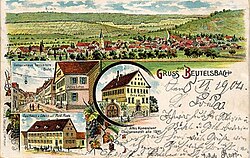
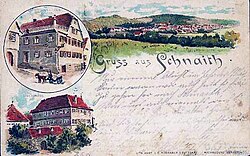
Both Beutelsbach and Schnait share similar historical trajectories. Schnait, originally identified as Snait, likely joined Württemberg alongside Beutelsbach, though other feudal lords maintained rights to the town until 1605. Both were historically part of the Amt/Oberamt Schorndorf (an administrative district within Württemberg). Following the dissolution of the Oberamt Schorndorf in 1938, Schnait transitioned to the Waiblingen district.
Endersbach
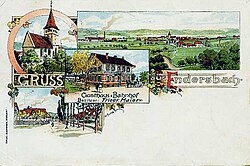
First recorded as Andrespach in 1278, Endersbach likely joined Württemberg as part of Schorndorf. Its administrative history differs slightly from Beutelsbach; it belonged to the Oberamt Waiblingen from 1762 to 1765, and again from 1807 onward, eventually becoming part of the Waiblingen district in 1938.
Strümpfelbach
First identified as Striumphilbach in 1265, Strümpfelbach likely became part of Württemberg during the 13th century. Like Endersbach, it moved between the Oberamt Schorndorf and the Oberamt Waiblingen (specifically from 1762–1765 and from 1807), finally joining the Waiblingen district in 1938.
Großheppach
Großheppach stands as one of the five foundational settlements that merged to create the modern city of Weinstadt.
Religious Development and Diversity
Due to their historical ties to the Grafschaft and later the Duchy of Württemberg, the Reformation reached all five districts. For centuries, these towns were almost exclusively Protestant, with parishes managed by the Evangelical-Lutheran Church in Württemberg. Currently, Endersbach, Großheppach, and Strümpfelbach fall under the ecclesiastical district of Waiblingen, while Beutelsbach and Schnait belong to Schorndorf.
The religious landscape shifted with the arrival of Catholic settlers from Bavaria, particularly during the construction of the railroad and following World War II. This led to the establishment of several Catholic churches:
- Church of St. Anna (Beutelsbach, 1956)
- Church of Saint Andrew (Endersbach)
- Church of the Holy Cross (Schnait, 1971)
- Church of Saint Stephen (Großheppach, 1974)
These churches are part of the Deanery of Waiblingen within the Diocese of Rottenburg-Stuttgart. The city is also home to the New Apostolic Church and Jehovah's Witnesses.
Population Growth
Since its inception, Weinstadt has seen a steady increase in its resident population, reflecting its development as a regional hub.
| Date | Number of Residents |
|---|---|
| December 31, 1975 | 22,162 |
| December 31, 1980 | 23,244 |
| December 31, 1985 | 23,255 |
| May 27, 1987 (Census) | 23,148 |
| December 31, 1990 | 23,999 |
| December 31, 1995 | 24,941 |
| December 31, 2000 | 25,643 |
| December 31, 2005 | 26,245 |
| December 31, 2008 | 26,005 |
| December 31, 2010 | 26,421 |
Frequently Asked Questions
When was the city of Weinstadt founded?
Weinstadt was founded on January 1, 1975, through a district reform that combined the towns of Beutelsbach, Endersbach, Großheppach, and Schnait.
Which towns make up the five centers of Weinstadt?
The five town centers are Beutelsbach, Endersbach, Großheppach, Schnait, and Strümpfelbach (which had been annexed by Endersbach in 1973).
What is a Große Kreisstadt?
A Große Kreisstadt is a status granted to larger towns that allows them to take on additional administrative responsibilities. Weinstadt achieved this status on January 1, 1979.
How did the religious demographics of Weinstadt change over time?
Originally almost exclusively Protestant due to the Reformation in Württemberg, the city saw an increase in the Catholic population due to the influx of Bavarian workers during railroad construction and after World War II.
Which administrative districts did the towns belong to before 1938?
The towns were split between the Amt/Oberamt Schorndorf and the Oberamt Waiblingen. After 1938, they were consolidated into the Waiblingen district.