Wave Function: The Mathematical Foundation of Quantum States
In the realm of quantum mechanics, a wave function (denoted by the Greek letters ψ or Ψ) serves as the complete mathematical description of the quantum state of an isolated system. Unlike classical mechanics, where a particle's state is defined by a precise position and momentum, quantum systems are described by these complex-valued functions that encapsulate all possible information about a system.
The wave function behaves qualitatively like physical waves—such as those found on a string or in water—because it is governed by the Schrödinger equation, a specific type of wave equation. This mathematical nature gives rise to wave–particle duality, the concept that every particle or quantum entity may be described as either a particle or a wave. However, the physical interpretation of the wave function remains a subject of ongoing debate among physicists.
Key Facts
- Complex-Valued: Wave functions assign complex numbers to points in space, representing probability amplitudes.
- Born Rule: The squared modulus of the wave function provides the probability density of finding a particle at a specific location.
- Normalization: The total probability of finding a particle across all space must equal 1.
- Superposition: Wave functions can be added together and multiplied by complex numbers to create new valid quantum states.
- Hilbert Space: The mathematical vector space where wave functions reside, allowing the use of linear algebra for quantum calculations.
The Evolution of Quantum Wave Theory
Foundational Discoveries
The journey toward the wave function began in 1900 when Max Planck proposed that a photon's energy is proportional to its frequency. By 1916, Albert Einstein established the relationship between a photon's momentum and its wavelength. In 1923, Louis de Broglie extended this logic to massive particles, suggesting that all matter exhibits wave-like properties—a breakthrough known as the De Broglie relation.
The Schrödinger Equation and Born's Interpretation
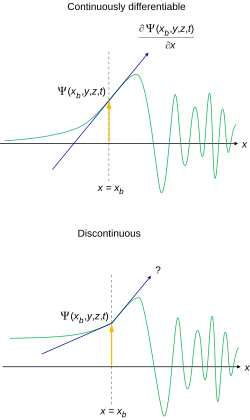
In 1926, Erwin Schrödinger published his landmark wave equation, which determines how wave functions evolve over time. While Schrödinger initially believed the wave function represented a particle "spread out" in space, this was contradicted by observations of wave packet scattering. Max Born resolved this in 1926 by introducing the concept of probability amplitude, asserting that the wave function describes the probability of a measurement outcome rather than the physical distribution of the particle.
Expanding to Spin and Relativity
As the theory matured, physicists realized that simple spatial functions were insufficient. In 1927, Wolfgang Pauli developed the Pauli equation to describe spin-1/2 particles, introducing the need for two complex numbers to represent spin states (+1/2 and -1/2). Shortly after, in 1928, Paul Dirac unified special relativity and quantum mechanics with the Dirac equation. This introduced the spinor, a wave function with four complex components to account for both electrons and their antiparticles, positrons.
Mathematical Framework and Representations
Position and Momentum Space
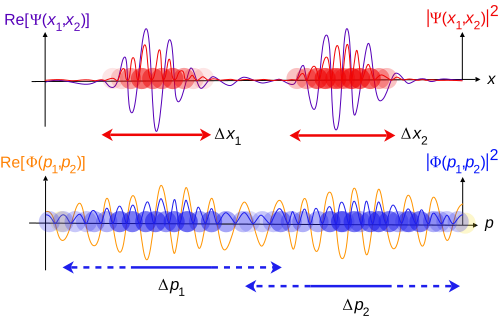
Wave functions can be represented in different "spaces." A position-space wave function assigns a value to every point in space. Conversely, a momentum-space wave function describes the system in terms of its momentum. These two representations are related through mathematical transformations, allowing physicists to switch perspectives depending on the problem being solved.
The Role of Operators and Observables
Because the wave function itself is complex-valued, it cannot be measured directly. To find measurable quantities (observables), physicists apply quantum operators to the wave function. The possible results of these measurements correspond to the eigenvalues of the operators, and the statistical distribution of these results is derived from the wave function's state.
Practical Examples in Quantum Systems
The Hydrogen Atom
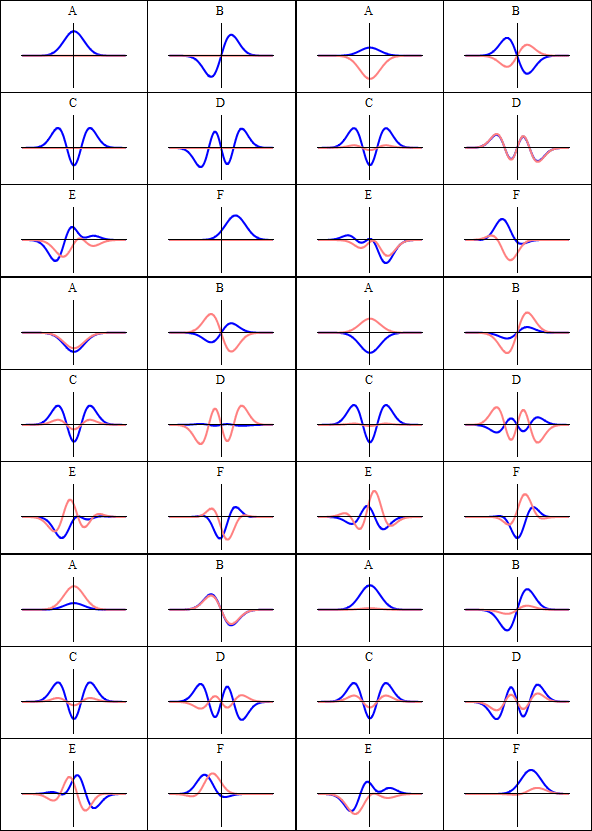
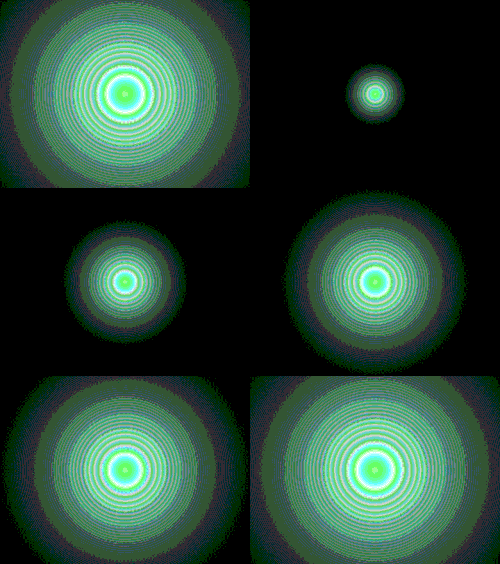
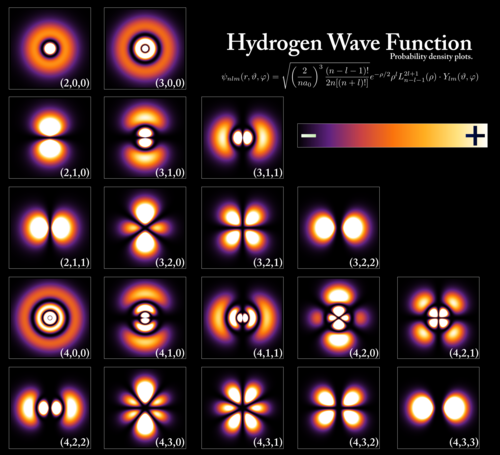
The hydrogen atom is the only atom for which the Schrödinger equation has been solved exactly. Its wave functions are separated into radial functions and spherical harmonics, defined by three quantum numbers: the principal (n), azimuthal (ℓ), and magnetic (m) quantum numbers. These solutions form the basis for our understanding of electron orbitals.
Potential Barriers and Oscillators
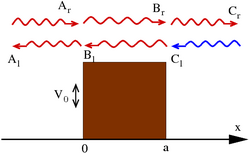
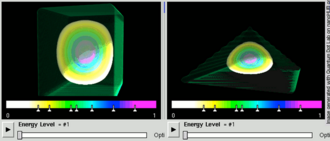
Other critical models include the quantum harmonic oscillator, which describes particles in a quadratic potential, and the finite potential barrier, which illustrates how particles can interact with energy barriers. In more complex systems, such as quantum dots, the shape of the confinement (rectangular or triangular) significantly alters the symmetry and energy states of the electron wave functions.
Summary of Quantum Wave Concepts
| Concept | Description | Physical Significance |
|---|---|---|
| Born Rule | Squared modulus of ψ | Determines probability density |
| Normalization | Integral of |ψ|² = 1 | Ensures total probability is 100% |
| Superposition | Linear combination of states | Allows particles to exist in multiple states |
| Spinor | Multi-component wave function | Describes intrinsic angular momentum (spin) |
Frequently Asked Questions
What is the difference between a wave function and a physical wave?
While a physical wave (like water) involves the actual displacement of matter, a wave function is a mathematical tool representing probability amplitudes. Whether the wave function corresponds to a physical entity is a matter of theoretical interpretation.
Why must a wave function be normalized?
Normalization ensures that the probability of finding a particle somewhere in the entire universe is exactly 1 (or 100%). Without normalization, the probabilistic predictions of quantum mechanics would be mathematically inconsistent.
What does the Born rule actually do?
The Born rule bridges the gap between the abstract, complex-valued wave function and observable reality. It converts the complex probability amplitude into a real-valued probability density by taking the squared modulus of the function.
How does spin affect the wave function?
Spin adds additional degrees of freedom. Instead of a single complex function, a particle with spin requires a vector-like wave function (such as a spinor) to account for the different possible spin orientations, such as spin-up and spin-down.