Schrödinger Equation: The Foundation of Wave Mechanics
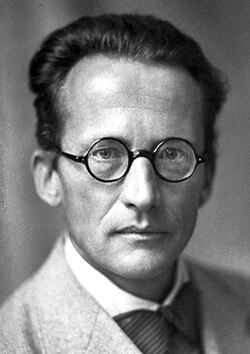
The Schrödinger equation is a fundamental partial differential equation that governs the wave function of a non-relativistic quantum-mechanical system. Postulated by Austrian physicist Erwin Schrödinger in 1925 and published in 1926, this equation became a landmark in the development of quantum mechanics, eventually earning Schrödinger the Nobel Prize in Physics in 1933.
Conceptually, the Schrödinger equation serves as the quantum counterpart to Newton's second law of motion. While Newton's laws predict the specific path a physical system will take over time based on initial conditions, the Schrödinger equation describes the evolution of the wave function—the mathematical characterization of an isolated quantum system. This breakthrough was inspired by Louis de Broglie's postulate that all matter possesses an associated matter wave.
Key Facts
- Purpose: Predicts the time-evolution of a quantum system's wave function.
- Origin: Developed by Erwin Schrödinger (1925-1926) based on de Broglie's matter wave hypothesis.
- Nature: A partial differential equation used in "wave mechanics."
- Core Concept: Replaces deterministic classical paths with probability amplitudes.
- Impact: Accurately reproduced the energy levels of the Bohr model for the hydrogen atom.
The Mechanics of Wave Functions
In quantum mechanics, the state of a system is described by its wave function. The Schrödinger equation details how this function changes, though it does not define the physical nature of the wave function itself. Early attempts by Schrödinger to interpret the wave function as a charge density were unsuccessful.
The breakthrough in interpretation came in 1926 from Max Born, who proposed that the wave function represents a probability amplitude. According to the Born rule, the modulus squared of the wave function is equal to the probability density of finding a particle at a specific position.
Time-Dependent vs. Time-Independent Equations
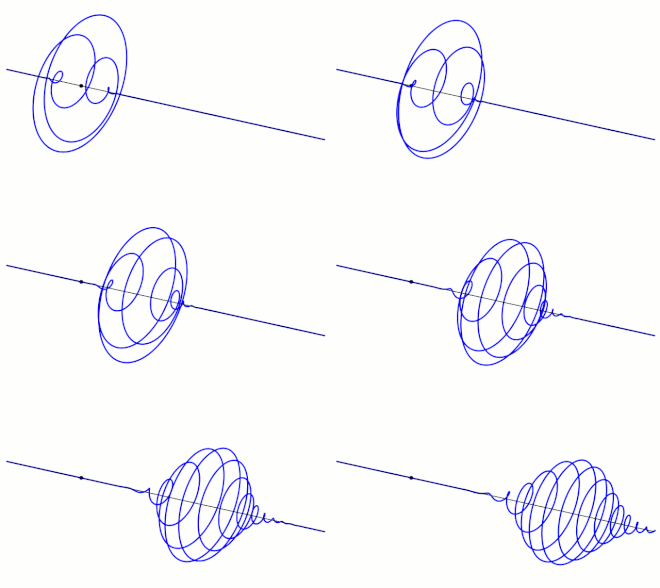
The Schrödinger equation exists in two primary forms. The time-dependent version describes how the quantum state evolves over time. In contrast, the time-independent version is used to find stationary states—states where the probability distribution does not change over time, often corresponding to standing waves.
Classic Quantum Examples
The utility of the Schrödinger equation is best demonstrated through several standard physical models:
Particle in a Box
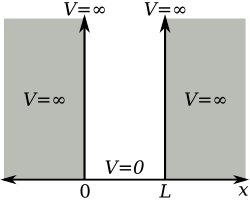
Also known as the infinite potential well, this model describes a particle trapped in a one-dimensional box with impenetrable walls. This constraint forces the energy levels to be quantized, meaning the particle can only exist at specific, discrete energy states.
Quantum Harmonic Oscillator
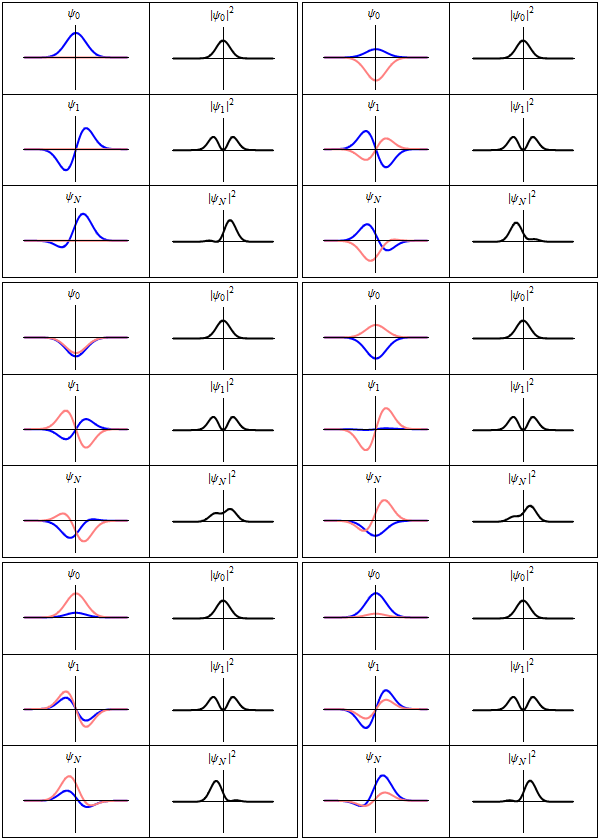
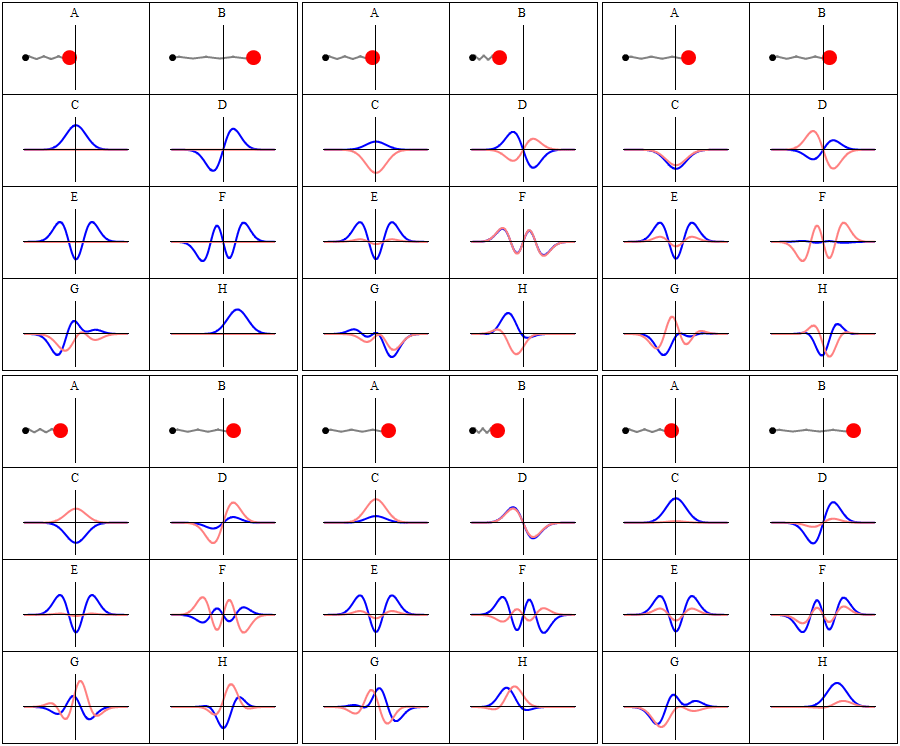
This model describes a system where a particle experiences a restoring force proportional to its displacement. Unlike classical oscillators, the quantum version has discrete energy eigenvalues.
The Hydrogen Atom
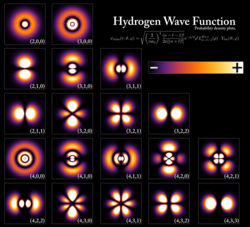
Schrödinger applied his equation to the hydrogen atom by treating the electron as a wave moving in a potential well created by the proton. This computation successfully reproduced the spectral energies of hydrogen, aligning with experimental observations.
Comparative Frameworks and Interpretations
While wave mechanics is widely used, it is not the only way to study quantum systems. Other formulations include matrix mechanics, introduced by Werner Heisenberg, and the path integral formulation developed by Richard Feynman.
The interpretation of the equation's results remains a subject of intense debate. One prominent view is the many-worlds interpretation, suggested in a precursor form by Schrödinger in 1952 and formalized by Hugh Everett in 1956. This theory posits that all possible outcomes of a quantum measurement occur simultaneously in a multiverse of parallel universes, removing the need for wave function collapse.
Summary of Quantum Models
| Model | Physical Scenario | Key Result |
|---|---|---|
| Particle in a Box | Infinite potential well | Quantized energy levels |
| Harmonic Oscillator | Restoring force (spring-like) | Discrete energy eigenvalues |
| Hydrogen Atom | Electron in proton potential | Correct spectral energy series |
Frequently Asked Questions
What is the difference between wave mechanics and matrix mechanics?
Wave mechanics uses the Schrödinger equation to describe quantum systems via differential equations and wave functions, while matrix mechanics, developed by Heisenberg, uses matrices and algebraic methods to reach the same physical predictions.
What does the wave function actually represent?
According to the Born interpretation, the wave function is a probability amplitude. Its modulus squared gives the probability density of finding a particle at a given point in space and time.
How does the Schrödinger equation relate to Newton's second law?
It is the quantum equivalent. Where Newton's second law predicts a deterministic trajectory for a classical object, the Schrödinger equation predicts the probabilistic evolution of a quantum system's state.
What is a stationary state?
A stationary state is a solution to the time-independent Schrödinger equation. In these states, the probability distribution of the particle remains constant over time, behaving like a standing wave.
Does the Schrödinger equation work for all particles?
The standard Schrödinger equation is non-relativistic. For particles moving at speeds close to the speed of light, relativistic equations such as the Klein-Gordon or Dirac equations are required.