War Dogs: The History and Evolution of Military Canines
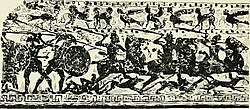
For millennia, the bond between humans and dogs has extended beyond the home and into the battlefield. From the ancient phalanxes of Greece to the high-tech operations of the 21st century, war dogs have served as indispensable allies. These animals have filled a vast array of roles, acting as combatants, scouts, messengers, and lifesavers, adapting their natural instincts to meet the evolving needs of military strategy.
The utility of the dog in warfare lies in their superior senses—particularly smell and hearing—and their unwavering loyalty to their handlers. While their roles have shifted from front-line combat to specialized detection and support, their impact on human survival and operational success remains profound.
Key Facts
- Ancient Origins: Used by early civilizations including the Egyptians, Greeks, Persians, Romans, and Slavs.
- World War I Heroism: Sergeant Stubby became the most decorated dog of WWI, promoted to sergeant through combat.
- Vietnam Impact: Approximately 5,000 US war dogs served, saving an estimated 10,000 human lives.
- Modern Training: Lackland Air Force Base is currently the only US facility that trains dogs for military use.
- Specialized Roles: Modern Military Working Dogs (MWD) focus on drug and explosives detection, scouting, and intimidation.
Historical Timeline of Canine Warfare
Ancient and Colonial Eras
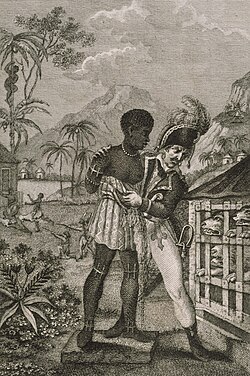
The use of dogs in war dates back to antiquity, where they were employed by the Egyptians, Greeks, Persians, Sarmatians, Baganda, Alans, Slavs, Britons, and Romans. Later, between the 1700s and 1800s, European colonial powers and the United States utilized dogs to suppress slave rebellions in the Americas.
The World Wars
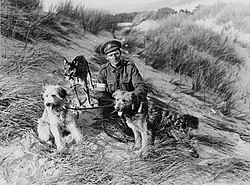
During World War I (1914–1918), dogs were vital for logistics and communication. They served as sentries, found wounded soldiers, and delivered critical messages. A notable example is Sergeant Stubby, a Bull Terrier or Boston Terrier who captured a German spy and became a mascot at Georgetown University. Another famous canine of this era was Rags.
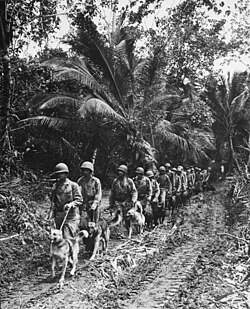
In World War II (1941–1945), the Soviet Union attempted to use dogs strapped with explosives against German tanks, though this had limited success. Meanwhile, the United States Marine Corps (USMC) utilized dogs in the Pacific theatre to reclaim islands from Japanese forces. While the Doberman Pinscher became the official USMC breed, all breeds were eligible. Of the 549 dogs that returned, only four could not return to civilian life. Chips was recognized as the most decorated dog of WWII.
The Vietnam War
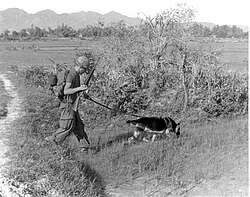
Between 1966 and 1972, roughly 5,000 US war dogs and 10,000 handlers served in Vietnam. These K-9 units are credited with saving over 10,000 human lives. However, the cost was high: 232 military working dogs and 295 handlers were killed in action. Following the war, only about 200 dogs were assigned to other US bases; the rest were either euthanized or left behind.
Diverse Roles in Military Service
Combat and Logistics
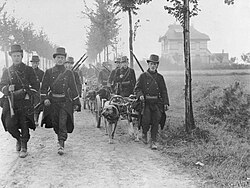
Historically, dogs have been used for direct fighting and logistical support. In World War I, the Belgian Army utilized dogs to draw machine gun carts. In a remarkable feat of communication, a 2-kilogram Yorkshire terrier named Smoky once ran a telegraph wire through a narrow pipe (10-to-20 centimeters in diameter) to establish communication without risking human troops.
Detection, Scouting, and Sentry Work
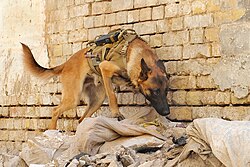
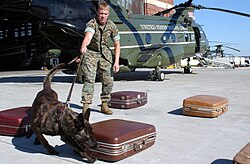
Dogs serve as the "eyes and ears" of the military. Scouts detect enemy presence, while sentries guard perimeters. In modern conflicts, detection dogs are critical for locating improvised explosive devices (IEDs) and narcotics. This includes searching rubble in urban environments or inspecting baggage for transport.
Intimidation and Law Enforcement
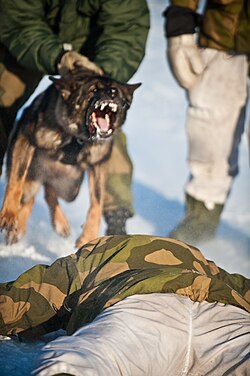
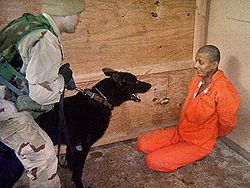
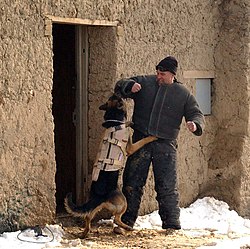
Dogs are often used for escalation-of-force training and intimidation. This role has been seen in various contexts, from simulated arrests by the Norwegian Army to the intimidation of prisoners at Abu Ghraib during the 2003 invasion of Iraq.
Modern Military Working Dogs (MWD)
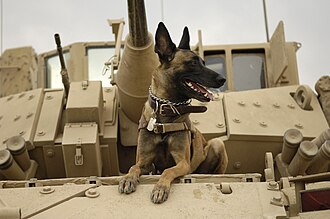
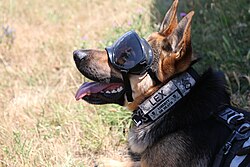
Today, these animals are referred to as Military Working Dogs (MWD) or K-9s. While they are less likely to be used in front-line formations than in the past, they remain essential. As of 2011, 600 US MWDs were active in Iraq and Afghanistan.
The US Air Force, which used over 1,600 dogs in the 1970s, now maintains approximately 530 dog teams globally. Training is centralized at Lackland Air Force Base, where dogs undergo rigorous preparation, including "High Dive" training, where they parachute from military aircraft with their handlers.
Medical Research and Recognition
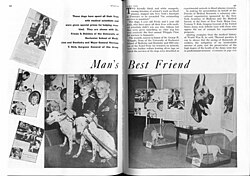
Beyond the battlefield, dogs have contributed to military medicine. Researchers and armed forces have historically awarded medals to laboratory animals to highlight the importance of animal experimentation in saving human lives.
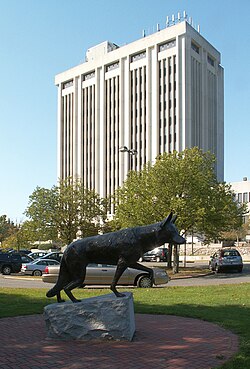
To honor their sacrifice, various memorials have been established, such as the monument in Hauppauge, New York, and the National War Dog Cemetery in Guam.
Summary of Military Canine Roles
| Role Category | Historical Examples | Modern Applications |
|---|---|---|
| Communication | Messenger dogs, telegraph wire pulling (Smoky) | Rarely used (replaced by electronics) |
| Combat/Support | Direct fighting, drawing machine gun carts | Special operations, capture-kill missions |
| Detection | Finding wounded soldiers (Mercy dogs) | Explosives, narcotics, and IED detection |
| Security | Sentries and scouts | Perimeter security, intimidation, and patrol |
Frequently Asked Questions
Who is the most decorated war dog of World War I?
Sergeant Stubby, a Bull Terrier or Boston Terrier, is considered the most decorated war dog of WWI. He was the only dog nominated for rank and subsequently promoted to sergeant through combat.
Where are US military dogs trained today?
Lackland Air Force Base is currently the only facility in the United States that trains dogs for military use.
How many lives did K-9 units save during the Vietnam War?
It is estimated that K-9 units saved over 10,000 human lives during the Vietnam War.
What is "High Dive" training?
High Dive is a specialized training exercise where a military working dog jumps from a military plane alongside their handler.
Which breed was the official dog of the USMC during WWII?
The Doberman Pinscher was the official dog of the US Marine Corps during World War II, although dogs of all breeds were eligible for training.