Walther Nernst: The Architect of Modern Thermodynamics
Walther Nernst was a towering figure in the realm of physical science, whose contributions bridged the gap between chemistry and physics. A German physical chemist, Nernst is most celebrated for his work in thermodynamics (the study of heat and energy), electrochemistry, and solid-state physics. His intellectual curiosity led him from the discovery of electrical potentials to the formulation of the Third Law of Thermodynamics, earning him the Nobel Prize in Chemistry in 1920.
Beyond his theoretical achievements, Nernst was a practical inventor and a mentor to some of the 20th century's greatest scientific minds, including Irving Langmuir and Gilbert N. Lewis. His life was marked by a relentless pursuit of knowledge, a passion for mechanical innovation, and a steadfast commitment to scientific integrity during one of Europe's darkest political eras.
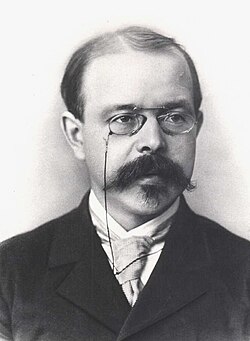
Key Facts
- Nobel Prize: Awarded the 1920 Nobel Prize in Chemistry for his work on thermochemistry.
- Major Discovery: Formulated the Nernst heat theorem, which paved the way for the Third Law of Thermodynamics.
- Key Equation: Developed the Nernst equation (1887), essential for cell physiology and neurobiology.
- Invention: Created the Nernst glower, a solid-body radiator used in infrared spectroscopy.
- Academic Influence: Co-organized the first Solvay Conference in 1911 and helped secure Albert Einstein's professorship in Berlin.
Early Life and Academic Foundation
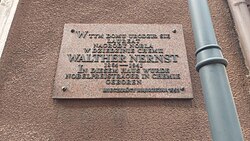
Born on June 25, 1864, in Briesen, Prussia (now Wąbrzeźno, Poland), Walther Nernst was the son of a country judge. His academic journey was expansive, spanning several prestigious institutions including the University of Zurich, the Friedrich Wilhelm University of Berlin, the University of Graz, and the University of Würzburg, where he earned his doctorate in 1887.
During his time at the University of Graz, working under Albert von Ettinghausen and influenced by Ludwig Boltzmann, Nernst discovered the Nernst effect. This phenomenon occurs when a magnetic field applied perpendicular to a metallic conductor in a temperature gradient creates an electrical potential difference.
Professional Career and Major Contributions
Nernst's career took him through Leipzig University, the University of Göttingen, and eventually to Berlin. At Göttingen, he authored the influential textbook Theoretical Chemistry and derived the Nernst equation. This equation describes the electrical potential generated by unequal concentrations of an ion separated by a permeable membrane, a concept that remains vital to modern neurobiology.
The Nernst Glower and Industrial Success
Nernst was not merely a theorist; he was a skilled inventor. He developed the Nernst glower, a filament made of rare-earth oxides that acted as a solid-body radiator. While it provided bright light, its primary lasting legacy is in infrared spectroscopy, operating effectively between 2 and 14 micrometers. Nernst sold the patent for one million marks, providing him with the wealth to pursue his passion for automobiles and land ownership.
The Third Law of Thermodynamics
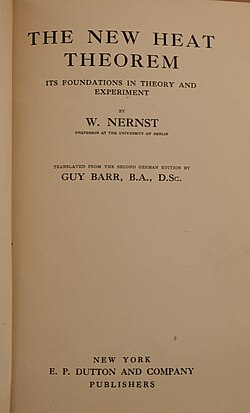
In 1905, Nernst proposed the "New Heat Theorem." This theorem posits that as temperature approaches absolute zero, entropy (the measure of disorder in a system) also approaches zero, while free energy remains above zero. This discovery allowed chemists to determine the equilibrium points of chemical reactions through heat measurements.
This work brought him into contact with Albert Einstein. Impressed by Einstein's 1909 paper on the quantum mechanics of specific heats at cryogenic temperatures, Nernst became a key advocate for Einstein, lobbying for and helping endow a research-focused professorship for him in Berlin.
War, Politics, and Later Years
During World War I, Nernst served as a Staff Scientific Advisor in the Imperial German Army. He contributed to the development of explosives, such as guanidine perchlorate, and trench mortars. Despite his military contributions, he attempted to warn the German high command about the danger of bringing the United States into the war, though his warnings were ignored.
Following the war, Nernst continued his research, proposing the atomic chain reaction theory in 1918—a concept closely related to nuclear fission. He also explored cosmology and cosmic rays, and even ventured into music by developing the Neo-Bechstein-Flügel, an early electric piano using vacuum tube amplifiers.
Resistance to Nazism
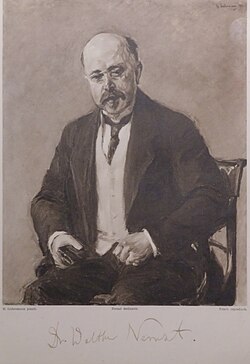
Nernst's final years were marked by his rejection of the Nazi regime. After discovering that a Jewish colleague had been dismissed, Nernst refused to comply with government forms regarding his racial origins. Consequently, he was removed from the board of the Kaiser Wilhelm Institute and retired from his professorship. He spent his remaining years in quiet retirement, dying on November 18, 1941, in Zibelle (now Niwica, Poland).
Summary of Scientific Legacy
| Contribution | Field | Key Impact |
|---|---|---|
| Nernst Heat Theorem | Thermodynamics | Foundation of the Third Law of Thermodynamics |
| Nernst Equation | Electrochemistry | Determining ion potentials in cell physiology |
| Nernst Glower | Optics/Spectroscopy | Essential tool for infrared spectroscopy |
| Chain Reaction Theory | Physical Chemistry | Theoretical precursor to nuclear fission |
| Neo-Bechstein-Flügel | Acoustics | Early application of electronic amplification in pianos |
Frequently Asked Questions
What is the Third Law of Thermodynamics?
The Third Law of Thermodynamics, derived from Nernst's heat theorem, states that as the temperature of a system approaches absolute zero, its entropy approaches a constant minimum (usually zero).
How is the Nernst equation used today?
The Nernst equation is widely used in neurobiology and cell physiology to calculate the equilibrium potential of specific ions across biological membranes.
What was the Nernst glower?
The Nernst glower was a solid-body radiator using rare-earth oxide filaments. While originally intended for lighting, it became a critical component in infrared spectroscopy.
What was Nernst's relationship with Albert Einstein?
Nernst deeply admired Einstein's work on quantum mechanics and specific heats. He was instrumental in persuading Einstein to move to Berlin to accept a prestigious, research-only professorship.
Why was Nernst removed from his academic positions in the 1930s?
Nernst was targeted by the Nazi regime because he refused to fill out government forms regarding his racial origins and openly opposed the dismissal of Jewish colleagues.