Wallace's Line and the Biogeography of the Indo-Australian Archipelago
The Indo-Australian Archipelago is one of the most biologically diverse regions on Earth, serving as a natural laboratory for the study of biogeography—the study of the distribution of species and ecosystems in geographic space and through geological time. For centuries, explorers and scientists have noted a striking contrast in wildlife between the islands of this region, leading to the conceptualization of a boundary known as Wallace's Line.
Key Facts
- Wallace's Line marks the faunal divide between the Asian (Oriental) and Australian (Australasian) biological realms.
- The concept was based on the observation that islands to the west share wildlife with Asia, while those to the east share characteristics with Australia, such as the presence of marsupials.
- T. H. Huxley formally named the boundary "Wallace's Line" in 1868.
- Modern geospatial tools and phylogenetic analysis largely validate the original boundaries proposed in the 19th century.
Historical Foundations of the Faunal Divide
Observations of biological contrasts in the region date back to 1521. Venetian explorer Pigafetta, during the voyage of Ferdinand Magellan, recorded distinct differences in biodiversity between the Philippines and the Maluku Islands (the Spice Islands). These early accounts laid the groundwork for later scientific inquiry into why similar climates could support such vastly different species.
By 1845, English navigator G. W. Earl expanded on these observations. He noted that shallow seas connected western islands, such as Java and Sumatra, to the Asian continent, resulting in similar wildlife. Conversely, eastern islands like New Guinea were connected to Australia and were characterized by marsupials—mammals that carry their young in pouches.
Alfred Russel Wallace and the Theory of Evolution
Building upon the work of Earl and his own extensive travels, Alfred Russel Wallace published a seminal paper in 1859. He proposed a boundary to the east of Bali, suggesting that islands eastward of Borneo and Java were once part of an Australian or Pacific continent before being separated.
While the line is his most famous legacy, Wallace's primary goal was to understand the geological phenomena and colonization events that created these boundaries. His work in Indonesia provided critical evidence for the emerging theory of evolution, paralleling the work of J. D. Hooker, Asa Gray, and Charles Darwin.
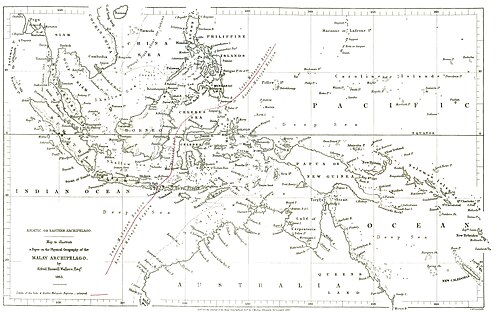
Despite his insights, Wallace faced challenges. The lack of knowledge regarding tectonic plates (the massive slabs of rock that make up the Earth's lithosphere) and uncertainties regarding the biodiversity of the Philippines created contradictions in his initial biogeographical theories.
The Refinement of the Boundary
Interestingly, Wallace did not include the Philippines in his original 1859 paper. The formal designation of the boundary as "Wallace's Line" was actually suggested by T. H. Huxley in 1868. After studying gallinaceous birds, Huxley found that species in the Philippines were remarkably distinct from those in the Asiatic realm. He redrew the boundary to the west of the Philippines, though Wallace himself had been reluctant to place the Philippines on the eastern side of the line.
Following Wallace and Huxley, several other scientists attempted to further characterize these botanical and faunal boundaries to account for the region's geographical complexity:
| Boundary/Balance Name | Year Proposed |
|---|---|
| Sclater line | 1894 |
| Lydekker's line | 1896 |
| Pelseneer's faunal balance (Weber line) | 1904 |
| Mayr's faunal balance | 1944 |
Modern Perspectives and Validations
In the modern era, researchers use computer-based geospatial tools and phylogeny (the study of evolutionary relationships among biological entities) to analyze these ancient boundaries. Most contemporary findings reinforce the 19th-century divisions, confirming that Wallace's original observations remain largely valid for land mammals, birds, and amphibians.
However, some refinements continue. For example, a 2020 study by Ali et al. on Christmas Island suggested that the ancestral colonizers of the island's amphibians and land mammals disappeared from the Lombok Strait. Consequently, they proposed re-configuring Wallace's Line to place Christmas Island on the Australasian side of the divide rather than the Oriental side.
Frequently Asked Questions
What is the primary purpose of Wallace's Line?
Wallace's Line serves as a biogeographical boundary that separates the ecozones of Asia and Wallacea (a transitional zone between Asia and Australia), explaining why animals on either side of the line are so different despite their proximity.
Did Alfred Russel Wallace name the line himself?
No. While the line is based on Wallace's theories and observations, it was T. H. Huxley who suggested the name "Wallace's Line" in 1868 after studying the distribution of birds in the archipelago.
Why were the Philippines a point of contention in the line's placement?
Wallace initially excluded the Philippines from his 1859 paper due to uncertainties about their biodiversity. Later, Huxley included them on the eastern side of the line because their bird species were distinct from those in the Asiatic realm, a placement Wallace was hesitant to accept.
How has modern technology affected our understanding of this boundary?
Modern geospatial tools and phylogenetic analysis have largely validated the original boundaries proposed in the 1800s, while allowing scientists to make precise adjustments, such as the proposed re-classification of Christmas Island.
What biological markers helped identify the divide?
The presence of marsupials on the eastern islands (connected to Australia) versus the placental mammals and other wildlife of the western islands (connected to Asia) provided key evidence for the divide.