Voting System Evaluation: Metrics and Models of Electoral Processes
Evaluating the effectiveness of a voting system requires more than just theoretical analysis; it requires rigorous measurement. By using random simulated elections that mirror real-world properties, researchers can determine how accurately different methods identify the "rightful" winner. This process of evaluation began in earnest in 1978 with Chamberlin and Cohen, who analyzed how often non-Condorcet systems successfully elected Condorcet winners—candidates who would defeat every other candidate in a head-to-head matchup.
Key Facts
- Condorcet methods achieve 100% accuracy in single-dimension spatial models with infinite voters.
- Borda count is highly accurate when voter errors are random but vulnerable to strategic candidate distribution.
- Instant Runoff Voting (IRV) is noted for its high resistance to tactical voting but can suffer from eliminating the rightful winner early.
- Spatial models view voters and candidates as positions in a multi-dimensional space, where proximity determines preference.
- The Geometric Median serves as the gold standard for identifying the "spatial winner" in multi-dimensional evaluations.
Models of the Electoral Process
To measure accuracy, researchers employ various models that simulate how voters perceive candidates and make choices.
The Condorcet Jury Model
The Marquis de Condorcet proposed that elections are similar to jury votes. In this valence model, candidates have an objective merit, but voters have imperfect information. If voter errors follow a normal distribution, score voting is the ideal procedure. If only rankings are available and the voter pool is large, any Condorcet method will likely converge on the best candidate.
However, this model assumes independent errors, meaning voters aren't biased by shared ideologies. In reality, communication and political parties create correlated errors, making this model sometimes unrealistic.
Black's Spatial Model
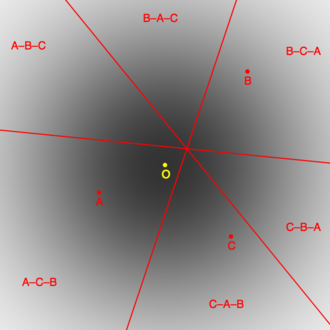
Proposed by Duncan Black in 1948 and expanded by Anthony Downs, this model views elections as ideologically driven. Voters and candidates are placed in a spatial environment (like a political spectrum). Voters choose candidates based on Euclidean distance—the shorter the distance between the voter's position and the candidate's, the higher the preference.
Neutral and Utilitarian Models
Neutral models, such as the impartial anonymous culture (Dirichlet) model, assume voters assign utility to candidates completely at random. In contrast, utilitarian models assume voters rank candidates based on personal utility to maximize overall social utility. Unlike spatial models, utilitarian models require asymmetric metrics because different voters are affected differently by the same candidate choice. This often highlights the conflict between maximum social utility and democratic equality, known as the tyranny of the majority.
Comparing Accuracy and Performance
Research by Tideman and Plassmann suggests that two-dimensional spatial models fit electoral rankings better than jury, neutral, or one-dimensional models. They also noted that voting cycles (where A beats B, B beats C, and C beats A) are rare in large electorates.
Accuracy Metrics in Simulation
In a simulated environment with a Gaussian distribution of voters, the "rightful winner" is the candidate closest to the mean or median. The following table illustrates the accuracy of various methods as the number of candidates increases.
| Method | m=3 | m=6 | m=10 | m=15 | m=25 | m=40 |
|---|---|---|---|---|---|---|
| FPTP | 70.6% | 35.5% | 21.1% | 14.5% | 9.3% | 6.4% |
| AV/IRV | 85.2% | 50.1% | 31.5% | 21.6% | 12.9% | 7.9% |
| Borda | 87.6% | 82.1% | 74.2% | 67.0% | 58.3% | 50.1% |
| Condorcet | 100% | 100% | 100% | 100% | 100% | 100% |
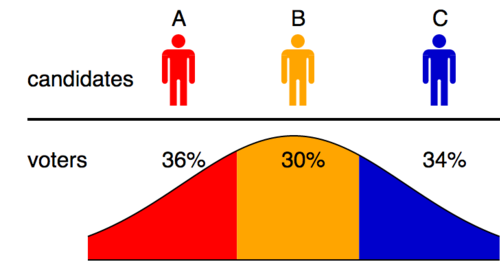
The poor performance of Instant Runoff Voting (IRV) in some scenarios occurs when the rightful winner is eliminated in the first round despite being broadly acceptable.
Resistance to Tactical Voting
Tactical voting occurs when voters manipulate their ballots to achieve a preferred outcome. Studies by James Green-Armytage et al. found that the Borda count is highly vulnerable to manipulation, while IRV is highly resistant. A hybrid Condorcet-Hare system (using IRV as a tie-break for Condorcet methods) combines high accuracy with strong resistance to tactical voting.
The Impact of Candidate Distribution
The Borda count's accuracy drops significantly when candidates are not drawn from the same distribution as voters. If the candidate pool is offset (displaced) from the voter center, Borda's performance can fall below random chance. This sensitivity makes it vulnerable to strategic entry and exit, where candidates enter the race specifically to manipulate the outcome.
Experimental Metrics and the Spatial Winner
To avoid "spurious errors" caused by using the mean (which can change based on the shape of the distribution), researchers use the median. In multiple dimensions, this is the geometric median—the point that minimizes the average distance to all voters.
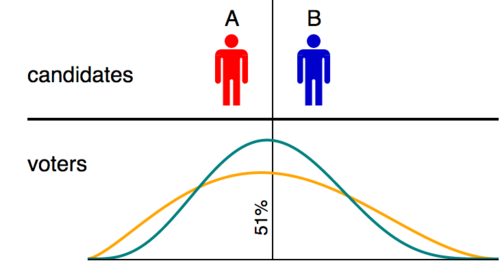
The candidate closest to this geometric median is termed the spatial winner. This metric provides a consistent way to evaluate whether a voting system is identifying the candidate who most accurately represents the electorate's collective position.
Frequently Asked Questions
What is a Condorcet winner?
A Condorcet winner is a candidate who would win a head-to-head majority contest against every other candidate in the election.
Why is the Borda count considered vulnerable?
The Borda count is susceptible to tactical voting and is highly sensitive to the distribution of candidates; if candidates are strategically positioned or offset from the voter distribution, the system's accuracy decreases.
How does IRV differ from Condorcet methods in accuracy?
While Condorcet methods are 100% accurate in single-dimension spatial models with infinite voters, IRV can fail by eliminating the most centrally located (rightful) winner in early rounds.
What is the "tyranny of the majority" in utilitarian models?
It refers to the conflict where a voting system that gives equal influence to all voters may fail to maximize overall social utility, potentially ignoring the intense needs of a minority in favor of the mild preferences of a majority.
What is the spatial winner?
The spatial winner is the candidate located closest to the geometric median of the voter distribution, representing the point of minimum average distance (or disutility) for the entire electorate.