Spoilt Ballots: Causes, Types, and Electoral Impact
In any democratic election, the integrity of the vote depends on the clear communication of a voter's intent. However, not every ballot cast is counted. When a law or an election authority determines that a ballot is spoilt (chiefly British), spoiled (chiefly American), void, null, informal, invalid, rejected, or stray, it is excluded from the final vote count. This occurrence can be the result of a simple mistake or a deliberate political statement.
In the United States, the total number of these excluded votes is referred to as the residual vote. While some jurisdictions report these figures to provide a complete picture of voter behavior, others do not. Whether accidental or intentional, spoilt ballots can provide critical insights into voter frustration or the effectiveness of ballot design.
Key Facts
- Definition: A spoilt ballot is any vote that cannot be counted due to legal requirements or technical errors.
- Common Causes: These include overvoting (too many choices), undervoting (too few choices), or defacing the ballot.
- Intentionality: Voters may deliberately spoil ballots as a form of protest against available candidates.
- Legal Safeguards: Some countries, like India, have introduced "None of the Above" (NOTA) options to reduce the number of spoilt votes.
- Fraud: Intentionally spoiling another person's ballot is classified as electoral fraud.
Types of Spoilt Votes
Ballots can be rendered invalid in several ways, ranging from complete omission to technical errors that confuse the counting system.
Marking Errors
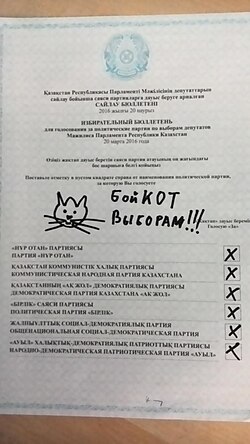
- Blank Votes: Failing to mark the ballot entirely or defacing it without attempting to vote.
- Overvoting: Marking more choices than the voting system permits.
- Undervoting: Marking fewer choices than are required.
- Sequence Errors: In preference-based systems, filling out numbers out of order (e.g., 1-2-2-3-4). Often, only the first few valid choices are counted.
- Unauthorized Write-ins: Adding a candidate's name when write-in options are not permitted.
Technical and Legal Invalidity
Beyond marking errors, ballots may be rejected for physical or privacy reasons. Physically deforming a ballot can make it unreadable for machine counters. Furthermore, any mark that allows a voter's identity to be ascertained is typically voided to preserve the secrecy of the ballot.
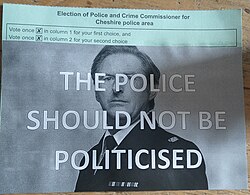
For example, UK law explicitly rejects ballots that are unmarked, void for uncertainty, or contain marks that identify the voter.
Replacement and Classification
Different countries distinguish between a mistake made before casting the vote and an invalid vote after it has been submitted.
| Region | Spoiled/Spoilt Ballot | Rejected/Invalid Vote |
|---|---|---|
| United States | A physical ballot cancelled by the voter to start over. | A cast vote that cannot be counted. |
| Canada | A ballot ruined beyond use or improperly printed; set aside by officials. | A cast ballot with improper markings (e.g., multiple marks). |
| General | Often refers to the physical paper. | Refers to the legal status of the vote. |
In the U.S., where one physical ballot often covers multiple offices, a ballot can be partially valid. This occurs when a voter selects a president but ignores lower-level offices, a phenomenon known as voter rolloff.
Intentional Spoiling as Protest
Deliberate spoiling is often used as a protest vote. This is particularly common in jurisdictions with compulsory voting, allowing citizens to participate in the process while expressing disapproval of all available candidates. Such actions are often linked to political alienation, low trust, or restrictive nomination rules.
To mitigate this, some systems introduce a "None of the above" option. The Supreme Court of India mandated this option in 2013 to provide a formal channel for dissatisfaction. In other cases, intentional spoiling is used as a tool of resistance; for instance, during the 2021 Hong Kong legislative elections, supporters of pro-democratic movements urged voters to cast invalid ballots to protest rewritten election rules.
Unintentional Spoiling and Design
Accidental spoiling is frequently a result of poor ballot design or complex electoral systems. In Australia, group voting tickets were once introduced to reduce informal votes in single transferable vote (STV) elections, though most have since been abolished. In Ireland, a 2015 Supreme Court case clarified that ballots marked with non-sequential preferences (e.g., 4-5-6) across simultaneous elections were invalid.
Modern technology helps reduce these errors. Many Direct-Recording Electronic (DRE) voting machines notify voters of over-votes or under-votes. In the U.S., the Help America Vote Act requires such notifications unless a paper-based system is used.
In the Philippines, "stray votes" previously occurred when voters chose "nuisance candidates"—individuals who ran specifically to confuse voters with names similar to bona fide candidates. Since 2013, votes for these specific nuisance candidates are transferred to the legitimate candidate with the same name.
Frequently Asked Questions
What is the difference between overvoting and undervoting?
Overvoting occurs when a voter selects more candidates than allowed for a specific office, while undervoting occurs when a voter selects fewer candidates than required or leaves the section blank.
Can a spoilt ballot be replaced?
In many jurisdictions, such as the U.S. and Canada, if a voter makes a mistake before officially casting their ballot, they can cancel the ruined paper and be issued a new one.
Why do some people intentionally spoil their ballots?
Voters may do this as a form of protest to show they are dissatisfied with all the candidates on the ballot, especially in countries where voting is mandatory.
What is a "residual vote"?
A residual vote is a term used primarily in the United States to describe the total number of ballots that are not counted for a particular office due to being spoilt, blank, or invalid.
Is it illegal to encourage others to spoil their ballots?
Laws vary by country. While it is generally not illegal to advocate for informal voting in Australian federal elections, other jurisdictions, such as Hong Kong, have criminalized inciting voters to cast invalid ballots.