Voiced Alveolar Tap and Flap: Phonetic Mechanics and Global Usage
In the complex world of human speech, certain sounds are defined not by how much effort they require, but by the extreme brevity of their execution. One such sound is the voiced alveolar tap or flap, represented in the International Phonetic Alphabet (IPA) by the symbol ⟨ ɾ ⟩. This rapid movement of the tongue creates a distinct acoustic signature found in a wide variety of the world's languages.
While many people use the terms "tap" and "flap" interchangeably, some linguists, such as Peter Ladefoged, suggest a subtle technical distinction. A tap is thought to strike its point of contact directly as a very brief stop. In contrast, a flap strikes the point of contact tangentially, often by retracting the tongue tip behind the alveolar ridge and moving it forward so that it strikes the ridge in passing. This distinction can be observed in certain American English dialects when distinguishing between words like "potty" (tap) and "party" (flap).

Key Facts
- IPA Symbol: ⟨ ɾ ⟩
- Manner of Articulation: Tap or flap (a single, brief muscle contraction).
- Place of Articulation: Dental or alveolar (behind the upper front teeth or at the alveolar ridge).
- Phonation: Voiced (the vocal cords vibrate during production).
- Airstream Mechanism: Pulmonic (produced using air from the lungs).
- Common Role: Often functions as an allophone of alveolar stops or rhotic consonants.
Phonetic Features and Articulation
To understand how the voiced alveolar tap is produced, we must look at its specific phonetic properties. It is an oral consonant, meaning air does not escape through the nose, and a median consonant, meaning the airstream is directed down the midline of the tongue.
The articulation is typically apical, meaning it is produced using the tip of the tongue. Depending on the specific language or dialect, the sound can also be postalveolar (⟨ ɾ̠ ⟩), where the contact occurs slightly further back on the roof of the mouth. In some instances, a voiced alveolar nasal tap (⟨ ɾ̃ ⟩ or ⟨ n̆ ⟩) occurs, where air is allowed to escape through the nose during the brief contact.
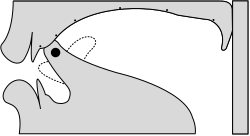
Technical Classification
In linguistic analysis, when this sound functions as a phoneme (a distinct unit of sound that changes meaning), it is categorized as a rhotic consonant. However, in many languages, it is merely an allophone—a variation of a sound that does not change the word's meaning. For example, in many English dialects, the tap is an allophone of the alveolar stops [t] or [d].
Global Occurrence and Variations
The voiced alveolar tap is a versatile sound found across diverse language families. Its role varies from being a primary phoneme to a regional dialectal variation.
| Language | Example Word | IPA Transcription | Meaning |
|---|---|---|---|
| Albanian | Shqipëri | [ʃc͡ɕipəˈɾi] | Albania |
| Arabic (Egyptian) | رجل | [ˈɾeɡɫ̩] | leg |
| Bengali | ত্রি শ | [t̪ɾiʃ] | dear |
| English (North American) | party | [ˈpɑɹɾi] | party (flap) |
| Japanese | 心 | [ko̞ko̞ɾo̞ꜜ] | heart |
| Spanish | caro | [ˈkaɾo̞] | expensive |
| Thai | พระ | [pʰɾäʔ˦˥] | monk |
Regional Dialect Examples
In English, the sound is highly prominent in regional variations. In Cockney English, it serves as an intervocalic allophone of /t/ in words like "better." Similarly, in Australian and New Zealand English, it is a common allophone for both /t/ and /d/ when they occur between vowels.
Frequently Asked Questions
What is the difference between a tap and a flap?
While often used interchangeably, some linguists define a tap as a direct, brief stop, whereas a flap is produced tangentially by the tongue tip striking the alveolar ridge while moving forward.
Is the alveolar tap always a rhotic sound?
Not necessarily. While it is analyzed as a rhotic consonant when it is a phoneme, it often serves as an allophone of alveolar stops ([t] or [d]) or other rhotic consonants in many languages.
Can the alveolar tap be nasalized?
Yes. An alveolar nasal tap or flap (⟨ ɾ̃ ⟩) exists, where air escapes through the nose. This is seen in certain English dialects (like Estuary English) and in languages like Guarani due to nasal harmony.
Where is the place of articulation for this sound?
The sound is articulated at the dental or alveolar position, meaning the tongue makes contact behind the upper front teeth or at the alveolar ridge.
What does "voiced" mean in this context?
"Voiced" means that the vocal cords vibrate during the production of the sound.