Voice of America: A History of Global Broadcasting and Its Evolution
For over eight decades, Voice of America (VOA) has served as a primary instrument of American international broadcasting. As a state-funded entity, it has sought to deliver news and information to audiences across the globe, navigating the shifting tides of geopolitics from the height of World War II through the digital age.

Key Facts

- Founded: February 1, 1942
- Headquarters: Wilbur J. Cohen Federal Building, Washington, D.C.
- Function: State-funded international broadcaster
- Current Director: Michael Abramowitz
- Budget (FY 2023): US$267.5 million
- Language Services: Broadcasts in dozens of languages including English, Mandarin, Spanish, and Russian.
The Foundations of VOA

The origins of VOA can be traced back to the period of American private shortwave broadcasting before World War II. However, the agency was formally established on February 1, 1942, as part of a broader effort to communicate American perspectives to a world engulfed in conflict.
During World War II, the agency played a critical role in disseminating information. Early leadership included figures such as Robert E. Sherwood, who headed the Foreign Information Service, and John Houseman. The agency's mission was to provide a reliable source of news to international audiences during a time of unprecedented global upheaval.

The Cold War Era and Global Impact
![Buzz Aldrin on the moon, in a photograph taken by Neil Armstrong, who can be seen in the visor reflection along with Earth[68]](/images/54/e7/54e7ebcd01248c2b319d900914dbd75540fb2346b7fb6905e492043c3804f221.jpg)
As the world transitioned from World War II into the Cold War—a period of intense geopolitical tension between the United States and the Soviet Union—VOA became a vital tool for information exchange. It operated in an environment often defined by the Iron Curtain, the political and physical boundary dividing Europe.
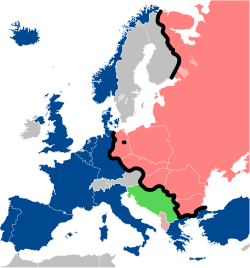
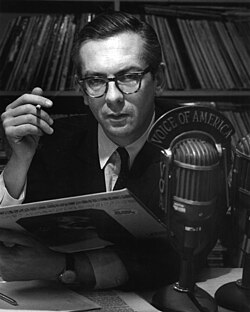
Broadcasting via shortwave radio allowed VOA to reach behind these barriers. Notable broadcasters like Willis Conover became household names to listeners abroad, providing a window into Western culture and news.
The agency's reach extended to major historical moments, including the live radio broadcasts announcing the death of President John F. Kennedy. Throughout this era, VOA's ability to bypass censorship made it a significant player in the global information landscape.
Technological Shifts: From Shortwave to the Internet
The evolution of VOA is closely tied to the evolution of communication technology. While shortwave radio was the backbone of its operations for decades, the rise of the Internet era fundamentally changed how news is consumed. VOA transitioned from traditional radio frequencies to digital platforms, ensuring its content remained accessible in a connected world.
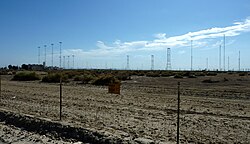
The agency's physical infrastructure also played a major role. Facilities like the Edward R. Murrow Greenville Transmitting Station in North Carolina were essential for long-distance broadcasts. However, as technology changed, some facilities, such as the Delano Transmitting Station, were eventually closed.

Operational Overview and Language Services
VOA operates as a massive multilingual enterprise. It provides news in a vast array of languages to serve diverse regions, including the Horn of Africa, the Middle East, and East Asia. This linguistic diversity allows the agency to target specific demographics with culturally and linguistically relevant content.
| Category | Details |
|---|---|
| Type | State-funded international broadcaster |
| Primary Location | Washington, D.C., United States |
| Staffing (2025) | Approximately 200 |
| Current Website | editorials.voa.gov |
| Key Languages | English, Mandarin, Spanish, Arabic, Russian, etc. |
Linguistic Reach
The agency's language services are extensive. While some services have changed over time—such as the cessation of Greek broadcasts in 2014—the core mission remains to reach global audiences. Current services include:
- Mandarin and Cantonese: Serving audiences in China and surrounding regions.
- Spanish: Targeting Latin America and Spain.
- Persian and Arabic: Providing news to the Middle East.
- Russian and Ukrainian: Serving Eastern Europe and Central Asia.
- African Languages: Including Swahili, Hausa, Amharic, and Afan Oromo.
Recent Transitions and Changes
In recent years, VOA has undergone significant organizational and structural changes. The agency has navigated various political administrations, which brought shifts in editorial focus and leadership. For instance, during the first and second Trump administrations, the agency faced various changes in management and policy.
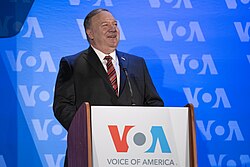
Recent reports indicate a period of significant transition. As of 2025, the agency has seen a reduction in news reporting capabilities and a move toward a statutory minimum function. This follows a period of staff changes and leadership shifts that have marked the agency's modern history.

Frequently Asked Questions
What is the primary purpose of Voice of America?
Voice of America is a state-funded international broadcaster designed to provide news, information, and American perspectives to audiences around the world.
How does VOA reach its audience?
Historically, VOA relied heavily on shortwave radio to bypass international borders. Today, it utilizes a combination of radio, television, and digital internet platforms to reach global viewers and listeners.
In how many languages does VOA broadcast?
VOA broadcasts in a wide variety of languages, including major global languages like English, Spanish, and Mandarin, as well as many regional languages such as Swahili, Pashto, and Khmer.
Where is VOA headquartered?
The headquarters of Voice of America is located in the Wilbur J. Cohen Federal Building in Washington, D.C.
What is the current status of VOA's news reporting?
As of 2025, the agency has undergone significant changes, including a reduction in news reporting and a transition toward a statutory minimum function.