Village Cinemas: A Legacy of Global Film Exhibition and Innovation
Founded in 1954, Village Cinemas has evolved from a single drive-in theater into a powerhouse of the global film exhibition industry. Headquartered in Melbourne, Victoria, the company has spent decades redefining how audiences experience movies, transitioning from traditional screenings to high-tech multiplexes and luxury cinema formats.
The company's journey is marked by strategic partnerships and a commitment to diversifying the cinematic experience. Today, it operates as a key subsidiary under Australian Theatres, a joint venture between Village Roadshow and Amalgamated Holdings.
Key Facts
- Founded: 1954 with the establishment of the first drive-in theater.
- Headquarters: Melbourne, Victoria, Australia.
- Parent Company: Australian Theatres (Joint venture between Village Roadshow and Amalgamated Holdings).
- Key Innovations: Pioneer of the Gold Class luxury format and Vmax large-format screens.
- Workforce: Approximately 2,000 employees.
- Core Business: Cinema exhibition and film distribution via Roadshow Distribution.
The Evolution of Village Roadshow
The foundation of the business was laid by Roc Kirby, who was later joined by his sons, Robert and John, and Graham Burke. While the company began in exhibition, it expanded into film distribution in 1967 with the creation of Roadshow Distributors, which eventually became the largest of its kind in Australia. By the 1970s, the company further diversified by entering film production.
In 1988, a pivotal shift occurred when Village Roadshow entered a joint venture with Warner Bros. and Greater Union to develop a network of multiplex cinemas—theaters featuring multiple screens under one roof. This Australian Multiplex Joint Venture expanded rapidly throughout the 1990s, culminating in nearly 30 theaters and 320 screens. The first of these, Village Greater Union 8, opened in Melbourne's Westfield Airport West in 1989.
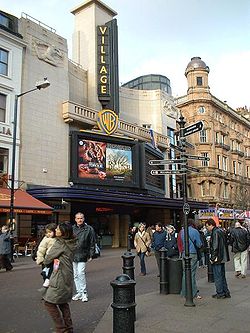
![A former four-screen Village Cinema on Bourke Street in the Melbourne central business district. It operated from 1986 to 2006, with Village Roadshow's headquarters located in the upper levels (the HQ has since been relocated to The Jam Factory near their other cinemas). Some of its opening movies were Short Circuit and The Color Purple. This building has since been redeveloped and renamed as '206 Bourke Street.'[4][5][6][7]](/images/d0/47/d04708d61e5c7d78902470a36ed13a54babf051eb654bce379d4808bddd75888.jpg)
Diversification into Virtual Entertainment
Beyond the big screen, Village Roadshow explored "virtual entertainment" in 1995 through a joint venture called Village Nine Leisure. This led to the creation of Intencity video arcades, which were often co-located with cinema sites across Victoria and Tasmania. While the chain was wholly acquired by Village Roadshow in 1999, it was later rationalized to nine primary locations by 2005.
Global Expansion and Market Shifts
Village Cinemas sought to export its success internationally, partnering with Warner Bros. to open Australia's first 24-hour cinema at the Crown Casino complex in 1997. This site also introduced Gold Class, a luxury cinema format designed to provide a premium viewing experience.
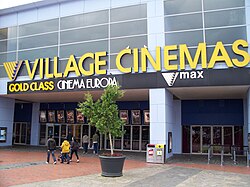
![The first PVR Cinema in Select Citywalk, Saket District Centre, within New Delhi. The establishment of this cinema in 1997 started the chain's Indian operations for Priya Exhibitors and Village Roadshow. The brand continues to trade after Village withdrew their involvement in 2002, with Gold Class and Cinema Europa screens held under licence (it operates IMAX instead of Vmax).[16]](/images/1d/09/1d0990156f295fefb5d614b48189d52250b44d5b972b6160dff3b3c806d9719c.jpg)
The company's international footprint expanded into several regions, though many were later divested to focus on core production and exhibition goals:
- Argentina: Operated Village Cines as a joint venture until 2005, later sold to US investment funds.
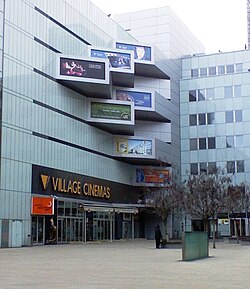
- Europe: Operated cinemas in Italy and Austria, and established a presence in Greece. In 2009, Greek operations were acquired by the Demco Group under license.
- Asia: Held a 50% stake in Singapore's Golden Village, which was fully acquired by Orange Sky Golden Harvest in 2017.
- Oceania: Maintained partnerships in New Zealand and Fiji, with interests eventually divested to Amalgamated Holdings Limited by 2010.
Modern Cinema Concepts and Technology
To stay competitive in a saturated market, Village Cinemas introduced several specialized screen formats to cater to different audience preferences.
Premium Formats
- Gold Class: A luxury experience featuring high-end auditoriums, available in Australia, Singapore, Argentina, Greece, India, and the Czech Republic.
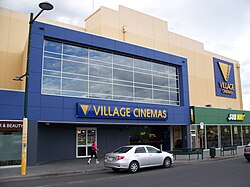
- Vmax: Large-format screens designed for immersive viewing, with some locations featuring Dolby Atmos (a surround sound technology) and screens up to 28 meters wide.
- Cinema Europa: Specialized auditoriums found in select locations across Australia, Singapore, Greece, and India.
- VPremium and 4DX: Enhanced seating and sensory experiences available at select sites like Century City.
Operational Overview
The following table summarizes the primary cinema formats and their key characteristics.
| Format | Primary Feature | Key Locations |
|---|---|---|
| Gold Class | Luxury seating and premium service | Crown, Jam Factory, VivoCity (Singapore) |
| Vmax | Massive screens and immersive audio | Westfield Knox, Plenty Valley, Crown |
| Cinema Europa | Specialized viewing auditoriums | Westfield Southland, The Mall Athens |
| 4DX | Environmental effects and motion seats | Century City |
Frequently Asked Questions
What is the relationship between Village Cinemas and Australian Theatres?
Since 2003, Village Cinemas' Australian sites have been part of a joint venture between Village Roadshow and Amalgamated Holdings, which together form the parent entity known as Australian Theatres.
What makes Gold Class different from a standard cinema?
Gold Class is a luxury cinema format that offers a more premium experience than standard auditoriums, typically featuring enhanced seating and high-end amenities.
What is Vmax?
Vmax is a large-format screen concept designed for maximum immersion. Some Vmax screens are exceptionally large (up to 28m) and utilize advanced audio systems like Dolby Atmos.
Does Village Cinemas still operate internationally?
While Village Roadshow has divested many of its direct international holdings (such as those in Argentina, Italy, and New Zealand), the brand continues to operate in some regions under license, such as in Greece via the Demco Group.
What is Intencity?
Intencity is a chain of "virtual entertainment" video arcades that were originally created as a joint venture and are often co-located with Village Cinema sites.