Vigdís Finnbogadóttir: The World's First Democratically Elected Female President
Vigdís Finnbogadóttir is a trailblazing Icelandic stateswoman and theatre director who etched her name into global history as the fourth president of Iceland. Serving from 1980 to 1996, she became the first woman in the world to be democratically elected as a head of state. Over her 16-year tenure, she not only broke the glass ceiling of national leadership but also became the longest-serving elected female head of state in history.
Key Facts
- Historic First: First woman globally to be democratically elected as a country's president.
- Tenure: Served as President of Iceland from August 1, 1980, to August 1, 1996.
- Global Impact: Oversaw the 1986 Reykjavík Summit between the US and the Soviet Union.
- Advocacy: Promoted environmentalism, reforestation, pacifism, and gay rights.
- Education: Studied at prestigious institutions including the Sorbonne and University of Copenhagen.
Early Life and Diverse Career
Born on April 15, 1930, in Reykjavík, Vigdís was the daughter of Finnbogi Rútur Þorvaldsson, a civil engineer, and Sigríður Eiríksdóttir, a nurse and head of the national nurses' association. Her academic journey was international and rigorous; she studied English and French literature at the University of Grenoble and the Sorbonne, graduating in 1953.
Before entering politics, Vigdís established herself in the arts and education. She co-founded a theatre group, translated French plays, and studied theatre history at the University of Copenhagen. Her public profile grew significantly in 1972 when she began teaching French lessons on television for RÚV, the Icelandic National Broadcasting Service. During this period, she also served as the artistic director of the Reykjavík Theatre Company and eventually headed the Icelandic Tourist Bureau.
Vigdís was also a woman of strong convictions. In the 1960s and 1970s, she participated in anti-military rallies protesting the United States' military presence in Iceland. In 1972, she became the first single woman in Iceland to adopt a child.
A Historic Presidency (1980–1996)
Vigdís entered the 1980 presidential race primarily to demonstrate that women were capable of leading political campaigns. Despite facing allegations of communism due to her anti-military stances, she won the election on June 29, 1980, with 33.6% of the vote. Her victory sparked a significant increase in the number of women serving in the Althing, Iceland's parliament.
Throughout her presidency, Vigdís transformed a largely ceremonial role into an active platform for national identity and global diplomacy. One of her most significant achievements was overseeing the Reykjavík Summit in October 1986. This meeting between U.S. President Ronald Reagan and Soviet President Mikhail Gorbachev is widely credited with improving superpower relations and accelerating the end of the Cold War.
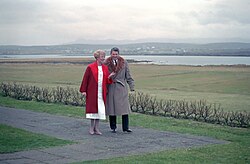
Beyond diplomacy, she used her office to champion environmental causes, specifically fighting topsoil loss and leading reforestation campaigns. A self-described "peace person," she remained a steadfast pacifist and an advocate for gay rights throughout her term.
Her tenure was not without challenge. In 1994, she faced what she called the "most difficult episode" of her career regarding Iceland's association with the European Economic Area. Despite strong domestic opposition to European integration, Vigdís supported the European Union and refused to use her presidential veto to block the association.
Life After the Presidency
After stepping down in August 1996, Vigdís continued her commitment to global leadership and culture. She became the founding chair of the Council of Women World Leaders and served as the first chair of the World Commission on the Ethics in Scientific Knowledge and Technology from 1997 to 2001.
Since 1998, she has served as a UNESCO Goodwill Ambassador for languages. She remains an active voice for peace, notably calling in 2016 for the United States and Russia to resolve their differences through dialogue in Iceland, mirroring the success of the 1986 summit.
| Detail | Information |
|---|---|
| Term Dates | August 1, 1980 – August 1, 1996 |
| Election Win (1980) | 33.6% of the vote |
| Election Win (1988) | 92.7% of the vote |
| Key Diplomatic Event | 1986 Reykjavík Summit |
| Primary Advocacy Areas | Environment, Pacifism, Women's Rights, Gay Rights |
Frequently Asked Questions
Was Vigdís Finnbogadóttir the first female president in the world?
She was the first woman to be democratically elected as a president. While other women had held the title of president through succession or as chairs of presidiums, Vigdís was the first to win a democratic election for the role.
What was the significance of the Reykjavík Summit?
The summit, held in 1986 and overseen by President Vigdís, brought together Ronald Reagan and Mikhail Gorbachev. It is credited with improving relations between the US and the Soviet Union, helping to bring the Cold War to a close.
What environmental initiatives did she support?
President Vigdís was a dedicated environmentalist who used her platform to advocate for the prevention of topsoil loss and led a national campaign for reforestation in Iceland.
How did her presidency affect other women in Iceland?
Following her historic election in 1980, there was a significant increase in the number of women elected to the Althing, the Icelandic parliament.
What was her most difficult political decision?
She considered her decision not to veto Iceland's association with the European Economic Area in 1994 to be the most difficult episode of her career, as it pitted her support for European integration against strong domestic opposition.