Valdas Adamkus: The Diplomat and Two-Term President of Lithuania
Valdas Adamkus is a distinguished figure in modern Lithuanian history, serving as both the fifth and seventh president of the republic. A man of diverse professional backgrounds, Adamkus transitioned from a career as a civil engineer and high-ranking American civil servant to become a moral authority and political leader in his homeland. His legacy is defined by his commitment to democracy, environmental stewardship, and the integration of the Baltic states into the global community.
Key Facts
- Presidencies: Served as President of Lithuania from 1998–2003 and 2004–2009.
- U.S. Career: Spent 29 years with the U.S. Environmental Protection Agency (EPA), eventually serving as Regional Administrator.
- Education: Studied at Ludwig-Maximilians-Universität München and the Illinois Institute of Technology.
- Diplomacy: Acted as a mediator during Ukraine's 2004 political crisis.
- Honors: Recipient of the Distinguished Executive Presidential Rank Award from President Ronald Reagan.
Early Life and Emigration
Born Voldemaras Adamkavičius on November 3, 1926, in Kaunas, Lithuania, Adamkus grew up in a family with strong military ties; his father headed the Lithuanian Air Force School and his uncle was a general in the interwar Armed Forces. In his youth, he was a talented athlete, holding the national record for the 100-meter sprint.
The trajectory of his life changed in 1944 during the second Soviet occupation of Lithuania. After fighting with the Fatherland Defense Force, Adamkus and his family fled the country to escape Soviet repression. He initially studied in Germany at Ludwig-Maximilians-Universität München before emigrating to the United States in 1949.
Upon arriving in Chicago as a displaced person, Adamkus worked in an automobile factory and as a draftsman while pursuing his education. He graduated as a civil engineer from the Illinois Institute of Technology in 1961. During his student years, he was a vocal advocate for Lithuania, petitioning Vice President Richard Nixon and other global leaders to address the Soviet deportation of Lithuanians to Siberia.
Distinguished Career in the United States
In 1970, Adamkus joined the newly formed United States Environmental Protection Agency (EPA). His expertise and leadership led to his appointment as Regional Administrator in 1981 by President Ronald Reagan. In this role, he oversaw pollution control programs—including air, water, and hazardous waste management—across six states: Illinois, Indiana, Michigan, Minnesota, Ohio, and Wisconsin.
His contributions to the U.S. civil service were highly recognized. In 1985, he received the Distinguished Executive Presidential Rank Award, the highest honor for a civil servant. By the time he retired in 1997, he had served 29 years, receiving a Distinguished Career Award and a congratulatory letter from President Bill Clinton.
The Presidency of Lithuania
Adamkus returned to Lithuania in the late 1990s to enter politics. Despite legal challenges regarding his residency requirements due to his time abroad, he renounced his U.S. citizenship and was elected president in 1998.
First Administration (1998–2003)
His first term focused on stabilizing the young democracy. However, he was unexpectedly defeated in the 2003 election by Rolandas Paksas. This period of transition was short-lived, as Paksas was later impeached and removed from office by parliament in April 2004.
Second Administration (2004–2009)
Following the impeachment of Paksas, Adamkus ran again and won the 2004 election. During his second term, he became a highly regarded moral authority in the state. He focused on government reorganization, the professionalization of civil servants, and the transparent use of EU funds.
Foreign Affairs and Global Diplomacy
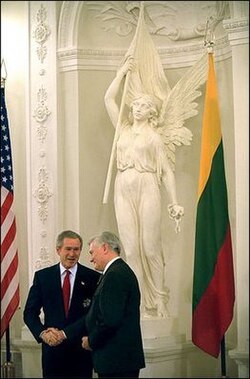
Adamkus was a pivotal figure in promoting democracy in former Soviet territories. He served as a mediator during the 2004 Ukrainian political crisis, working alongside other international leaders to resolve the dispute between Viktor Yanukovych and Viktor Yushchenko.
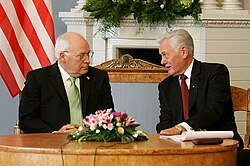
He was also a staunch defender of Baltic sovereignty. In 2005, he and Estonian President Arnold Rüütel declined to attend World War II victory celebrations, arguing that for Lithuania, the end of the war signaled the start of a 50-year Soviet occupation. This stance prompted a unanimous U.S. Congress resolution calling for Russia to condemn the illegal annexation of the Baltic states.
Summary of Presidential Terms
| Term | Period | Preceded By | Succeeded By | Key Focus |
|---|---|---|---|---|
| First Term | 1998–2003 | Artūras Paulauskas (Acting) | Rolandas Paksas | Democratic stabilization |
| Second Term | 2004–2009 | Rolandas Paksas (Impeached) | Dalia Grybauskaitė | EU integration & regional diplomacy |
Personal Life and Later Years
Valdas Adamkus was married to Alma Adamkienė (née Nutautaite) from 1951 until her death in 2023. The couple was known for their philanthropy, including funding the largest bell for the Kaunas Carillon. In his retirement, Adamkus remained active in international development and joined the European Academy of Diplomacy.
In recent years, Adamkus has faced health challenges, including hospitalizations in early and late 2025 for cardiac conditions and infections.
Frequently Asked Questions
Why did Valdas Adamkus serve two non-consecutive terms?
He served from 1998 to 2003 but lost the 2003 election to Rolandas Paksas. After Paksas was impeached and removed from office in 2004, Adamkus ran again and was re-elected, serving until 2009.
What was Adamkus's role in the United States before becoming president?
He was a civil engineer and a high-ranking official at the U.S. Environmental Protection Agency (EPA), where he served as the Regional Administrator for Region 5 for sixteen years.
How did Adamkus contribute to Ukrainian politics?
He acted as an international mediator during the 2004 political crisis in Ukraine, helping to resolve the dispute over the presidential election results between Viktor Yanukovych and Viktor Yushchenko.
What is the significance of the "Valdas V. Adamkus Sustained Commitment to the Environment Honor Award"?
This award was established by EPA Region 5 to honor Adamkus's long-term dedication and leadership in environmental protection during his 29-year career with the agency.
What was Adamkus's stance on the end of World War II?
He viewed the end of World War II not as a simple victory, but as the beginning of a fifty-year period of Soviet occupation and repression for Lithuania.