Vertical Stabilizers: The Science of Aircraft Yaw Stability and Control
In the complex world of aerodynamics, maintaining a straight course is just as critical as generating lift. One of the most vital components ensuring an aircraft stays on its intended path is the vertical stabilizer, often referred to as the tail fin. As a key part of the aircraft's empennage (the entire tail assembly), the vertical stabilizer provides the necessary stability and control to manage yaw—the movement of the aircraft's nose left or right around its vertical axis.
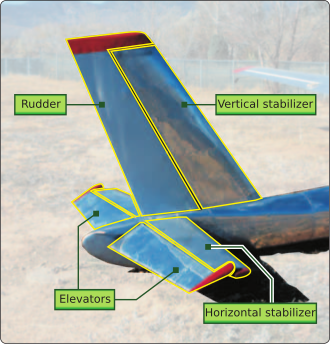
While the stabilizer itself is a static, fixed surface, it works in tandem with a movable component called the rudder. Together, these surfaces allow pilots to maintain directional stability (also known as weathercock stability) and perform precise maneuvers during flight, takeoff, and landing.
Key Facts
- The vertical stabilizer provides stability and control in the yaw direction.
- The rudder is the movable part hinged to the stabilizer used for directional control.
- Effectiveness increases the further the tail is positioned from the aircraft's center of gravity.
- Vertical stabilizers are used in motorsports, such as Le Mans Prototype racing, to prevent high-speed blow-overs.
- Configurations vary from conventional tails to T-tails, twin tails, and V-tails.
How the Vertical Tail Functions
The primary role of the vertical tail assembly is threefold: to enable trim in the yaw direction, to provide control during maneuvers, and to ensure inherent stability. Trim allows a pilot to compensate for asymmetries in thrust or drag, preventing the aircraft from constantly pulling to one side.
The Importance of Position and Volume
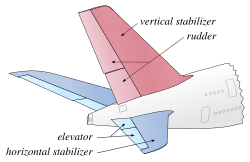
The effectiveness of a vertical stabilizer is heavily influenced by its distance from the aircraft's center of gravity. Generally, the further away the tail is, the more effective it becomes. This is why shorter aircraft, such as the Airbus A318, often require larger vertical tails compared to their longer counterparts in the same family.
Engineers use a non-dimensional value called the vertical tail volume coefficient to measure effectiveness. This ratio compares the area and length of the tail to the dimensions of the main wing. While values vary, they typically range from 0.02 for sailplanes to 0.09 for jet transport aircraft.
Yaw Control and Steering
The rudder is the primary tool for controlling yaw. By moving the rudder, a pilot can change the horizontal direction in which the nose points. This is essential for initiating a side slip during crosswind landings or compensating for an engine failure in multi-engine aircraft.
During taxiing and takeoff, steering is a combined effort. At low speeds, pilots rely on the nosewheel or tailwheel for direction. As speed increases, the aerodynamic force generated by the rudder becomes the dominant method of control. In many aircraft, the rudder and the wheel steering are managed via separate mechanisms, such as a tiller for the wheels and pedals for the rudder.
Stability and Complex Aerodynamics
Yaw stability is the aircraft's ability to return to its original heading when disturbed. The vertical tail provides the restoring moment required to correct a slip. However, airflow over the tail is not always simple; it is often influenced by the fuselage, wings, and engines.
The Impact of Supersonic Flight
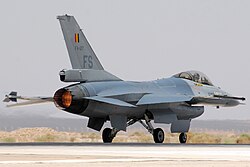
As an aircraft approaches and exceeds the speed of sound, the effectiveness of the vertical stabilizer changes. In supersonic flight, the side force generated by the tail decreases for every degree of sideslip due to unique pressure distributions and shock waves. To combat this loss of stability, some aircraft use enlarged fins, ventral fins (fins located on the underside), or even automatic rudder deflections.
Preventing Rudder Lock
To prevent a dangerous phenomenon known as rudder lock—where a rudder becomes stuck at full deflection due to a stall—engineers often add a dorsal fin. This fillet at the base of the vertical tail increases the stall angle, ensuring smoother aerodynamic transitions.
Structural Challenges and Configurations
The forces acting on a vertical stabilizer can be immense, especially during high-speed maneuvers or extreme turbulence. Structural failures have occurred in history due to excessive rudder deflection or severe clear-air turbulence. Additionally, fighter aircraft often face fin buffeting, where fluctuating loads from air vortices cause vibration and fatigue on the fin structure.
Common Tail Configurations
Aircraft utilize various tail designs depending on their mission requirements:
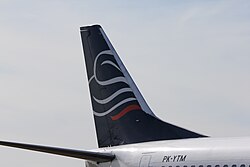
- Conventional Tail: The vertical stabilizer is mounted on top of the rear fuselage.
- Twin Tail: Two vertical stabilizers are used, common in many modern combat aircraft like the F/A-18 Hornet.
- V-Tail: Two surfaces arranged in a 'V' shape, acting as both elevators and rudders (ruddervators), seen on the F-117 Nighthawk.
- T-Tail: The horizontal stabilizer is mounted at the top of the vertical fin.
Summary of Tail Components and Roles
| Component | Type | Primary Function |
|---|---|---|
| Vertical Stabilizer | Fixed | Provides directional stability and weathercock effect. |
| Rudder | Movable | Controls yaw and allows for directional maneuvering. |
| Trim Tab | Movable | Compensates for aerodynamic moments to reduce pilot input. |
| Dorsal Fin | Fixed | Increases stall angle to prevent rudder lock. |
| Ventral Fin | Fixed | Adds stability, especially in high-speed or supersonic flight. |
Frequently Asked Questions
What is the difference between a vertical stabilizer and a rudder?
The vertical stabilizer is the fixed, stationary part of the tail fin, while the rudder is the movable surface hinged to the stabilizer that allows the pilot to control the aircraft's yaw.
What is weathercock stability?
Weathercock stability, or directional stability, is the tendency of an aircraft to align itself with the oncoming airflow, much like a weather vane, ensuring it maintains a straight path.
Why do some aircraft have twin tails?
Twin tails can be used to improve control in certain configurations, provide additional longitudinal control when gear is down, or act as an airbrake through differential rudder movement.
What causes rudder lock?
Rudder lock occurs when the vertical tail stalls during a steady sideslip, causing the aerodynamic force on the deflected rudder to suddenly reverse, potentially leaving the rudder stuck at full deflection.
How does supersonic flight affect the tail?
In supersonic flight, the effectiveness of the vertical tail decreases because the lift-curve slope (the side force generated per degree of sideslip) is reduced due to the presence of shock waves and different pressure distributions.