Verb Conjugation: How Languages Shape Action Through Inflection
In the study of linguistics, conjugation is the process of creating different forms of a verb from its principal parts. This is achieved through inflection, which is the alteration of a word's form according to specific grammatical rules. For example, in English, the verb "break" can be conjugated into "breaks" or "broke" to convey different meanings. While English conjugation is relatively straightforward, many other languages feature much more intricate systems.
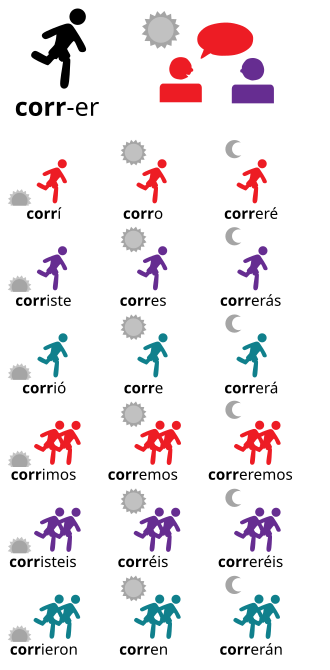
The complexity of these systems varies wildly across the globe. Languages like French and Spanish possess dozens of conjugated forms for a single verb. Even more complex are languages such as Georgian, Basque, and Navajo, which can feature hundreds of possible conjugations for every single verb. These variations allow speakers to encode a massive amount of information directly into the verb itself.
Key Facts
- Conjugation refers specifically to the inflection of verbs, whereas the inflection of nouns and adjectives is called declension.
- Finite forms are conjugated verbs that carry grammatical information, unlike non-finite forms such as infinitives, gerunds, or participles.
- A lexeme is the set of all different forms of the same verb, while the lemma is the canonical form found in dictionaries.
- Verbal agreement (or concord) occurs when a verb changes its form to match the properties of its subject or object.
- Irregular verbs are those that do not follow the standard conjugation patterns of their language.
The Mechanics of Verbal Inflection
Verbs do not change randomly; they inflect to express specific grammatical categories. These categories act as a roadmap for the meaning of a sentence. Common factors that influence conjugation include:
Finite Verb Categories
Finite verbs—those that are fully conjugated—typically reflect the following:
- Person: Indicates who is performing the action (e.g., first, second, or third person).
- Number: Distinguishes between singular and plural subjects.
- Gender: Some languages require verbs to reflect the gender of the subject.
- Tense: Locates the action in time (past, present, or future).
- Aspect: Describes the nature of the action (e.g., whether it is completed or ongoing).
- Mood: Expresses the speaker's attitude (e.g., indicative, subjunctive, or imperative).
- Voice: Indicates if the subject is performing or receiving the action (active vs. passive).
Additional Influencing Factors
Beyond the standard finite categories, conjugation can also be affected by non-finite properties and social nuances, such as:
- Transitivity: Whether the verb takes an object.
- Valency: The number of arguments a verb can take.
- Politeness: Levels of formality or honorifics (common in Japanese and Korean).
- Clusivity: Distinctions in personal pronouns (e.g., whether "we" includes or excludes the listener).
Verbal Agreement and Concord
Verbal agreement, also known as concord, is a morpho-syntactic construct where the verb form indicates the properties of the subject or object. In English, we see this in subject agreement: we say "I go" and "he goes," but "he go" is ungrammatical in standard English.
In many languages, this agreement is much more intensive. In French, verbs must change significantly to agree with different pronouns (e.g., je suis vs. nous sommes). Some languages, like Ubykh, even feature agreement for the direct object, indirect object, and even the beneficiary of an action.
Interestingly, some languages allow for implicit subjects. In Spanish, the verb form often carries enough information that the subject pronoun is unnecessary (e.g., soy instead of yo soy). Conversely, in French, subject pronouns are obligatory.
Nonverbal Person Agreement
Not all agreement is strictly "verbal." In some languages, predicative adjectives (adjectives that describe a subject) or copular complements (words following a linking verb) receive person agreement. This is often considered nonverbal because the agreement derives from pronouns that have become attached to the nouns they refer to.
For example, in Turkic languages, predicative adjectives use affixes similar to verbs, but their behavior under negation is different, suggesting a distinct grammatical character. This is sometimes viewed as a "verbal takeover" by a copular strategy.
Summary of Conjugation Complexity
| Language Family | Language Example | Complexity Level | Key Feature |
|---|---|---|---|
| Germanic | English / German | Low to Moderate | Subject-verb agreement |
| Italic | Latin / Italian | Moderate | Defined conjugation classes |
| Wati | Wanman / Pitjantjatjara | High | Class-based endings (l, ø, n, ng) |
| Pama-Nyungan | Ngarla | High | Binary class system with complex tense/aspect |
Frequently Asked Questions
What is the difference between conjugation and declension?
Conjugation refers specifically to the inflection of verbs. Declension is the term used for the inflection of other parts of speech, such as nouns, adjectives, and pronouns.
What defines an irregular verb?
An irregular verb is any verb that does not follow the standard, predictable conjugation patterns or rules of its specific language.
What are finite and non-finite verb forms?
Finite forms are conjugated to show person, number, tense, and mood. Non-finite forms, such as infinitives, gerunds, and participles, do not show these specific grammatical properties.
How do conjugation classes work?
A conjugation class (or verb class) is a group of verbs that share a similar conjugation pattern. For example, Latin has four distinct conjugation classes, meaning if you know a verb's class, you can predict its forms.
Can a verb agree with an object?
Yes. While many languages only require verbs to agree with the subject, some languages exhibit much richer agreement systems where the verb also indicates the properties of the direct or indirect object.