V Formation Flight: The Aerodynamics of Birds and Aircraft
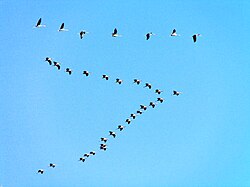
Whether observing a flock of geese crossing a winter sky or watching a precision military flyover, the V formation—a symmetric, chevron-shaped arrangement—is one of nature's and aviation's most recognizable patterns. This strategic positioning is not merely for visual order; it is a sophisticated method of optimizing energy and maintaining communication during long-distance travel.
While most commonly associated with large migratory birds, the principles of the V formation have been studied extensively by scientists and engineers to improve the efficiency of human-made aircraft, from military jets to commercial airliners.
Key Facts
- Energy Efficiency: Birds use the "upwash" from the lead bird's wingtips to reduce the effort needed to stay aloft.
- Range Extension: Research suggests a formation of 25 birds can increase flight range by up to 71%.
- Aviation Application: NASA and Airbus have explored V formations to reduce fuel consumption by 5% to 15%.
- Coordination: Birds synchronize their wing-flapping patterns to maximize lift and avoid downward air currents.
The Aerodynamics of Avian Flight
The primary advantage of flying in a V formation is the exploitation of wingtip vortices. As a bird flies, it creates spirals of air at the tips of its wings. The air moving upward outside these spirals is known as upwash.
Birds following the leader position themselves to catch this upwash, which provides a lift force that helps support their weight. This is similar to how a glider maintains height by finding rising air. Scientists believe birds locate these optimal zones using their vision or by sensing airflow through their feathers.
Scientific Findings on Energy Savings
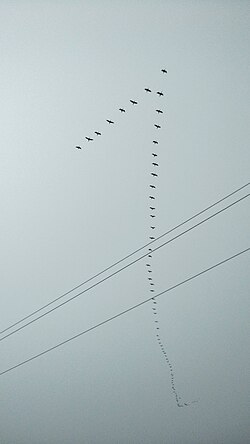
The efficiency gains of this formation are significant. A 1970 study indicated that in a group of 25 birds, members could increase their range by 71% while flying at a speed 24% lower than a solo bird. Further research in 2001 using tracked pelicans revealed that birds flying alone had higher heart rates and flapped their wings more frequently than those in a V formation.
The Role of Timing and Coordination
Positioning is only half of the equation; timing is equally critical. Birds in the formation synchronize their flapping with the leader to stay within the trail of upwash. Interestingly, if a bird finds itself directly behind another, it will reverse its flapping pattern to avoid downwash, the downward flow of air that would otherwise hinder its flight.
Applications in Human Aviation
Human aviation has long mirrored these natural patterns, both for ceremonial purposes and for technical efficiency.
Military and Ceremonial Flight
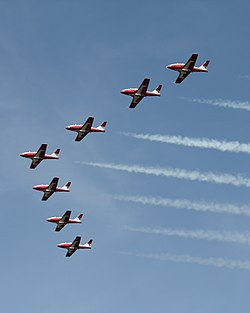
In military aviation, the "Vic" formation is a fundamental building block used in air shows and ceremonial flyovers. Beyond aesthetics, the U.S. Air Mobility Command has experimented with "vortex surfing," using autopilot adjustments to balance the reduced drag of the formation with the stability of the flight.
Commercial Aviation and Sustainability
Airbus has pursued the "fello’fly" project to lower the environmental impact of commercial flights. Because large aircraft create massive vortices, they must fly further apart—approximately 1.5 to 2 miles—to capture the updraft without compromising passenger comfort. Tests using AS350 Écureuil helicopters showed that the trailing aircraft could reduce fuel consumption by 5% to 10% per trip.
Similarly, NASA’s Autonomous Formation Flight program utilized GPS-based instrumentation to position aircraft automatically, with experimental data suggesting potential fuel savings of 10% to 15%.
Comparative Summary of V Formation Benefits
| Subject | Primary Benefit | Key Metric/Finding | Mechanism |
|---|---|---|---|
| Migratory Birds | Increased Range | Up to 71% range increase | Upwash exploitation & flap syncing |
| Military Aircraft | Fuel Efficiency | 10% to 15% fuel savings (NASA) | Vortex surfing via GPS/Autopilot |
| Commercial Jets | Emission Reduction | 5% to 10% fuel reduction (Airbus) | Wide-spaced V formation (fello’fly) |
Birds Known to Use V Formations
While many species utilize this strategy, it is most common among large birds. Notable examples include:
- Geese, Swans, and Ducks (often forming a skein)
- Cranes and Pelicans
- Gulls and Cormorants
- Ibises
Frequently Asked Questions
Why do birds fly in a V shape instead of a straight line?
The V shape allows each bird to position itself in the upwash created by the bird in front of it, reducing the energy required to fly. It also provides a clear field of vision for communication and navigation.
Do all birds in the V formation save energy?
The lead bird does not benefit from the upwash of others and works the hardest. However, the birds behind it save significant energy. This is why birds typically rotate the lead position.
How does "vortex surfing" work for airplanes?
Vortex surfing involves a trailing aircraft positioning itself to capture the upward-moving air (upwash) generated by the wingtips of the leading aircraft, thereby reducing drag and fuel consumption.
Can commercial airplanes fly in a V formation today?
While technically possible and tested by companies like Airbus, widespread use is limited by operational challenges, such as coordinating schedules between different airlines and maintaining precise altitude and position data.
What is the difference between a V formation and a skein?
A skein is a specific term used to describe the V-shaped formation commonly adopted by geese, ducks, and swans during migration.