UV Index: How to Measure and Protect Yourself from Sunburn-Producing Radiation
The UV index is an international standard used to measure the strength of sunburn-producing ultraviolet (UV) radiation at a specific time and location. While moderate exposure to sunlight offers health benefits, excessive UV radiation can lead to serious issues, including sunburn, skin aging, DNA damage, skin cancer, immunosuppression, and eye damage such as cataracts.
Designed as an open-ended linear scale, the UV index helps the general public understand daily and hourly forecasts so they can take effective precautions. By understanding these numbers, you can better manage your time outdoors and protect your long-term health.
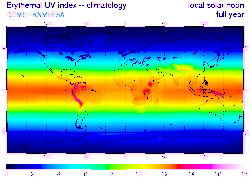
Key Facts
- The UV index is a linear scale, meaning a value of 12 is twice as intense as a value of 6.
- Public health organizations recommend protection when the UV index reaches 3 or higher.
- The scale was developed by Canadian scientists in 1992 and standardized globally in 1994.
- Daily UV index predictions typically represent the intensity at solar noon.
- Factors like altitude, snow reflectivity, and ozone depletion can significantly increase UV levels.
How the UV Index Works
Unlike logarithmic scales such as the Richter scale (for earthquakes) or decibels (for sound), the UV index is directly proportional to the intensity of radiation. This linear relationship is crucial for safety: if you would develop a sunburn after 30 minutes at a UV index of 6, you would likely experience a similar sunburn after only 15 minutes at a UV index of 12.
When weather reports provide a daily UV index, they are usually predicting the intensity around solar noon—the point when the sun reaches its highest position in the sky. This typically occurs between 11:30 and 13:30, depending on whether daylight saving time is in effect. Computer models calculate these predictions by accounting for several variables, including:
- Sun-Earth distance and the solar zenith angle.
- Total ozone levels and tropospheric aerosol optical depth.
- Elevation and the reflectivity of surfaces like snow, ice, or water.
- Cloud transmission.
![Typical variation of UV index by time of day and time of year, around 40.71 -74.01, based on FastRT UV Calculator[4]](/images/ea/a8/eaa8f7375c7c6f84858cfc1cbedb90a30ca37361e2a3ca72e4adcc73375d3b0b.png)
The Science of Skin Sensitivity
The UV index does not just measure raw radiation; it measures radiation specifically in relation to its ability to cause a sunburn. This is because different wavelengths of UV light affect human skin differently. To account for this, scientists use the erythemal action spectrum—a weighting curve that reflects how sensitive human skin is to various wavelengths.
The most damaging wavelengths are the shorter ones (between 295 and 325 nm). Even if a specific wavelength has lower intensity, its high capacity to cause damage means it carries more weight in the final index calculation. This process results in a figure called the Diffey-weighted UV irradiance (DUV), which is then divided by 25 mW/m² to produce the standard index value.
![Sunburn effect (as measured by the UV index) is the product of the sunlight power spectrum (radiation intensity) and the erythemal action spectrum (skin sensitivity) across the range of UV wavelengths.[9][10]](/images/73/f4/73f4e9f87819db27956e7261b56dccbf61f71747c33b4557d5653c848fe56946.webp)
UV Index Levels and Protection Recommendations
Protection needs vary based on the index level. The following recommendations are intended for the average adult with lightly tanned skin (Fitzpatrick Type II). Individuals with darker skin (Type IV+) may withstand more exposure, but children, seniors, and those with fair skin require extra caution.
| UV Index | Color Code | Risk Level | Recommended Protection |
|---|---|---|---|
| 0–2 | Green | Low | Wear sunglasses on bright days. Use SPF 15+ if you burn easily. |
| 3–5 | Yellow | Moderate | Seek shade near midday. Wear a hat, sunglasses, and SPF 50+ sunscreen. |
| 6–7 | Orange | High | Reduce sun exposure between 10 a.m. and 4 p.m. Use protective clothing. |
| 8–10 | Red | Very High | Minimize time in the sun. Unprotected skin can burn quickly. |
| 11+ | Violet | Extreme | Avoid sun exposure between 10 a.m. and 4 p.m. Seek shade constantly. |
History of the UV Index
The modern UV index was invented in Toronto, Ontario, by Environment Canada scientists James B. Kerr, C. Thomas McElroy, and David I. Wardle. They launched it on May 27, 1992, making Canada the first nation to issue official UV forecasts. Following its success, the World Health Organization (WHO) and the World Meteorological Organization (WMO) standardized the index in 1994 to ensure consistent global reporting.
The importance of this tool was recognized in 2007 when the inventors received the United Nations Innovators Award. The development of the index was even ranked as one of the "100 Biggest Weather Moments" by The Weather Channel.
Frequently Asked Questions
Is the UV index a logarithmic scale?
No, the UV index is a linear scale. This means that each increase in the index represents a proportional increase in the intensity of sunburn-producing radiation, unlike the Richter scale which is logarithmic.
Why does the UV index change based on my location?
UV intensity is influenced by your elevation, the amount of ozone in the atmosphere, and how much sunlight is reflected by your surroundings, such as snow, water, or sand.
When is the UV radiation at its strongest during the day?
The UV index is typically highest around solar noon, which is when the sun reaches its highest point in the sky. This usually occurs between 11:30 and 13:30, depending on your time zone and daylight saving time.
Does cloud cover protect me from UV radiation?
While clouds can reduce UV levels, the index accounts for cloud transmission. It is still important to follow protection guidelines, as UV radiation can still reach the surface even on cloudy days.
How does skin type affect UV sensitivity?
The recommendations provided are for the average adult with lightly tanned skin. People with darker skin (Type IV or higher on the Fitzpatrick scale) may have more natural resistance, while children and fair-skinned individuals require much more stringent protection.