US Court of Appeals Ruling on the Hitler Watercolors and Photographic Archives
In November 1995, the United States Court of Appeals for the Fifth Circuit delivered a significant ruling regarding the ownership and legal status of historical artifacts, including watercolors by Adolf Hitler and various photographic archives. The court upheld the US government's appeal and rejected the claims brought by Price, centering the decision on the principle of sovereign immunity—a legal doctrine that prevents the government from being sued without its express consent.
Key Facts
- The Fifth Circuit Court of Appeals ruled that the US government maintained sovereign immunity against the tort claims.
- Four watercolors by Adolf Hitler were classified as "military objects" and moved from Germany to the US around June 1950.
- The main photographic archive was vested in the Attorney General under the Trading with the Enemy Act of 1917.
- The Carlisle archive was transferred to the US Army by Time magazine publishers between 1981 and 1983.
- The court found no valid waiver of immunity for any of the disputed items.
The Dispute Over Hitler's Watercolors
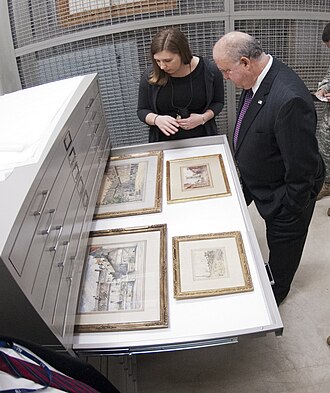
The controversy involved four watercolors painted by Adolf Hitler. During World War II, these works were stored in a castle where they were eventually discovered by the U.S. Army during the occupation of Germany. The pieces were first moved to a central collecting point in Munich for registration and cataloging. While other artworks belonging to Hoffmann were returned to him, the Hitler watercolors were designated as "military objects." They were transferred from Munich to Wiesbaden, and subsequently shipped to the United States around June 1950.
The Court of Appeal did not rule on whether the confiscation itself was legal. Instead, it focused on when the alleged tortious act—the action harming the owner's interests—occurred. The court determined that this act took place when the watercolors were separated from Hoffmann's other property and sent from Munich to Wiesbaden. Because this event occurred in Germany, the claim was barred in US federal courts under the Federal Tort Claims Act (specifically 28 U.S.C. § 2680(k)).
The Main Photographic Archive
The primary photographic archive played a role in the Nuremberg Trials before being shipped to the United States around the time of the Berlin Airlift (1948–1949). On June 25, 1951, the Attorney General utilized the Trading with the Enemy Act 1917 (50 U.S.C.App. § 1–33) to vest all rights to these photographs in himself. This allowed the images to be held, administered, or sold for the benefit of the United States. The archive was eventually transferred to the United States National Archives.
Under 28 U.S.C. § 2680(w) of the Federal Tort Claims Act, claims arising from the administration of the Trading with the Enemy Act are specifically excluded. Price attempted to challenge the validity of the original vesting order, but the Court ruled that the time limit for such challenges had expired. Consequently, the Court of Appeal concluded that the District Court lacked subject matter jurisdiction over the claim.
The Carlisle Archive
The Carlisle archive is a smaller collection with less historical significance and a less documented history than the main archive. These photographs were apparently removed from Germany in the late 1940s by or for Time magazine. The publishers of Time later passed the collection to the U.S. Army between 1981 and 1983.
The Court of Appeal dismissed the claim regarding the Carlisle archive as untimely. According to the Federal Tort Claims Act (28 U.S.C. § 2675(a)), a plaintiff must either receive a written denial from the government or wait six months before initiating a lawsuit. Because Price failed to meet this requirement, the court found no waiver of sovereign immunity.
Summary of Legal Outcomes
| Asset | Legal Basis for Government Position | Court Conclusion |
|---|---|---|
| Hitler Watercolors | Federal Tort Claims Act (28 U.S.C. § 2680(k)) | Claim barred; act occurred in Germany. |
| Main Photo Archive | Trading with the Enemy Act / 28 U.S.C. § 2680(w) | No jurisdiction; time limit for challenge passed. |
| Carlisle Archive | Federal Tort Claims Act (28 U.S.C. § 2675(a)) | Claim untimely; procedural requirements not met. |
Frequently Asked Questions
Why did the court reject the claim for the watercolors?
The court found that the act of separating the watercolors from the owner's other property occurred in Germany. Under the Federal Tort Claims Act, this location barred the claim from being heard in US federal courts.
What is the Trading with the Enemy Act 1917?
It is a US law that, in this context, allowed the Attorney General to vest rights to the photographic archive in the government to be used or administered for the benefit of the United States.
How did the Carlisle archive reach the US Army?
The photographs were removed from Germany in the late 1940s by or on behalf of Time magazine, and the publishers subsequently transferred them to the US Army between 1981 and 1983.
What is sovereign immunity in the context of this case?
Sovereign immunity is the legal principle that the United States government cannot be sued unless it has expressly waived that immunity. The court ruled that no such waiver existed for the items in this dispute.
Why was the claim for the Carlisle archive considered untimely?
The plaintiff did not follow the requirements of the Federal Tort Claims Act, which mandates that a plaintiff must either wait six months or receive a written denial from the government before filing a lawsuit.