Uruguayan Identity Documents: From Cédula to Electronic ID
Identity verification is the cornerstone of civic life in Uruguay. For decades, the primary tool for this has been a standardized identification card, which has evolved from a simple laminated card into a sophisticated electronic tool. This transition reflects a global shift toward enhanced security, biometric verification, and digital integration.
The Legacy Cédula de Identidad
Prior to 2015, the national identification card was known as the Cédula de Identidad. This document was a light green laminated card measuring approximately 9 cm by 5 cm. Its design featured the flag of the Thirty-Three Orientals at the center, accompanied by the motto "Libertad o muerte" (Liberty or death).
The front of the card displayed the holder's photograph, their full name, and a unique number assigned by the D.N.I.C. (Dirección Nacional de Identificación Civil), which included a verification digit. It also featured the individual's signature or a note if they were unable to sign.
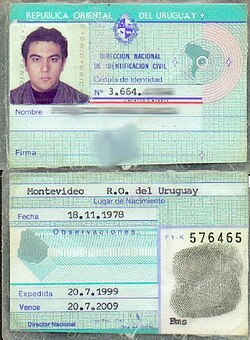
The reverse side contained essential personal data, including nationality, date of birth, and issuance and expiration dates. Validity periods varied: generally 10 years for adults, five years for children, and lifelong validity for those issued the document after age 70. By 2010, the D.N.I.C. added barcodes and additional photos to improve tracking and security. This card served as the primary tool for everything from age verification to credit card transactions.
The Modern Documento de Identidad
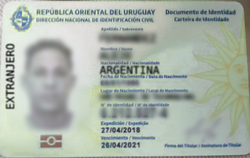
In 2015, Uruguay introduced a new format, officially renaming the card the Documento de Identidad. This update was not merely cosmetic; it introduced a shift to polycarbonate material and laser-engraving technology. Because the laser essentially burns the data into the polycarbonate, the information cannot be erased or tampered with, ensuring a durability of 10 years.
To facilitate international use, the new document includes Portuguese translations for key fields, such as "Apellido/Sobrenome" (Surname) and "Nombre/Nome" (Name).
Security Architecture
The Documento de Identidad employs a three-tier security system to prevent forgery:
- Visible Features: Elements discernible to the naked eye, such as OVI (Optically Variable Ink) and complex guilloché patterns.
- Second-Level Features: Elements requiring basic tools, such as UV holograms and microtext visible under a microscope or UV light.
- Third-Level Features: Highly specialized security measures known only to the D.N.I.C. and requiring advanced equipment to verify.
Electronic Capabilities and Chip Technology
Adult identification cards are equipped with two distinct chips, each serving a different purpose. It is important to note that cards issued to minors do not contain these chips.
The Contactless Chip (Invisible)
The invisible chip is designed for wireless communication and complies with ICAO 9303 standards for electronic travel documents. It enables automatic immigration control via eGates (such as those at Carrasco Airport) in South American countries where the ID card is accepted as a travel document.
To protect privacy, the chip uses Basic Access Control (BAC), which prevents unauthorized scanning by requiring a secret key derived from the Machine-Readable Zone (MRZ) printed on the card. Additionally, Active Authentication ensures the chip has not been cloned by using a private key and a digital signature from the D.N.I.C.
The Contact Chip (Visible)
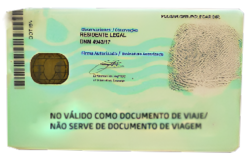
The visible chip follows ISO/IEC 7816 standards and requires a physical smart card reader. It provides three primary applications:
- Identification: Allows systems to electronically extract the holder's data, removing the need for manual entry.
- Match-on-Card: A biometric security feature that compares a live fingerprint scan against the fingerprint stored on the chip to verify the holder's identity.
- Authentication and Digital Signature: Contains a certificate and key pair for advanced electronic signatures. This requires a user-defined PIN for activation.
Naturalized Citizens and ICAO Standards
There is a known inconsistency regarding naturalized citizens. Because the D.N.I.C. lists the country of birth rather than "Uruguayan" citizenship on these cards, they do not fully comply with ICAO 9303-3 7.1 standards. This discrepancy can lead to the rejection of the document at international eGates or by foreign immigration authorities, as the issuance country and nationality fields may appear inconsistent.
Summary of Document Evolution
| Feature | Cédula de Identidad (Pre-2015) | Documento de Identidad (Post-2015) |
|---|---|---|
| Material | Laminated Card | Laser-engraved Polycarbonate |
| Primary Color | Light Green | Multi-colored/Secure |
| Security | Basic Lamination/Barcode | 3-Level Security (OVI, UV, Microtext) |
| Electronic Features | None (Barcode only after 2010) | Contact and Contactless Chips |
| Travel Utility | Physical Verification | ICAO Compliant / eGate Compatible |
| Biometrics | Ink Thumbprint | Electronic Match-on-Card Fingerprint |
Key Facts
- The identity card was renamed from Cédula de Identidad to Documento de Identidad in 2015.
- Modern cards are made of polycarbonate to prevent tampering and data erasure.
- Adult cards feature two chips: one for contactless travel/ID and one for contact-based digital signatures.
- The Match-on-Card feature allows for biometric fingerprint verification.
- The ID card serves as a valid travel document within South America.
- Cards for minors do not include electronic chips.
Frequently Asked Questions
Does the electronic ID card replace a passport?
No. While it follows ICAO regulations and allows for automatic immigration control in South America, it does not replace the passport for international travel outside that region.
How is the privacy of the contactless chip protected?
Privacy is maintained through Basic Access Control (BAC), which requires a secret key from the card's printed Machine-Readable Zone (MRZ) to access the data, preventing unauthorized wireless scanning.
What is the "Match-on-Card" functionality?
Match-on-Card is a biometric process where a person's live fingerprint is compared electronically against the fingerprint data stored securely on the chip to verify identity.
Why might a naturalized citizen's ID be rejected at an eGate?
Because the D.N.I.C. lists the country of birth instead of "Uruguayan" citizenship, the document may not meet ICAO 9303-3 7.1 standards, causing inconsistencies that immigration systems may flag.
What is required to use the digital signature feature?
To use the advanced electronic signature, the user must have a standard smart card reader and enter a personal PIN chosen when the document was first received.