Urbanization: The Global Shift from Rural Landscapes to Megacities
Urbanization is the transformative process by which human settlements expand and evolve as more people move to cities and towns to live, work, and recreate. Rather than just counting the number of people in a city, urbanization specifically refers to the increasing proportion of a nation's total population that resides in urban areas. This shift represents a fundamental change in how societies function, influencing culture, economy, and the physical environment.
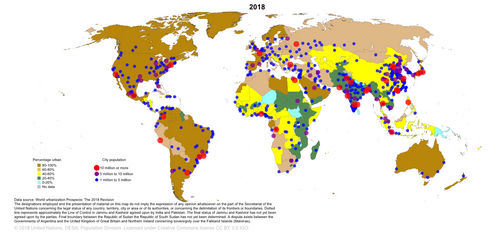
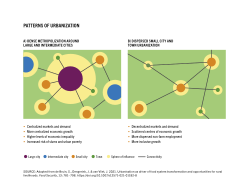
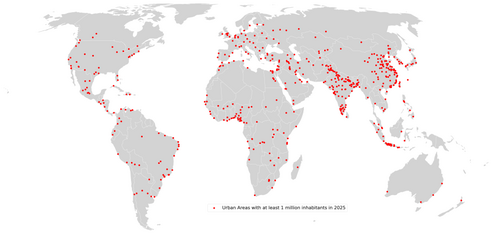
As we look toward the future, the scale of this movement is staggering. By 2050, it is predicted that approximately 64% of the developing world and 86% of the developed world will be urbanized. This growth is expected to add roughly 3 billion urban dwellers to the planet, with much of this expansion concentrated in Africa and Asia. In fact, the United Nations projects that nearly all global population growth between 2017 and 2030 will occur within cities, adding about 1.1 billion new urbanites in just a decade.
Key Facts
- Global Trend: By 2050, 86% of the developed world is expected to be urbanized.
- Growth Drivers: Most new urban population growth will occur in Africa and Asia.
- Historical Turning Point: The Industrial Revolution in the late 18th century triggered unprecedented urban growth.
- Environmental Impact: Between 1992 and 2015, urban areas more than doubled in size, consuming millions of hectares of cropland and forest.
- Current Leaders: South America is the most urbanized continent, with over 80% of its population living in cities.
The History of Human Settlement
The origins of urban centers can be traced back thousands of years. Archaeological mapping and data from Yale University, covering the period from 3700 BC to 2000 AD, illustrate the gradual spread and development of cities across the globe.
![A global map illustrating the first onset and spread of urban centres around the world, based on.[14]](/images/af/52/af52810460b025bd04284e68c2372e6b0718d93f32064f18ba0bfc7cdffd29cf.gif)
A major turning point occurred during the late 18th century with the onset of the British Agricultural Revolution and the Industrial Revolution. This era broke the traditional link between rural living and population stability, leading to massive migration to cities. In England and Wales, the proportion of people living in towns of more than 20,000 residents jumped from 17% in 1801 to 54% in 1891. During this same period, urbanization rates in other nations were lower, with France at 37%, Prussia at 41%, and the United States at 28%.
![Urbanization over the past 500 years[13]](/images/4f/25/4f255dadfa713a0ad702c052d02c046f324928e1dd08abab1069a6b8eb70b822.webp)
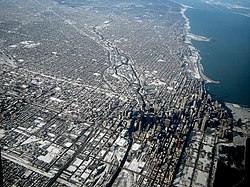
In the United States, early urban development often followed structured patterns, such as the grid system. An example of this can be seen in Chicago, Illinois, where the grid is strictly enforced even across uneven topography.
Environmental and Social Consequences
Rapid urban expansion brings significant challenges. Between 1992 and 2015, global urban areas grew from 33 million hectares (Mha) to 71 Mha. This expansion resulted in the consumption of 24 Mha of fertile cropland, 3.3 Mha of forestland, and 4.6 Mha of shrubland.
Environmental Pressures
The physical growth of cities contributes to several ecological issues, including:
- Urban Heat Island Effect: Cities often experience higher temperatures than surrounding rural areas.
- Habitat Fragmentation: The spread of urban infrastructure breaks up natural habitats, affecting wildlife.
- Resource Scarcity: Rapid growth can lead to shortages in drinking water and land.
- Water and Waste: Urbanization impacts water quality and increases the challenges of food waste management.
Health and Social Impacts
Living in densely populated environments affects human well-being in various ways. Research indicates that urbanization can influence nutrition, the spread of infections, and respiratory issues like asthma. Socially, the shift can impact mental health, physical activity levels, and crime rates. Furthermore, the movement of young adults from rural areas to cities—often seen in places like Iowa—can leave rural communities with an aging population.
![Population age comparison between rural Pocahontas County, Iowa and urban Johnson County, Iowa, illustrating the flight of young adults (red) to urban centres in Iowa.[22]](/images/b6/bd/b6bd9e0b0adb14dea83a95190ed3414be6447b9321688e98f1db9f500341b2d7.jpg)
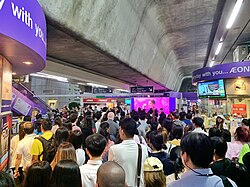
In many rapidly developing regions, the sheer density of people can lead to intense pressure on infrastructure, such as the crowded transit systems seen in cities like Bangkok.
Global Urbanization Patterns
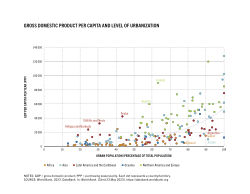
Urbanization is not uniform across the globe. As of 2022, many nations have achieved urbanization rates exceeding 80%, including the United States, Canada, Japan, Australia, and South Korea. South America stands out as the most urbanized continent.
| Region/Metric | Status/Projection |
|---|---|
| Developed World (by 2050) | 86% Urbanized |
| Developing World (by 2050) | 64% Urbanized |
| South America | Over 80% Urbanized |
| New Urbanites (2017–2030) | ~1.1 Billion |
Frequently Asked Questions
What is the difference between urbanization and population growth?
Population growth refers to the increase in the total number of people, while urbanization refers to the shift in the proportion of people living in urban areas compared to rural areas.
Which continents are most urbanized?
South America is currently the most urbanized continent, with more than 80% of its population living in urban areas.
How does urbanization affect the environment?
Urbanization can lead to the loss of fertile cropland and forests, habitat fragmentation for wildlife, increased water scarcity, and the creation of urban heat islands.
Where will most future urban growth occur?
Much of the predicted urban population growth through 2050 is expected to take place in Africa and Asia.
What are the potential risks of rapid urbanization?
Rapid growth can create artificial scarcities of essential resources, such as land, drinking water, and public spaces like playgrounds.