Urarina People of the Peruvian Amazon
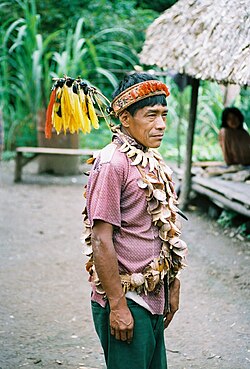
The Urarina are an indigenous people residing in the Loreto region of the Peruvian Amazon Basin. For centuries, they have inhabited the valleys of the Corrientes, Urituyacu, and Chambira Rivers. While known to ethnologists as the Urarina, they refer to themselves as Kachá, which literally translates to "person."
The term "Urarina" likely originates from the Quechua words uray (below) and runa (people), meaning "people from below" or "downstream people." Conversely, the local term Shimaku is considered pejorative by the Urarina, as it is a Quechua word meaning "unreliable."
Key Facts
- Population: Estimated at approximately 2,000 people.
- Location: Chambira Basin, northeastern Peru (Loreto).
- Language: Classified as a language isolate or unclassified.
- Economy: Semi-mobile hunting and horticultural society.
- Spiritual Practice: Animistic system centered on ayahuasca shamanism.
Society and Cultural Structure
Urarina society is organized around semi-mobile hunting and horticulture. Their settlements consist of multiple longhouse groups situated on restingas (high ground or embankments) to avoid the annual flooding of the tahuampa and bajiales (low-lying territories) that occurs between November and May.
Political life is fluid, characterized by a shifting balance of power between groups linked by marriage (affinal ties), episodic alliances, and exchange relations. Socially, the Urarina practice uxorilocal residence (where a couple lives with or near the wife's family), brideservice, sororal polygyny, and debt peonage.
Gender roles are distinct yet mutually respected. Men are valued for their shamanic abilities and hunting skills, while women are renowned for their expert craftsmanship, specifically in weaving net-bags, hammocks, and bast mats from palm fiber.
Cosmology and Mythology
The Urarina maintain an elaborate animistic cosmological system. This is heavily influenced by ayahuasca shamanism and the ritual use of Brugmansia suaveolens.
Their mythology includes various deluge stories. In one account, a man survived a great flood by climbing a cudí (amasiza) tree; during this event, his wife became a termite nest and his sons were transformed into birds. Another myth attributes a deluge to the daughter of the ayahuasca god, who urinated during a cassava-beer festival, creating the chthonic world of spirits.
Historical Memory and Trauma
Oral traditions also serve as a record of historical violence. The Urarina tell stories of forced-labor conscription, disease, rape, and abusive treatment by outsiders. While portions of the Bible were published in the Urarina language in 1973, a complete version has not been produced.
Language and Survival
The Urarina language is of significant interest to linguists, as Terrence Kaufman (1990) classified it as a language isolate—a language with no demonstrable genealogical relationship with other known languages. Documentation efforts were pioneered by SIL International and continued into the 21st century.
The community faces ongoing threats to its survival, including cultural appropriation, inadequate healthcare, and ecocide (the extensive destruction of their natural environment). They have historically resisted colonial and postcolonial violence, particularly during the regime of Alberto Fujimori.
Indigenous Rights and Mobilization
To protect their heritage and rights, the Urarina have engaged in political mobilization and intercultural education projects. Their commitment to human rights is further evidenced by the creation of an incomplete Urarina version of the Universal Declaration of Human Rights via the Coordinadora Nacional de Derechos Humanos.
Urarina Summary Table
| Category | Details |
|---|---|
| Self-Designation | Kachá ("person") |
| Primary Region | Chambira Basin, Loreto, Peru |
| Settlement Type | Longhouses on restingas (high ground) |
| Key Crafts | Palm-fiber weaving (mats, hammocks, bags) |
| Linguistic Status | Language Isolate / Unclassified |
Frequently Asked Questions
What does the name "Urarina" mean?
The name is likely derived from Quechua, where uray means "below" and runa means "people," translating to "people from below" or "downstream people."
How do the Urarina adapt to the Amazonian environment?
They build their longhouse settlements on restingas, which are high-ground embankments that remain flood-free during the rainy season from November to May.
What is the significance of the term "Shimaku"?
Shimaku is a local vernacular term from Quechua meaning "unreliable." The Urarina consider this term to be pejorative.
What are the primary spiritual practices of the Urarina?
Their spiritual life is based on an animistic system and ayahuasca shamanism, which includes the ritual consumption of the plant Brugmansia suaveolens.
Is the Urarina language related to other regional languages?
No, it is generally classified as a language isolate, meaning it has no known relationship to other languages in the region.