University of Bergen Faculties and Academic Structure
The University of Bergen is organized into several specialized faculties, each serving as a hub for advanced research and higher education. From the creative arts to the rigorous study of law and medicine, these faculties provide a comprehensive academic environment designed to foster innovation and critical thinking.
Key Facts
- Faculty of Law: One of only three institutions in Norway offering legal studies.
- Faculty of Psychology: The only faculty of its kind dedicated solely to psychology in the Nordic countries.
- Faculty of Fine Art, Music and Design: Established on January 1, 2017, merging the Grieg Academy and the Bergen Academy of Art and Design.
- Faculty of Mathematics and Natural Sciences: Hosts a diverse array of research-based innovation centres, including Climate Futures and Smart Ocean.
- Faculty of Law Capacity: Currently educates approximately 1,900 students.
Faculty of Humanities
The Faculty of Humanities focuses on the study of human culture, language, and thought. Following a structural revision in August 2007, the faculty manages a wide array of departments including Archeology, History, Cultural Studies and Religion (AHKR), and the Department of Foreign Languages, which offers courses in Arabic, English, French, Italian, Japanese, Russian, Spanish, German, and Chinese.
The faculty also houses the Department of Linguistics, Literary and Aesthetical studies (LLE)—covering fields such as Digital Culture and Art History—and the Department of Philosophy and First Semester Studies (FOF), which oversees Examen philosophicum and Examen facultatum (foundational philosophy examinations).
Research excellence is driven by two Norwegian Centres of Research Excellence: the Centre for Early Sapiens Behaviour (SapienCE) and the Center for Digital Narrative (CDN). Additionally, the faculty hosts the Centre for the Study of the Sciences and the Humanities and the Centre for Women and Gender Research.
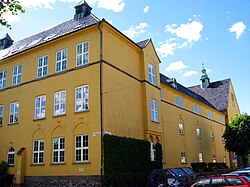
Faculty of Law
While legal research and studies have been part of the university since 1969, the Faculty of Law was formally established as a separate entity in 1980. It is one of three Norwegian institutions providing legal education, alongside the University of Oslo and the University of Tromsø.
The faculty provides a comprehensive academic path, offering a five-year Master's degree in law and a three-year PhD programme to support advanced legal scholarship.
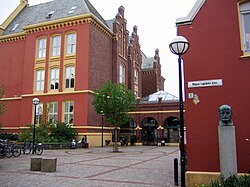
Faculty of Mathematics and Natural Sciences
As of January 1, 2023, this faculty is organized into seven primary departments: Biological Sciences, Chemistry, Earth Science, Informatics, Mathematics, Physics and Technology, and the Geophysical Institute. It also includes the Michael Sars Centre.
The faculty is deeply integrated with various specialized research units, including Centres of Excellence in Research (such as the Bergen Centre for Ethics and Priority Setting) and Centres of Research-based Innovation, including the Sea Lice Research Centre, Smart Ocean, and Climate Futures.
Other notable units include the Bjerknes Centre for Climate Research, the K.G. Jebsen Centre for Deep Sea Research, and the Norwegian Ocean Observation Laboratory.
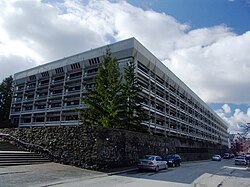
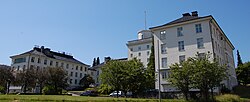
Faculty of Medicine
Organized since January 2013, the Faculty of Medicine is dedicated to clinical practice and biomedical research. It comprises the Department of Biomedicine, Department of Clinical Medicine, Department of Clinical Science, Department of Clinical Dentistry, and the Department of Global Public Health and Primary Care.
The faculty also operates the Centre for International Health and a dedicated Laboratory Animal Facility to support scientific advancement.
Faculty of Psychology
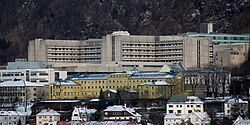
Established in 1980, the Faculty of Psychology is unique in the Nordic region for being the only institution where psychology is assigned its own independent faculty. In addition to educating psychologists, it is responsible for the university's pedagogic education.
The faculty is divided into several specialized departments: Psychosocial Science, Health Promotion and Development, Education, Clinical Psychology, and Biological and Medical Psychology. It also hosts the Centre for Crisis Psychology, SLATE (Centre for the Science of Learning & Technology), and the Norwegian Competence Center for Gambling and Gaming Research.
Faculty of Social Sciences
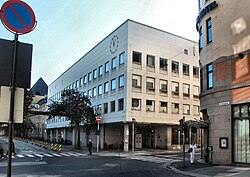
The Faculty of Social Sciences examines the structures and dynamics of society through various lenses. Its departments include Administration and Organization Theory, Comparative Politics, Economics, Geography, Information Science and Media Studies, Social Anthropology, and Sociology.
The faculty further expands its reach through the Centre for Development Studies, the Centre for Gender Studies, and the Centre for Middle Eastern and Islamic Studies.
Academic Summary
| Faculty | Key Focus Areas | Notable Units/Centres |
|---|---|---|
| Fine Art, Music and Design | Contemporary Art, Music, Design | Grieg Academy, Bergen Academy of Art and Design |
| Humanities | Culture, Language, Philosophy | SapienCE, Center for Digital Narrative |
| Law | Legal Studies and Research | Master's and PhD programmes |
| Mathematics and Natural Sciences | STEM, Climate, Marine Biology | Bjerknes Centre, BioCEED |
| Medicine | Clinical Medicine, Public Health | Centre for International Health |
| Psychology | Psychological Science, Pedagogy | SLATE, Centre for Crisis Psychology |
| Social Sciences | Politics, Economics, Sociology | Centre for Development Studies |
Frequently Asked Questions
Which faculty handles the university's pedagogic education?
The Faculty of Psychology is responsible for the university's pedagogic education.
How many institutions in Norway offer legal studies?
There are three institutions in Norway that offer legal studies: the University of Bergen, the University of Oslo, and the University of Tromsø.
When was the Faculty of Fine Art, Music and Design established?
The Faculty of Fine Art, Music and Design was established on January 1, 2017.
What are the two Norwegian Centres of Research Excellence in the Faculty of Humanities?
The two centres are the Centre for Early Sapiens Behaviour (SapienCE) and the Center for Digital Narrative (CDN).
What is the student population of the Faculty of Law?
The Faculty of Law currently has approximately 1,900 students.