United States Statutes at Large: A History of Official Legal Publication
The United States Statutes at Large serves as the official permanent record of the laws of the United States. Unlike temporary codes, this collection provides a chronological account of every act of Congress and other official documents essential to the governance of the nation.
The Evolution of Publication
The publication of the Statutes at Large began in 1845. Initially, the task was handled by a private firm, Little, Brown and Company, acting under the authority of a joint resolution of Congress. During this private era, the series was shaped by three primary editors: Richard Peters (Volumes 1–8), George Minot (Volumes 9–11), and George P. Sanger (Volumes 11–17).
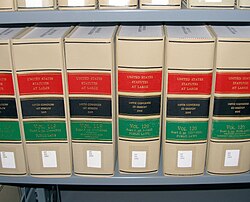
As the need for standardized government records grew, Congress transferred the publishing authority in 1874 to the Government Printing Office (GPO), operating under the direction of the Secretary of State.
Administrative Shifts in the 20th Century
The mid-20th century saw further refinements in how these laws were compiled. On July 30, 1947, Pub. L. 80–278 (61 Stat. 633) mandated that the Secretary of State compile, edit, index, and publish the collection. This responsibility shifted on September 23, 1950, via Pub. L. 81–821 (64 Stat. 980), which transferred the duty to the administrator of general services.
Since 1985, the preparation and publication of the Statutes at Large have been managed by the Office of the Federal Register (OFR), a component of the National Archives and Records Administration (NARA).
Scope and Contents
The Statutes at Large is more than just a list of laws; it is a comprehensive archive of American foundational documents. It includes the text of the Declaration of Independence, the Articles of Confederation, the Constitution, and all subsequent amendments to the Constitution.
Additionally, the collection contains presidential proclamations and treaties with both foreign nations and Native American nations. It is important to note a change in scope that occurred in 1948: prior to that year, all treaties and international agreements approved by the U.S. Senate were included. After 1948, these documents were moved to a separate publication titled United States Treaties and Other International Agreements (U.S.T).
Handling Large-Scale Legislation
Due to the sheer size of certain legislative acts, some are too voluminous for standard volumes. In such cases, they are published as separate "appendix" volumes. A notable example is the Internal Revenue Code of 1954, which was published as volume 68A (68A Stat. 3).
Key Facts
- Start Date: Publication began in 1845.
- Original Publisher: Little, Brown and Company.
- Current Authority: Office of the Federal Register (OFR) under NARA since 1985.
- Key Documents: Includes the Constitution, Declaration of Independence, and Articles of Confederation.
- Treaty Shift: Senate-approved treaties moved to U.S.T. after 1948.
- Special Volumes: Large acts (e.g., Internal Revenue Code of 1954) are published as appendix volumes.
| Period | Responsible Entity | Authority/Note |
|---|---|---|
| 1845–1874 | Little, Brown and Company | Joint resolution of Congress |
| 1874–1950 | Government Printing Office | Directed by Secretary of State |
| 1950–1985 | Administrator of General Services | Pub. L. 81–821 |
| 1985–Present | Office of the Federal Register (OFR) | Part of NARA |
Frequently Asked Questions
Who currently publishes the United States Statutes at Large?
Since 1985, the Statutes at Large have been prepared and published by the Office of the Federal Register (OFR), which is part of the National Archives and Records Administration (NARA).
Are all U.S. treaties found in the Statutes at Large?
Only treaties approved by the Senate prior to 1948 are included. Treaties and international agreements approved after 1948 are published in the United States Treaties and Other International Agreements (U.S.T).
What foundational documents are included in this collection?
The collection includes the Constitution, amendments to the Constitution, the Declaration of Independence, and the Articles of Confederation.
What happens when a law is too long for a standard volume?
Very large acts of Congress are published in their own "appendix" volumes. For instance, the Internal Revenue Code of 1954 was assigned volume 68A.
Who were the first editors of the Statutes at Large?
The early volumes were edited by Richard Peters (Volumes 1–8), George Minot (Volumes 9–11), and George P. Sanger (Volumes 11–17).