United States License Plates: Designs, Mounting Laws, and Federal Standards
Vehicle license plates serve as more than just identification for motor vehicles; they are a complex intersection of state law, federal regulation, and personal expression. Across the United States, the physical appearance, mounting requirements, and even the legal penalties associated with these plates vary significantly from one jurisdiction to another.
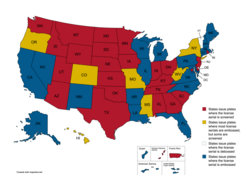
Standardized in size at approximately 12 in × 6 in (300 mm × 150 mm), these plates utilize various serial formats and printing methods. While the registration number format is not standardized nationwide, the methods used to produce them—ranging from embossed (raised) to debossed (recessed) or screened lettering—provide a diverse visual landscape.
Key Facts

- Standard Size: Most US plates measure 12 inches by 6 inches.
- Mounting Variations: Requirements range from rear-only to mandatory front and rear displays.
- Registration Stickers: In Michigan, Minnesota, and Washington, these are commonly referred to as "tabs."
- Federal Coding: US government vehicles use specific letter prefixes to identify their respective departments.
- Specialty Options: States offer vanity and specialty plates for professional, organizational, or personal interests.
License Plate Mounting and State Regulations

One of the most significant differences between states is the requirement for front and rear mounting. While some states require plates on both ends of the vehicle, others mandate only a rear plate.
States Requiring Front and Rear Plates
Several states maintain strict requirements for both front and rear plates. These include Idaho, Massachusetts, Missouri, Montana, Nebraska, Nevada, Rhode Island, and South Dakota.
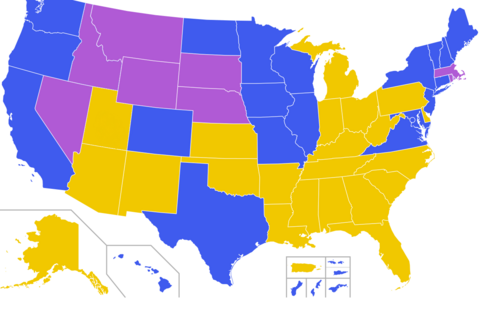
However, recent legislative shifts have introduced nuances to these rules. For instance, in Idaho, a law effective July 1, 2025, stipulates that front plates are only required if the vehicle is equipped with a mounting bracket. Similarly, Nebraska is set to remove the front plate requirement starting January 1, 2029, coinciding with its new five-year plate cycle.
Exceptions and Unique State Laws
Certain states provide specific exemptions or unique rules regarding plate display:
- Nevada: Most passenger vehicles are issued two plates, but displaying the front plate is optional if the vehicle lacks a manufacturer-supplied bracket.
- Wyoming and Montana: Both states have amended laws to exempt vehicles that were not designed for front plates or lack mounting hardware, though Montana requires approval from the Highway Patrol.
- Massachusetts: Motorists must display all plates issued to them. While the state previously issued single green-on-white plates, the current "Spirit of America" base requires two plates for front and rear mounting.
- South Dakota: Drivers may opt for a single rear plate for a $25 fee if the vehicle is driven fewer than 7,500 miles annually.

Specialty, Vanity, and Professional Plates
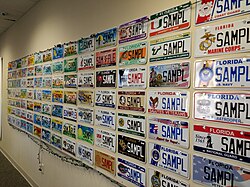
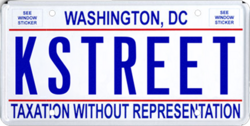
Beyond standard registration, many states offer specialty plates, which allow drivers to support specific causes or display affiliations. Vanity plates allow for personalized alphanumeric combinations, though these are often subject to state-specific restrictions and legal scrutiny.
Government and Departmental Identification
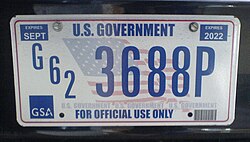
Federal and state government vehicles utilize distinct coding systems to identify their origin. Federal license plate codes are prefixed based on the specific agency. For example, the Department of Agriculture uses "A," the Department of Defense uses "D," and the Department of Transportation uses "DOT."
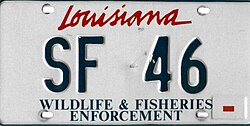
This system ensures that even in high-traffic environments, the authority of a vehicle can be quickly identified. Below is a summary of common federal prefixes:
| Federal Entity | Plate Code |
|---|---|
| Department of Agriculture | A |
| Department of Commerce | C |
| Department of Defense | D |
| Department of Energy | E |
| Department of Justice | J |
| Department of the Navy | N |
| Department of State | S |
| Department of the Treasury | T |
Diplomatic and Specialty Examples
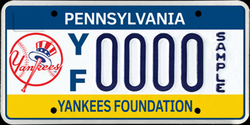
Diplomatic vehicles utilize specialized plates to denote international status. These have evolved in style over the years, with significant design changes occurring around 2007. Additionally, states issue plates for specific organizations, such as the New York Yankees specialty plate in Pennsylvania or various professional and commemorative designs.
Frequently Asked Questions
What is the standard size for a US license plate?
The standard size for most license plates in the United States is 12 inches by 6 inches (300 mm by 150 mm).
Do all states require a front license plate?
No. Requirements vary by state. Some states require both front and rear plates, while others only require a rear plate. Some states, like Idaho and Nevada, provide exemptions if the vehicle lacks a mounting bracket.
What are "tabs" on a license plate?
In states like Michigan, Minnesota, and Washington, registration stickers used to show current registration are commonly referred to as "tabs."
How are federal government plates identified?
Federal government vehicles use specific letter prefixes that correspond to their agency, such as "D" for the Department of Defense or "DOT" for the Department of Transportation.
Can I get a personalized license plate?
Yes, these are known as vanity plates. Most states allow motorists to request custom alphanumeric combinations, subject to state regulations and availability.