United Kingdom Football Terraces: History, Safety, and Evolution
For decades, the atmosphere of British sport was defined by the terrace—the tiered standing areas where passionate fans gathered to cheer on their teams. From humble earth banks to massive concrete structures, terraces were more than just architecture; they were the heart of working-class sporting culture. While they provided an unmatched energy, their history is also marked by tragedy and a gradual transition toward modern safety standards.
The Early Evolution of Standing Areas
In the early twentieth century, terraces were rudimentary. They typically consisted of earth banks, often constructed from rubble found at building sites. To provide a stable surface for spectators, rows of railway sleepers were laid across the soil.
The shift toward more permanent structures was accelerated by tragedy. Following the 1902 Ibrox disaster, where a wooden stand collapsed during a Scotland versus England match, the government banned framework-supported terraces. This mandate forced stadiums to adopt solid earthwork-supported terracing for better stability.
Over time, earth and sleepers were replaced by concrete. To manage the flow of crowds and prevent surges, metal crush barriers—sturdy railings designed to break up the pressure of a crowd—were installed. A remnant of this era can still be seen at Cathkin Park in Glasgow, the abandoned home of Queen's Park F.C.
The Cultural Phenomenon of the Kop
Between the 1920s and 1980s, terraces became deeply embedded in English culture. Because of their strong links to the working class, fans gave these areas affectionate nicknames. The most iconic of these was the Spion Kop, named after a hill from the 1902 Battle of Spion Kop during the Boer War in South Africa.
Arsenal F.C. was the first to use the name, but the most famous "Kop" was located at Liverpool F.C.'s Anfield Road ground. The term became so synonymous with the most popular end of a stadium that many clubs referred to their standing areas as the Kop, even if they had official names, such as the Holte End at Aston Villa F.C.'s Villa Park. A notable exception is Everton F.C., whose fierce rivalry with Liverpool meant they refused to use the term.
From a business perspective, terracing was highly efficient. Clubs could pack significantly more fans into a smaller area compared to seating, which explains why many all-time attendance records were set during the 1930s and 1940s.
Safety Challenges and the Shift to All-Seater Stadiums
While generally viewed as an enjoyable way to watch sport, terraces had inherent risks. Early railway sleepers were slippery when wet, leading to falls. More seriously, overcrowding could lead to fatal crushes, such as the 1946 disaster at Bolton Wanderers F.C.'s Burnden Park, where 33 people died.
Despite the risks, the experience was prized for its affordability and the thunderous noise generated in covered Goal Stands, such as those at Anfield, Villa Park, and Molineux.
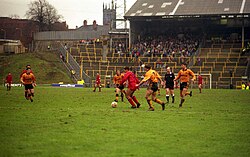
By the 1970s, cheaper travel led to an increase in "away days." Some visiting fans attempted to "take the terrace" by infiltrating the home supporters' sections, often resulting in violence. This led to crowd segregation and the installation of high perimeter fencing and segregated pens.
These pens contributed to the Hillsborough disaster in Sheffield, the worst stadium tragedy in England's history. 97 Liverpool fans were crushed to death against a perimeter fence after too many people entered the central pens. In response, the Taylor Report recommended that major British stadiums be converted to all-seater venues.
Terracing in the Modern Era
Today, all major British football grounds are all-seater. However, terracing persists in lower leagues and in rugby. Notable examples include the "Shed" at Gloucester's Kingsholm and the South Stand at Leeds Rhinos' Headingley Stadium.
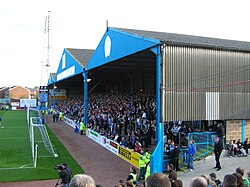
Currently, Brunton Park in Carlisle remains the largest terraced ground in Britain, retaining three sides of standing areas.
Crowd Disorder and Statistics
There is a common belief that standing terraces encourage disorder. However, UK Home Office data suggests otherwise. In the 2008–09 and 2009–10 seasons, the arrest rate per 100,000 supporters was actually higher at all-seated Football League One and Two clubs than at those with terraces. While overall arrest rates dropped from 34 per 100,000 in 1988–89 to 9 per 100,000 in 2009–10, this decline began before the mandatory shift to all-seater stadiums.
The Return of Safe Standing
In recent years, there has been a push to reintroduce safe standing—modern standing areas designed with integrated safety barriers. The Scottish Premier League permitted this in 2011. In 2012, Derby County became the first Championship club to support the move. Peterborough United also backed the campaign, with CEO Bob Symns signing a petition and the club's mascot, Peter Burrow, appearing in a promotional video filmed at the AWD-Arena in Germany.
Key Facts
- The Kop: Named after a Boer War battle; popularized by Arsenal and Liverpool F.C.
- Safety Shift: The 1902 Ibrox disaster led to a ban on framework-supported terraces in favor of earthworks.
- Hillsborough: The 1989 disaster led to the Taylor Report and the mandate for all-seater major stadiums.
- Current Status: Brunton Park is Britain's largest remaining terraced football ground.
- Crime Trends: Home Office data indicates that all-seater grounds in lower leagues have seen higher arrest rates than terraced ones in certain periods.
| Era | Primary Material | Key Safety Feature/Issue | Cultural Characteristic |
|---|---|---|---|
| Early 1900s | Earth & Railway Sleepers | Slippery surfaces; framework collapses | Basic construction |
| Mid 20th Century | Concrete | Crush barriers; overcrowding | Rise of the "Kop" culture |
| 1970s - 1980s | Concrete & Steel | Segregated pens; perimeter fencing | Crowd segregation; "Away days" |
| Modern Era | All-Seater / Safe Standing | Individual seating; integrated barriers | Regulated safety standards |
Frequently Asked Questions
What is a "Kop" in a football stadium?
A Kop is a popular standing terrace, typically located at one end of the stadium. The name originates from the Battle of Spion Kop in the Boer War and was first adopted by Arsenal F.C. before becoming world-famous at Liverpool's Anfield.
Why did British stadiums move to all-seater models?
The transition was primarily driven by the Taylor Report following the Hillsborough disaster in 1989, where 97 fans died. The report recommended removing terraces at major stadiums to improve safety and prevent crushes.
Do terraces actually cause more crowd violence?
Not necessarily. UK Home Office statistics from 2008–2010 showed that arrest rates per 100,000 supporters were higher at some all-seater lower-league clubs than at those that still had terraces.
What is "safe standing"?
Safe standing refers to modern standing areas that incorporate safety barriers to prevent crowds from surging forward, combining the atmosphere of traditional terracing with modern safety engineering.
Which is the largest remaining terraced ground in Britain?
Brunton Park, the home of Carlisle United F.C., is currently the largest remaining terraced ground, featuring three sides of standing areas.