All-Seater Stadiums: Evolution, Safety, and Global Trends
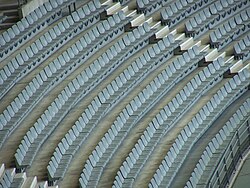
An all-seater stadium is a sports venue where every single spectator is provided with an individual seat. While this configuration is now the standard for professional association football in the United Kingdom, Spain, and the Netherlands, it represents a significant shift from the historical reliance on standing areas. In contrast, stadiums that are not all-seaters include designated areas for attendees with standing-room only tickets.
In British terminology, these standing areas are known as terraces. Historically, terraces dominated football attendance in the UK. For example, the South Bank Stand at Molineux Stadium (home of Wolverhampton Wanderers) once accommodated 32,000 standing spectators, contributing to a total stadium capacity of approximately 59,000.
Key Facts
- Definition: A stadium where every spectator has a designated seat, eliminating standing-room terraces.
- UK Mandate: All-seater stadiums became compulsory for the English Premiership starting in the 1994–95 season.
- Safety Driver: The Taylor Report, following the 1989 Hillsborough disaster, was the primary catalyst for seating mandates in England.
- Global Governance: FIFA, UEFA, and CONCACAF require all-seater configurations for competitions they control.
- Regional Variations: Germany maintains standing areas for affordability and fan choreography, while North American venues often use bleachers.
The Transition in the United Kingdom
The move toward all-seater venues in the UK happened in stages. Meadowbank Stadium was the first all-seated football ground in the UK (1974–1995). Aberdeen's Pittodrie later became the country's first all-seated and all-covered ground after a reconstruction in 1978. In 1981, Coventry City's Highfield Road became the first in England to convert to all-seating, though the move was unpopular and terracing was partially reinstated by 1985.
Safety concerns accelerated the transition. Luton Town converted Kenilworth Road to all-seater status following a 1985 riot. Following the 1989 Hillsborough stadium disaster, the landscape changed permanently. St Johnstone opened McDiarmid Park in August 1989 as the first purpose-built all-seater stadium in the UK, and Ipswich Town's Portman Road became the first professional English club to convert in 1992.
The Taylor Report and Legal Mandates
The Taylor Report (the Hillsborough Stadium Disaster Inquiry report) recommended strict safety improvements. By the 1994–95 season, all-seater stadiums were mandatory for the English Premiership. While lower-tier clubs initially had more time to comply, the trend led to the demolition of world-famous terraces, including Manchester United's Stretford End, Arsenal's North Bank, Liverpool's Spion Kop, and Aston Villa's Holte End.
Global Perspectives on Stadium Seating
Different regions approach spectator capacity based on culture, cost, and regulation. In Germany, standing places are often more affordable. At Borussia Dortmund's Signal Iduna Park, the all-seated capacity is 65,829, but the limit for Bundesliga games is 81,360. This suggests that roughly 15,000 seats are replaced by 30,000 standing fans, following the guideline that two standing people occupy the space of one seated person.
North American and Oceanic Trends
In the United States and Canada, the term "all-seater" is less common because standing-room terraces are rare. Instead, many venues use bleachers—tiered, uncovered flat benches often called "cheap seats," such as the "Rock Pile" at Coors Field. Some NFL teams, like the Washington Commanders and Dallas Cowboys, sell specific standing-room tickets for endzone terraces. Future plans for the Buffalo Bills stadium include a 5,000-person standing terrace to manage capacity.
In Australia, New Zealand, and South Africa, many cricket stadiums (such as the Adelaide Oval and Basin Reserve) feature grass banks where spectators can sit on the lawn for a lower entry fee.
International Regulations and Hybrid Solutions
Because FIFA, UEFA, and CONCACAF mandate all-seater stadiums for their events, venues with terraces must either close those sections or install temporary seating. A modern trend in Europe is the use of convertible seats, which allow a stadium to switch between standing for domestic league games and seating for international fixtures.
| Seating Type | Description | Common Regions/Examples |
|---|---|---|
| All-Seater | Every spectator has an individual seat | English Premiership, Spain, Netherlands |
| Terraces | Standing-room only areas | Germany (Bundesliga), Historic UK |
| Bleachers | Tiered flat benches, usually uncovered | USA (MLB, NFL, College Football) |
| Grass Banks | Sloped lawns for sitting | Australia, New Zealand, South Africa |
| Convertible | Seats that can be flipped for standing | Modern European Stadiums |
Frequently Asked Questions
Why did the UK move to all-seater stadiums?
The transition was primarily driven by safety concerns following the 1989 Hillsborough disaster. The resulting Taylor Report recommended the removal of standing terraces to prevent overcrowding and improve spectator safety.
Do all professional stadiums worldwide require seats?
No. While international governing bodies like FIFA and UEFA require all-seater venues for their competitions, some domestic leagues (like the Bundesliga in Germany) still allow standing areas for affordability and fan culture.
What are "bleachers" in North American stadiums?
Bleachers are tiered seating areas consisting of flat benches rather than individual chairs. They are typically uncovered and located in less expensive sections of the stadium.
What is a convertible seat?
Convertible seats are specialized seating units that can be easily changed from a seated configuration to a standing rail, allowing stadiums to meet different regulatory requirements for domestic and international matches.
Which was the first purpose-built all-seater stadium in the UK?
McDiarmid Park, opened by St Johnstone in August 1989, was the first purpose-built all-seater football stadium in the United Kingdom.