Unit Circular Disk: Statistical Distributions and Average Distances
In the field of statistics, a uniform distribution on a unit circular disk is a specialized model used to represent points spread evenly across a circle with a radius of one. This mathematical framework is particularly valuable in operations research and urban planning, where it can effectively model the distribution of a population within a city. Additionally, this distribution is favored because it simplifies the computation of probabilities for sets of linear inequalities, avoiding the need for numerical quadrature required by Gaussian distributions in a plane.
One of the primary interests in this distribution is the calculation of the mean Euclidean distance—the straight-line distance—between points. For two random points within the disk, the mean distance is approximately 0.90541 (exactly 128/45π). When considering the mean squared distance, the value is exactly 1.
Key Facts
- Mean Distance: The average distance between two random points in a unit disk is 128/45π (≈ 0.90541).
- Mean Squared Distance: The average squared distance between two random points is 1.
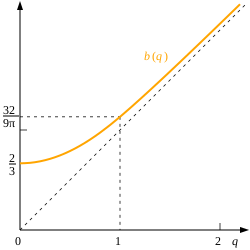
- Internal Point Distance: The average distance from the center (q=0) to all points in the disk is 2/3.
- Boundary Distance: The average distance from a point on the edge (q=1) to all points in the disk is 32/9π (≈ 1.13177).
- Mathematical Tools: Calculations for arbitrary points rely on complete elliptic integrals of the first (K) and second (E) kinds.
Calculating Distance to an Arbitrary Location
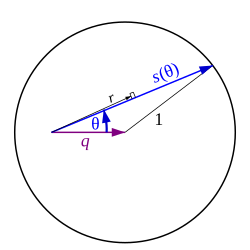
When analyzing the average distance b(q) from a fixed location to all points in the distribution, the result depends on the distance q of that location from the center of the disk. While the average squared distance is straightforwardly computed as q + 1/2, the average distance b(q) requires more complex integration using polar coordinates and the Law of cosines.
Average Distance to an Internal Point
For a location inside the disk (where q < 1), the average distance is determined by integrating the distance over the disk's area. This calculation results in a formula involving complete elliptic integrals:
b(q) = 4/9π { 4(q² − 1)K(q²) + (q² + 7)E(q²) }
At the center of the disk (q = 0), the average distance is 2/3. As the point moves to the boundary (q = 1), the distance increases to approximately 1.13177.
Average Distance to an External Point
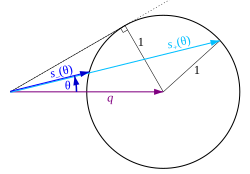
For a location outside the disk (where q > 1), the integration process is similar but accounts for the fact that the point is external. The resulting formula is:
b(q) = 4/9π { q(q² + 7)E(1/q²) − (q² − 1)/q (q² + 3)K(1/q²) }
As the external point moves infinitely far away (as q approaches infinity), the average distance behaves according to the limit q + 1/8q.
Summary of Distance Metrics
| Scenario | Metric | Value / Formula |
|---|---|---|
| Two random points | Mean Distance | 128/45π (≈ 0.90541) |
| Two random points | Mean Squared Distance | 1 |
| Center point (q=0) | Average Distance | 2/3 |
| Boundary point (q=1) | Average Distance | 32/9π (≈ 1.13177) |
| Arbitrary point | Average Squared Distance | q + 1/2 |
Frequently Asked Questions
What is a uniform distribution on a unit circular disk?
It is a statistical distribution where every point within a circle of radius one has an equal probability of being selected.
Why is this distribution used in urban planning?
It provides a mathematical way to model the distribution of a population within a circular city boundary for operations research purposes.
What are complete elliptic integrals?
These are special mathematical functions (denoted as K and E) used to solve integrals that cannot be expressed using elementary functions, such as those found when calculating average distances in a disk.
How does the average distance change as a point moves outside the disk?
As the distance q from the center increases beyond 1, the average distance b(q) increases, eventually approximating the value q + 1/8q as the point moves toward infinity.