Union Chapel Brighton: A History of Faith and Transformation
Brighton's evolution from a modest 12th-century fishing village to a fashionable Regency resort is mirrored in the architectural and spiritual history of the Union Chapel. Located in the heart of the old village, this site has served as a sanctuary for diverse religious communities for over three centuries before transitioning into a secular space.
The Rise of Nonconformity in Early Brighton
In the early days of the settlement, St Nicholas' Church was the sole place of worship, as the Church of England was the only legally recognized denomination. During the 17th century, strict laws such as the Conventicle Act 1664 prohibited non-Anglican Christians from meeting for worship. Despite these restrictions, a resilient Nonconformist community grew in Brighton.
By 1660, this community was established enough to found a school. A 1676 religious census recorded 260 Nonconformists, representing approximately 8% of the village's 3,340 residents. As legal pressures eased, a chapel was constructed for Presbyterians. While historical sources debate the exact date—citing 1683, 1688, or 1698—a foundation stone in the south wall suggests a late 17th-century origin.
The Evolution of the Union Chapel
The chapel's identity shifted under the leadership of Reverend John Duke (1698–1745), the first permanent minister. Duke opened the doors to Independent Christian ministers, leading the congregation to adopt the name Union Chapel to symbolize the merging of different denominations. The surrounding street was subsequently named Union Street in honor of the building.
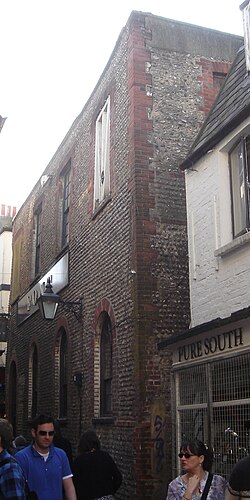
Around 1800, a residence for the minister was added, and the yard behind the chapel became a burial ground. A decade later, the building was extended. The east wall features a traditional Sussex style, utilizing flints, cobbled stones, and red-brick dressings.
Regency Redesign and Architectural Debate
As Brighton transformed into a premier seaside destination in the late 18th century—driven by royal patronage and Dr. Richard Russell's promotion of seawater cures—the demand for Regency style architecture surged. In 1825, the Union Chapel underwent a complete redesign in a Classical style, incorporating Greek and Egyptian Revival elements.
The authorship of this redesign has been a subject of historical debate. While many attributed the work to Amon Wilds, 1992 research by English Heritage suggests that Charles Busby created the design in 1825 while in partnership with Amon Henry Wilds. Following the dissolution of their partnership later that year, Amon Henry Wilds took responsibility for the project.
From Congregationalism to the Miners' Mission
By 1838, the chapel was used exclusively by Independent Christians under the long tenure of Reverend John Nelson Goulty. The chapel continued to be a center for preaching, hosting figures such as the poet and hymn writer Reverend George Wade Robinson in the 1870s. After a period of stagnation, Reverend Reginald Campbell reinvigorated the chapel in the late 19th century.
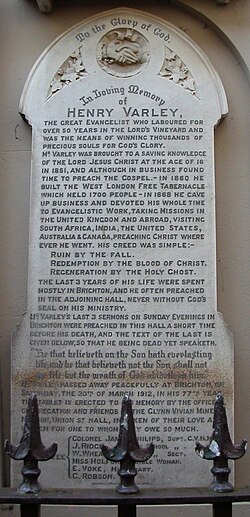
In approximately 1898, the chapel merged with the Queen Square Congregational Church, becoming the Union Church. However, by 1905, the congregation moved permanently to the larger Queen Square site. The building was then purchased by Glynn Vivian, a Welsh industrialist who had converted to Evangelical Christianity after losing his sight in Brighton. He established the Glynn Vivian Miners' Mission to support the spiritual and working lives of miners.
The Final Transition to Secular Use
The mission operated until the late 1920s or early 1930s, when the Elim Pentecostal Church acquired the property. Renamed the Elim Free Church (or Elim Tabernacle of the Four Square Gospel), the building underwent internal alterations that removed most of the 1825 interior fittings. In September 1988, the Elim congregation departed, ending 300 years of continuous religious use.
The building was subsequently purchased by the Firkin Brewery and converted into a pub and microbrewery known as the "Font & Firkin."
Key Facts
- Founded: Late 17th century (dates cited as 1683, 1688, or 1698).
- Original Denomination: Presbyterian, later becoming a union of Presbyterians and Independents.
- Architectural Style: Redesigned in 1825 with Classical, Greek Revival, and Egyptian Revival elements.
- Key Architects: Attributed to Charles Busby and Amon Henry Wilds.
- Later Uses: Evangelical mission hall (Glynn Vivian Miners' Mission), Elim Pentecostal Church, and finally a pub (Font & Firkin).
| Period | Entity/Use | Key Feature/Event |
|---|---|---|
| Late 17th C. - 1838 | Presbyterians & Independents | Founded as a Nonconformist place of worship |
| 1838 - 1898 | Independent Christians | Sole use by Independents; 1825 Classical redesign |
| 1898 - 1905 | Union Church | Merger with Queen Square Congregational Church |
| 1905 - c.1931 | Glynn Vivian Miners' Mission | Evangelical mission for British miners |
| c.1931 - 1988 | Elim Pentecostal Church | Known as the Elim Tabernacle |
| 1988 - Present | Firkin Brewery | Converted to "Font & Firkin" pub and microbrewery |
Frequently Asked Questions
Why was it called the Union Chapel?
The name was adopted during the ministry of Reverend John Duke (1698–1745) because he allowed both Presbyterian and Independent Christian ministers to hold services there, symbolizing the union of the two denominations.
Who was responsible for the 1825 redesign?
While historically attributed to Amon Wilds, English Heritage research suggests the design was created by Charles Busby in partnership with Amon Henry Wilds.
What was the Glynn Vivian Miners' Mission?
It was an Evangelical mission sponsored by Welsh industrialist Glynn Vivian, who sought to improve the spiritual and working conditions of miners after his own conversion to Christianity in Brighton.
What happened to the original 1825 interior?
Most of the interior fittings from the 1825 reconstruction were removed during internal alterations made by the Elim Pentecostal Church after they acquired the building in the early 20th century.
Is the building still used for religious purposes?
No. Religious worship on the site ended in September 1988 when the Elim congregation left and the building was sold to the Firkin Brewery for use as a pub.