Ultramarine Flycatcher
The Ultramarine Flycatcher (Ficedula superciliaris), also known as the white-browed blue flycatcher, is a small, striking arboreal bird belonging to the Old World flycatcher family, Muscicapidae. Known for its deep blue plumage and agile nature, this species is a characteristic sight in the high-altitude forests of Asia, migrating between its breeding grounds in the mountains and its wintering sites in the plains.
These birds are primarily found from eastern Afghanistan through the Hengduan Mountains during the breeding season, later moving south to winter in India and northwestern Indochina.
Key Facts
- Scientific Name: Ficedula superciliaris
- Conservation Status: Least Concern (IUCN 3.1)
- Size: Approximately 10 cm (slightly smaller than a sparrow)
- Primary Diet: Insects
- Breeding Range: Eastern Afghanistan to the Hengduan Mountains
- Wintering Range: Central India, northern Maharashtra, Goa, Andhra Pradesh, and Odisha
Physical Description and Variations
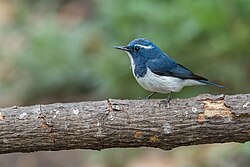
The Ultramarine Flycatcher possesses a stocky build and is slightly smaller than a common sparrow. The male is distinguished by deep blue feathers on its upperparts, head, and neck, contrasted by a prominent white patch that extends from the center of the throat through the breast to the belly.
One of the most interesting aspects of this species is its clinal variation—a gradual change in physical traits across a geographic area. Depending on their location along the Himalayan foothills, three distinct populations are often recognized:
- Western Subspecies: Found in the western Himalayas, featuring a distinct white supercilium (the stripe of feathers above the eye) and white bases on the outer tail feathers.
- Eastern Subspecies (F. s. aestigma): Located in the eastern Himalayas, these birds lack the distinct white patches.
- South Assam Population: Found in the south Assam hills, these birds completely lack a supercilium.
Habitat and Distribution
During the summer, the Ultramarine Flycatcher is a common breeding visitor to the western Himalayas, spanning from Jammu and Kashmir and Himachal Pradesh to Uttarakhand. In Nepal, the western race intergrades with the eastern race, which continues through Bhutan to Arunachal Pradesh. They typically breed at altitudes between 2,000 and 2,700 meters, though they have been recorded as low as 1,800 meters and as high as 3,200 meters.
Their preferred habitat consists of open, mixed forests featuring oak, rhododendron, pine, and fir, though they occasionally visit orchards. In winter, they migrate to central India, ranging from Delhi south to northern Maharashtra and Goa, and east toward Andhra Pradesh and Odisha. They are also occasionally spotted as vagrants in northern Bangladesh.
Behavior and Foraging
The Ultramarine Flycatcher is typically solitary, although it may join mixed hunting parties during the winter. It prefers the safety of low trees and bushes, foraging within the foliage canopy rather than venturing into open spaces. A characteristic behavior is the constant jerking of its tail, often accompanied by the fluffing of head feathers and a distinct "trrr" note, particularly when near its nest.
When foraging for insects, these birds exhibit a specific risk-management strategy, responding more to indirect cues than direct cues when assessing potential threats in their environment.
Nesting and Reproduction
The breeding season occurs from mid-April to early July. The flycatcher constructs a soft nest made of fine moss, strips of bark, and fine grass, which is then lined with rootlets and hair. These nests are typically placed in tree clefts or holes up to seven meters high, or occasionally in depressions on steep banks. In hill station gardens, they are known to readily use nest boxes.
A typical clutch consists of 3 to 5 eggs (usually 4). The eggs are olive-greenish to dull stone-buff and are densely freckled with reddish-brown spots, which may either cover the entire egg or form a "cap" around the large end. The average egg size is 16x12.2 mm.
| Feature | Details |
|---|---|
| Average Length | ~10 cm |
| Breeding Altitude | 1,800m to 3,200m |
| Clutch Size | 3–5 eggs |
| Diet | Insectivorous |
| IUCN Status | Least Concern |
Frequently Asked Questions
What is the difference between the western and eastern subspecies?
The western subspecies is characterized by a distinct white stripe above the eye (supercilium) and white bases on the outer tail feathers, whereas the eastern subspecies (F. s. aestigma) lacks these distinct white patches.
Where can the Ultramarine Flycatcher be found in winter?
During the winter, they are found in central India, ranging from Delhi south to northern Maharashtra and Goa, and eastward to Andhra Pradesh and Odisha.
What do Ultramarine Flycatchers eat?
Their diet consists mainly of insects, which they hunt while staying largely within the foliage canopy of low trees and bushes.
What are the nesting habits of this species?
They build nests from moss, bark, and grass lined with hair and rootlets. These are usually placed in tree holes or steep bank depressions, though they also frequently use man-made nest boxes in gardens.
How do they behave when they are near their nest?
When near the nest, they often jerk their tails upward and fluff their head feathers while emitting a characteristic "trrr" note.