UK Electoral Constituencies: Structure, History, and Governance
In the United Kingdom, the democratic process is organized around specific electoral areas known as constituencies. These divisions ensure that different regions of the country have dedicated representation in various legislative bodies. While most people associate constituencies with the UK Parliament, several devolved administrations and regional assemblies utilize their own distinct electoral districts to manage governance.
It is important to distinguish constituencies from wards or electoral divisions, which are the smaller areas used specifically for local government elections, excluding the London Assembly.
Key Facts
- There are 650 constituencies for the UK House of Commons.
- Constituencies are generally categorized as either borough (urban) or county (rural).
- The House of Commons uses a first-past-the-post system, where the candidate with the most votes wins.
- Campaign spending limits are higher in county constituencies to account for greater travel distances.
- The Boundary Commissions are responsible for defining the names and borders of these electoral areas.
Types of Constituencies: Borough vs. County
Most constituencies for the House of Commons, the Scottish Parliament, the Senedd, and the Northern Ireland Assembly are designated as either borough or county constituencies. In Scotland, the term burgh is used instead of borough.
The primary distinction is geographic: borough constituencies are predominantly urban, while county constituencies are predominantly rural. The Boundary Commission for England generally designates any area with more than a small rural element as a county constituency.
This distinction affects the administration of elections. In England and Wales, the returning officer (the official responsible for overseeing the election) is the mayor or chairman of the borough or district council for borough seats, and the high sheriff of the county for county seats. Actual administration is typically handled by an acting returning officer, such as a council's chief executive.
| Elected Body | Borough/Burgh Limit | County Limit |
|---|---|---|
| House of Commons | £11,390 + 8p per elector | £11,390 + 12p per elector |
| Northern Ireland Assembly | £5,483 + 4.6p per elector | £5,483 + 6.2p per elector |
| Scottish Parliament and Senedd | £5,761 + 4.8p per elector | £5,761 + 6.5p per elector |
For by-elections across any of these bodies, a flat spending limit of £100,000 applies regardless of the constituency type.
Evolution and History of Electoral Boundaries
The UK's electoral system has evolved significantly from its early roots. Originally, English counties elected "knights of the shire," while boroughs elected "burgesses." Historically, the franchise (the right to vote) varied wildly; some areas had "rotten boroughs" with almost no voters, while others were more inclusive.
Major legislative shifts have shaped the modern map. The Reform Act 1832 eliminated many rotten boroughs, and the Redistribution of Seats Act 1885 worked to equalize populations across constituencies, moving toward single-member districts. Until 1950, university constituencies also existed, allowing graduates additional representation.
In the mid-20th century, the House of Commons (Redistribution of Seats) Act 1958 established separate national minimal seat quotas for England, Northern Ireland, Wales, and Scotland. These were later adjusted by the Scotland Act 1998 and the Scottish Parliament (Constituencies) Act 2004 to align Scotland's quota with England's, reflecting the creation of the devolved Scottish Parliament.
The Logic of Constituency Naming
Constituency names are designed to be geographic and typically reflect the main population centers within the area. When names are similar, compass points are used as prefixes or suffixes. For example, a county constituency might be named South Northamptonshire (prefix), whereas a borough constituency would be Northampton South (suffix).
Over time, names have become longer to reflect the diverse communities within a single boundary. In 1950, the average name length was 12.6 characters; by 2021, it had risen to 15.7. Some of the most complex names include "Birmingham Hodge Hill and Solihull North" and "Cumbernauld, Kilsyth and Kirkintilloch East."
Regional and Devolved Assemblies
House of Commons
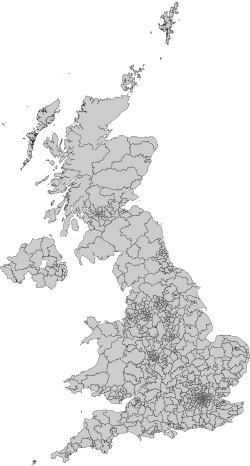
The House of Commons is the lower house of the UK's bicameral Parliament. As of the 2010 election, it consists of 650 constituencies, each electing one Member of Parliament (MP) via the first-past-the-post system.
London Assembly
The London Assembly features 14 constituencies, each electing one member via first-past-the-post. To ensure a degree of proportional representation, an additional 11 members are elected from Greater London as a whole.
Northern Ireland Assembly
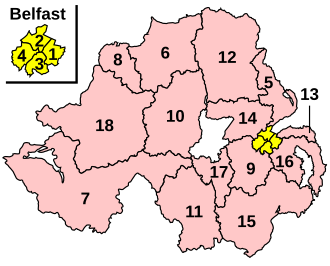
There are 18 constituencies in Northern Ireland: four borough constituencies for Belfast and 14 county constituencies. Unlike the House of Commons, these elect five Members of the Legislative Assembly (MLAs) each using the single transferable vote system.
Scottish Parliament
Often called "Holyrood constituencies," there are 73 areas that each elect one Member of the Scottish Parliament (MSP) via first-past-the-post. These are grouped into eight electoral regions, which elect seven additional members each to provide proportional representation.
Senedd
The Senedd (Welsh Parliament) is divided into 16 constituencies. Each of these elects six Members of the Senedd (MS) using the D'Hondt method, a mathematical formula used to allocate seats in proportional representation systems.
European Parliament Constituencies (Historical)
Prior to the UK's exit from the European Union in 2020, the UK used 12 multi-member constituencies to elect Members of the European Parliament (MEPs). While Northern Ireland used the single transferable vote, the 11 constituencies in Great Britain used the d'Hondt method of party-list proportional representation.
Frequently Asked Questions
What is the difference between a borough and a county constituency?
Borough constituencies are primarily urban areas, while county constituencies are primarily rural. This distinction affects who serves as the returning officer and determines the spending limits for election campaigns.
How are constituency names decided?
The Boundary Commissions for England, Wales, Scotland, and Northern Ireland create the names. They generally aim to reflect the main population centers and use compass points to distinguish between similar areas.
How many MPs are in the House of Commons?
There are 650 constituencies in the House of Commons, each electing one Member of Parliament (MP).
Do all UK assemblies use the same voting system?
No. While the House of Commons and the constituency-based seats in the Scottish and London Assemblies use first-past-the-post, the Northern Ireland Assembly uses the single transferable vote, and the Senedd uses the D'Hondt method.
What happened to European Parliament constituencies?
These constituencies were used to elect MEPs until the United Kingdom withdrew from the European Union in 2020, at which point they ceased to exist.