U.S. Embassy in Beijing: History, Architecture, and Diplomatic Role
The U.S. Embassy in Beijing serves as a critical hub for diplomatic relations between the United States and China. As one of the largest American diplomatic missions globally, the facility represents not only the architectural ambition of the United States but also the complex geopolitical history of the 20th and 21st centuries.
Key Facts
- Opening Date: August 8, 2008.
- Global Rank: Third largest U.S. diplomatic mission in the world.
- Size: 500,000 square feet across eight stories.
- Land Area: Situated on a 10-acre plot.
- Dedication: Opened by President George W. Bush.
Historical Evolution
The roots of the American diplomatic presence in China date back to 1935, when the existing legation—a lower-level diplomatic office—was upgraded to a full embassy in Nanjing. However, the trajectory of the mission was heavily influenced by the Chinese Civil War.
In 1949, the nationalist central government relocated to Taipei, leading to a shift in diplomatic operations. The embassy eventually reopened in 1953. A pivotal turning point occurred on January 1, 1979, when the embassy was transferred to Beijing following the normalization of relations with the communist government on the Chinese mainland.
Architecture and Facility Design
The current facility, dedicated in 2008, is a massive eight-story structure spanning 500,000 square feet (approximately 46,000 square meters). The design is characterized by its extensive use of both transparent and opaque free-standing glass, blending modern aesthetics with functional diplomatic needs.
While the main embassy sits on a 10-acre plot of land, its logistical operations extend beyond the primary site. The embassy warehouse is located separately within the Beijing Tianzhu Airport Industrial Zone, situated in the Shunyi District.
Diplomatic Sanctuary and Legal Status
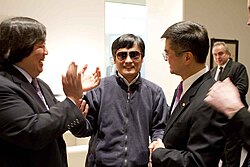
Under international law, embassy grounds are generally considered legally out of reach of the host government. This unique status has occasionally made the facility a place of refuge. Notably, the embassy served as a hiding place for Chinese dissident Chen Guangcheng after he escaped from house arrest.
Embassy Overview Summary
| Feature | Detail |
|---|---|
| Total Floor Area | 500,000 sq ft (46,000 m²) |
| Number of Floors | 8 |
| Plot Size | 10 acres (4.0 ha) |
| Global Size Rank | 3rd (after Baghdad and Yerevan) |
| Warehouse Location | Shunyi District (Tianzhu Airport Industrial Zone) |
Frequently Asked Questions
When was the current U.S. Embassy in Beijing opened?
The current facility was opened and dedicated on August 8, 2008, by U.S. President George W. Bush.
How does the Beijing embassy rank in size compared to other U.S. missions?
It is the third largest American diplomatic mission in the world, following the embassies in Baghdad and Yerevan.
Why was the embassy moved to Beijing in 1979?
The embassy was transferred to Beijing on January 1, 1979, as a result of the normalization of diplomatic relations with the communist government on the Chinese mainland.
What is the architectural style of the building?
The eight-story building is known for incorporating a significant amount of free-standing transparent and opaque glass in its design.
Who is Chen Guangcheng and why was he at the embassy?
Chen Guangcheng is a Chinese dissident who used the embassy as a hiding place after escaping house arrest, utilizing the fact that the embassy is legally out of reach of the Chinese government.