Two Hostile States Theory: North Korea's Radical Shift in Inter-Korean Relations
Since 2023, the political landscape of the Korean Peninsula has undergone a fundamental transformation. North Korea has officially adopted the two hostile states theory (Korean: 적대적 두 국가론), a policy that marks a definitive break from decades of pursuing national reunification. Under the leadership of Kim Jong Un, the Democratic People's Republic of Korea (DPRK) has transitioned from viewing South Korea as a partner for reconciliation to defining the Republic of Korea (ROK) as a primary, hostile enemy.
This shift represents more than just a change in rhetoric; it is a systematic dismantling of the ideological and physical symbols that once suggested a shared national identity between the North and the South.
Key Facts
- Policy Shift: North Korea has abandoned the goal of "one nation, one state with two systems" in favor of treating South Korea as a separate, hostile state.
- Constitutional Changes: Recent amendments to the DPRK constitution remove references to peaceful reunification and explicitly label the ROK as a "hostile state."
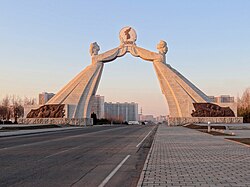
- Symbolic Erasure: Physical monuments like the Arch of Reunification have been demolished, and reunification-related language has been purged from textbooks and national anthems.
- Administrative Reorganization: Organizations previously dedicated to inter-Korean cooperation, such as the United Front Department, have been restructured or demoted.
- De-ethnification: The state is actively promoting a policy of "de-ethnification," emphasizing cultural and genetic differences to distance North Koreans from South Koreans.
Historical Context of Korean Unification
The history of a unified Korea is marked by periods of both cooperation and intense division. Following the annexation of the Korean Empire by Japan in 1910 and the subsequent partition of the peninsula by the Soviet Union and the United States after World War II, the two Koreas emerged as distinct entities.
For decades, both sides maintained official stances regarding unification. In 1972, North Korean leader Kim Il Sung proposed the Three Principles of National Reunification. Simultaneously, South Korean President Park Chung Hee introduced the Yushin Constitution, which mandated the pursuit of unification and claimed sovereignty over the entire peninsula. Historically, inter-Korean relations have fluctuated based on the political leanings of South Korean administrations, often improving under liberal leaders and deteriorating under conservative ones.
The Emergence of the Two Hostile States Theory
The formal pivot toward hostility was signaled in December 2023 during a speech by Kim Jong Un at the ninth plenum of the 8th Central Committee of the Workers' Party of Korea (WPK). Kim declared a "fundamental turnabout," arguing that the previous pursuit of reunification had failed to produce results and had instead led to a cycle of confrontation.
Kim criticized South Korean policies, specifically citing the concept of "unification by absorption" and "unification under liberal democracy" as direct threats to the DPRK regime. He characterized the relationship not as one between members of the same ethnic group (consanguineous), but as a relationship between two belligerent states. He further described South Korea as a "colonial subordinate state" heavily dependent on the United States.
Constitutional and Territorial Redefinition
In January 2024, the shift was codified during a speech to the Supreme People's Assembly (SPA). Kim Jong Un called for constitutional amendments to:
- Remove all references to cooperation and reunification.
- Specify the DPRK's territorial borders.
- Explicitly define the ROK as the "most hostile country."
Furthermore, North Korea rejected the maritime Northern Limit Line, stating that any South Korean incursion into North Korean territory, air space, or waters—even by 0.001 mm—would be treated as a provocation of war.
Implementation and Systematic Erasure
The transition from theory to practice has been comprehensive, affecting media, education, and physical infrastructure.
Media and Language Shifts
North Korean state media has replaced the term Namjosŏn (Southern Choson)—which implied a shared nation—with Hanguk and Daehanminguk, the names used by South Korea. Additionally, the term "puppet Korea" has been phased out in favor of terms that avoid implying a shared clan or nation, further distancing the two societies.
Physical and Educational Changes
The implementation of this policy has included several high-profile actions:
- Demolition of Monuments: The Arch of Reunification was demolished in early 2024.
- Map Redesign: State media and agencies have replaced maps of the unified Korean Peninsula with maps showing only North Korea.
- Textbook Purges: The word "reunification" has been removed from student textbooks.
- Anthem Modification: The lyrics of the national anthem, Aegukka, were modified to remove references to the "three thousand ri" (the traditional length of the peninsula), replacing it with "this world."
Organizational Restructuring
The WPK has reorganized its internal structures to reflect this new reality. The United Front Department (UFD), once responsible for inter-Korean relations, has been demoted to the "Workers' Party of Korea Central Committee 10 Bureau." Its duties have been split, with the Ministry of Foreign Affairs handling relations and the Reconnaissance General Bureau (RGB) taking over propaganda and clandestine operations.
The Concept of De-ethnification
A significant component of the new policy is de-ethnification. North Korean researchers and leaders have begun to emphasize the biological and cultural differences between the two populations. Kim Jong Un has described South Korean youth as "foreign youth" who are no longer part of the same people. This approach seeks to break the psychological bond of ethnic unity that has historically underpinned the reunification movement.
Summary of Policy Changes
| Feature | Previous Policy (Pre-2023) | Two Hostile States Theory (Post-2023) |
|---|---|---|
| Primary Goal | National Reunification | Maintenance of Hostile State Relations |
| View of South Korea | Partner for reconciliation/same nation | Most hostile enemy state |
| Ethnic Identity | Shared minjok (ethnic group) | De-emphasized/Biologically foreign |
| Constitutional Focus | Peaceful reunification principles | Territorial integrity and hostility toward ROK |
Frequently Asked Questions
What is the core meaning of the "Two Hostile States Theory"?
It is the official North Korean policy that treats the Republic of Korea (South Korea) not as a fellow Korean nation seeking unification, but as a completely separate and hostile foreign state.
How has North Korea changed its language regarding South Korea?
North Korea has stopped using terms that imply a shared nationality, such as Namjosŏn, and has adopted South Korean terminology like Hanguk to treat the South as a foreign entity. They have also removed "reunification" from textbooks and the national anthem.
What happened to the Arch of Reunification?
As part of the effort to remove physical symbols of a shared identity, the Arch of Reunification was demolished in early 2024.
Why is North Korea pursuing "de-ethnification"?
The policy aims to sever the emotional and cultural ties between North and South Koreans, framing South Koreans as "foreigners" to justify the abandonment of reunification goals and to prevent the influence of South Korean culture.
Has the North Korean Constitution been changed?
Yes. Recent amendments have removed goals related to peaceful reunification and have added provisions that define the ROK as a hostile state and establish clear territorial borders for the DPRK.