Turkish Migration to Australia: A Comprehensive History
The story of Turkish migration to Australia is a multifaceted journey spanning over a century. From the early days of Ottoman-era cameleers to the waves of Turkish Cypriots fleeing political unrest and the formal migration agreements of the 1960s, the Turkish community has evolved into a significant part of Australia's multicultural fabric.
Early Ottoman Migration and the Cameleers
The earliest known short-term Turkish migrants arrived between the 1860s and 1900. These individuals were primarily Muslim cameleers—specialists in using camels for transport—who were brought into Australia at three-year intervals. They played a critical role in South Australia's inland pastoral industry, transporting wool bales and essential goods across harsh terrains.
While these migrants were commonly referred to as "Afghans" or "Ghans," their origins were diverse, including British India, Egypt, Turkey, and Afghanistan. By the early 19th century, a small number of permanent Turkish settlers existed, numbering around 20. This population grew to 300 by the 1911 census, though numbers declined during the First World War as Australia and Turkey were adversaries in the conflict.
The Turkish Cypriot Experience
A significant shift occurred in the late 1940s with the arrival of Turkish Cypriots. Notably, they were the only Muslims accepted under the White Australia Policy, a set of historical policies that aimed to restrict non-European immigration. Before 1940, only three Turkish-speaking settlers from Cyprus were recorded in the census; however, by the period between 1947 and 1956, this number grew to 350.
Political instability in Cyprus drove further migration. As the island approached independence between 1955 and 1960, Turkish Cypriots feared for their future due to enosis—the movement by Greek Cypriots to overthrow British rule and unite Cyprus with Greece. The right-wing group EOKA launched attacks between 1963 and 1974 to achieve this goal, prompting an exodus of Turkish Cypriots to Britain and Australia.
These early immigrants often began their Australian lives working in factories, agriculture, or infrastructure projects, with some eventually saving enough capital to become entrepreneurs.
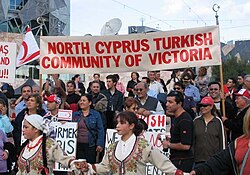
Political Upheaval and the TRNC
The situation escalated in 1974 when a coup d'état, supported by EOKA B and the Greek military junta, attempted to unite the island with Greece. This led to a military invasion by Turkey, which divided the island. In 1983, the Turkish Republic of Northern Cyprus (TRNC) was declared. Because the TRNC is internationally unrecognized (except by Turkey), it has faced economic embargos from the United States and the Government of Cyprus. This lack of foreign investment and export markets has left the economy stagnant, driving further migration to Canada, Britain, and Australia.
Mainland Turkish Migration and Growth
Formal migration from mainland Turkey began on October 5, 1967, following a bilateral agreement between the Australian and Turkish governments. Before this, fewer than 3,000 people of Turkish origin lived in Australia. Between 1968 and 1974, nearly 19,000 Turkish immigrants arrived.
The arrival of these migrants was a community effort: those landing at Sydney International Airport were greeted by Turkish Cypriots, while those arriving at Essendon Airport in Melbourne were welcomed by the Cyprus Turkish Association. Initially, about 70% of these migrants were unskilled workers from rural areas, but by the 1980s, there was a marked increase in skilled professionals applying for entry.
Over the subsequent 35 years, the Turkish population grew to nearly 100,000. A majority of this community settled in Victoria, particularly within the north-western suburbs of Melbourne.
Diverse Origins of the Turkish Diaspora
Beyond mainland Turkey and Cyprus, Australia's Turkish community includes ethnic Turks who migrated from various other regions. This includes immigrants from Bulgaria, the Western Thrace area of northern Greece, and North Macedonia, as well as those arriving from Germany and other Western European nations.
Key Facts
- Early Presence: Short-term migration began in the 1860s with cameleers servicing the pastoral industry.
- Policy Exception: Turkish Cypriots were the only Muslims accepted under the White Australia Policy in the late 1940s.
- Migration Surge: Nearly 19,000 mainland Turks arrived between 1968 and 1974 following a government agreement.
- Demographic Shift: Migration transitioned from predominantly unskilled rural workers in the 1960s to more skilled professionals by the 1980s.
- Regional Hub: More than half of the Turkish community is settled in Victoria, primarily in Melbourne's north-western suburbs.
| Period | Primary Group | Key Drivers/Context | Estimated Impact |
|---|---|---|---|
| 1860s – 1900 | Ottoman Cameleers | Pastoral industry transport | Small, short-term groups |
| Late 1940s – 1960s | Turkish Cypriots | White Australia Policy exception; political unrest (Enosis) | 350 settlers (1947-1956) |
| 1968 – 1974 | Mainland Turks | 1967 Migration Agreement | ~19,000 arrivals |
| 1980s – Present | Skilled Professionals | Economic and professional opportunities | Total population ~100,000 |
Frequently Asked Questions
Who were the "Afghans" in early Australian history?
The "Afghans" were cameleers brought to Australia between the 1860s and 1900 to transport goods and wool. Despite the name, they came from various regions, including Turkey, Egypt, Afghanistan, and British India.
Why did Turkish Cypriots migrate to Australia in the mid-20th century?
Many migrated due to political instability and fear for their lives resulting from "enosis" (the attempt to unite Cyprus with Greece) and subsequent attacks by the EOKA group.
What was the significance of the 1967 agreement?
The agreement signed on October 5, 1967, between Australia and Turkey officially allowed Turkish citizens to immigrate, leading to a surge of nearly 19,000 arrivals within six years.
Where is the largest concentration of Turkish Australians located?
More than half of the Turkish community resides in Victoria, with a high concentration in the north-western suburbs of Melbourne.
What is the TRNC and how did it affect migration?
The Turkish Republic of Northern Cyprus (TRNC) was declared in 1983. Due to international non-recognition and economic embargos, many Turkish Cypriots have left the island for better opportunities in Australia, Britain, and Canada.