Turgo Turbines: High-Efficiency Power for Medium Head Hydroelectricity
In the world of hydroelectric power, selecting the right turbine is critical to maximizing energy output based on the available water source. The Turgo turbine stands out as a versatile impulse water turbine—a type of turbine that uses the velocity of a water jet to create power—specifically engineered for medium head applications.
Developed in 1919 by Gilbert Gilkes & Gordon, the Turgo was designed as a modification of the Pelton wheel. By refining the way water interacts with the runner, engineers created a machine that bridges the gap between different turbine technologies, offering a balanced solution for various scales of power generation.
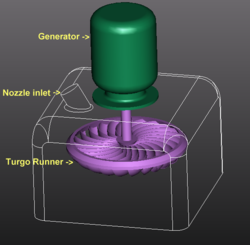
Key Facts
- Efficiency: Typically achieves 87% in operational settings, with lab tests reaching up to 90%.
- Head Range: Operates effectively with net heads between 15 and 300 meters.
- Design Origin: Created in 1919 as an evolution of the Pelton wheel.
- Primary Use: Ideal for medium head applications and cost-sensitive small hydro projects.
Comparing the Turgo to Other Turbine Designs
The Turgo turbine operates in a head range where the capabilities of the Francis turbine (a reaction turbine) and the Pelton wheel (an impulse turbine) overlap. While both are viable, the Turgo offers several distinct advantages depending on the project requirements.
Advantages Over the Pelton Wheel
The Turgo runner is generally less expensive to manufacture than that of a Pelton wheel. Furthermore, it possesses a higher specific speed—a dimensionless value used to describe the speed of a turbine relative to its size and power output. This allows the Turgo to handle a greater flow of water than a Pelton wheel of the same diameter, which in turn reduces the overall cost of the generator and the installation.
Advantages Over the Francis Turbine
Unlike the Francis turbine, which requires a complex, airtight housing to function as a reaction turbine, the Turgo does not need such an enclosure. This simplifies the installation process and reduces structural costs.
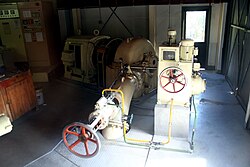
Operational Considerations and Efficiency
Efficiency is a hallmark of the Turgo design. In real-world operational environments, these turbines typically achieve an efficiency of approximately 87%. Under controlled factory and laboratory conditions, they have demonstrated efficiencies as high as 90%.
Because the Turgo utilizes nozzles to direct water onto the runner, it is susceptible to blockage. To ensure effective operation and prevent downtime, systems must include measures to prevent debris from entering the nozzles.
| Feature | Turgo Turbine Detail |
|---|---|
| Net Head Range | 15 to 300 meters |
| Operational Efficiency | ~87% |
| Maximum Lab Efficiency | 90% |
| Housing Requirement | No airtight housing needed |
| Cost Profile | Lower runner and installation costs |
Frequently Asked Questions
What is the ideal head range for a Turgo turbine?
Turgo turbines are designed to work with net heads between 15 and 300 meters, making them ideal for medium head applications.
How does a Turgo turbine differ from a Pelton wheel?
While based on the Pelton design, the Turgo has a higher specific speed, allowing it to handle more water flow with a smaller diameter runner, which reduces installation and generator costs.
Is the Turgo turbine suitable for small-scale hydro projects?
Yes, because of its lower manufacturing and installation costs, the Turgo is a popular choice for small hydro installations where budget is a primary concern.
What is the main maintenance concern for Turgo turbines?
Since they use nozzles to direct water, the primary concern is preventing debris from blocking the nozzles to maintain operational efficiency.
How efficient is a Turgo turbine in practice?
In actual operation, they typically achieve about 87% efficiency, though they can reach 90% in laboratory settings.