Tunicates: The Fascinating Biology of Sea Squirts
Tunicates, commonly known as sea squirts, are a diverse group of marine animals that belong to the phylum Chordata. Despite their often simple, sedentary appearance, they are closely related to vertebrates. Found in oceans worldwide, these creatures range from solitary organisms anchored to the seabed to free-swimming colonial chains in the open ocean.
Most tunicates live in shallow waters, though a small number of species are found at depths exceeding 200 meters. They are easily recognized by their tunic—a protective outer layer that can vary in color and shape, often resembling grapes, bottles, or barrels. Some species, such as the stalked sea tulip (Pyura pachydermatina), can reach impressive sizes of over one meter in height.
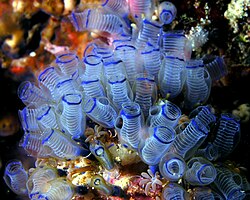
Key Facts
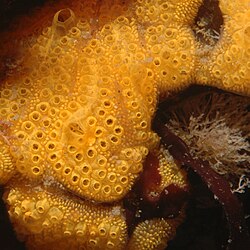
- Species Diversity: There are approximately 3,000 described species of tunicates.
- Chordate Relation: They are members of the phylum Chordata, making them close relatives of vertebrates.
- Habitat: Primarily shallow marine waters, attaching to rocks, coral, seaweed, or man-made structures like ship hulls.
- Feeding Method: Most are filter feeders that use a pharyngeal mucous net to capture prey.
- Temporal Range: Their fossil record extends from the Cambrian Stage 3 (approximately 518 million years ago) to the present.
Classification and Diversity
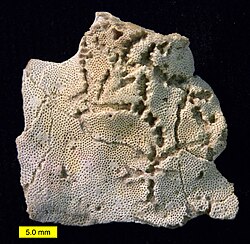
Tunicates are traditionally divided into three primary classes based on their body form and lifestyle:
Ascidiacea
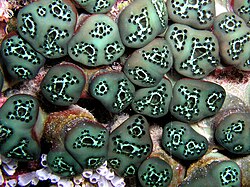
The most numerous group, these are the typical "sea squirts." Many are sessile (fixed in one place), attaching themselves to substrates such as mangrove roots or docks. They can be solitary or colonial.
Thaliacea
Unlike ascidians, thaliaceans are pelagic, meaning they swim freely in the open ocean. This class includes:
- Pyrosomes: Bioluminescent colonial tunicates that form hollow cylindrical structures.
- Doliolids: Small, barrel-shaped solitary animals that move via jet propulsion.
- Salps: Small organisms that often form long chains through budding.
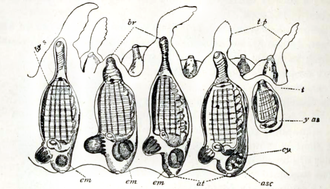
Appendicularia
These are small, solitary pelagic tunicates known as copelates.
Anatomy and Physiology
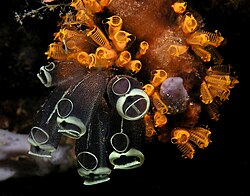
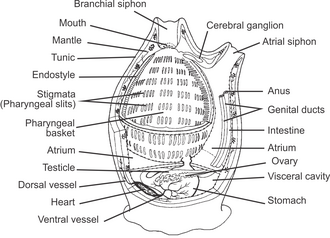
The internal structure of a tunicate is designed for efficient filter feeding. They draw water in through a buccal siphon (the intake opening) and expel it through an atrial siphon.
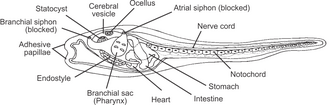
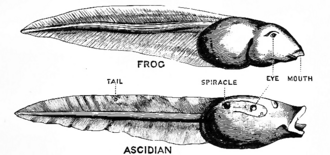
A defining characteristic of the tunicate life cycle is the difference between the larval and adult stages. Tunicate larvae possess features typical of chordates, which are often lost or modified as they transition into their sedentary adult forms.
Human Use and Economic Importance
Tunicates are utilized by humans in several ways, most notably as a food source in East Asia and South America. In Chile, the piure (Pyura chilensis) is a staple in seafood stews. In Japan and Korea, the sea pineapple (Halocynthia roretzi) is highly valued and commercially cultivated on palm frond cords.
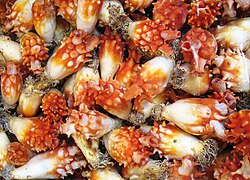
Beyond food, tunicates are studied for their chemical compounds, which may have medical applications, and are being researched as potential sources for biofuels.
Tunicate Summary Table
| Class | Lifestyle | Key Characteristics | Examples |
|---|---|---|---|
| Ascidiacea | Mostly Sessile | Attached to substrate; solitary or colonial | Sea squirts, Sea tulips |
| Thaliacea | Pelagic | Free-swimming; jet propulsion; some bioluminescent | Salps, Pyrosomes, Doliolids |
| Appendicularia | Pelagic | Small, solitary free-swimmers | Copelates |
Frequently Asked Questions
What is a tunicate?
A tunicate is a marine invertebrate belonging to the subphylum Tunicata. They are chordates, meaning they share a common evolutionary ancestor with vertebrates, and are characterized by a tunic—a tough outer covering.
How do tunicates feed?
Most tunicates are filter feeders. They pump water through their bodies using siphons, trapping organic particles and plankton in a pharyngeal mucous net before digesting them.
Are all sea squirts attached to rocks?
No. While the Ascidiacea class is mostly sessile and attached to substrates, the Thaliacea and Appendicularia classes are pelagic and swim freely in the open ocean.
Are tunicates edible?
Yes, certain species are delicacies. The sea pineapple (Halocynthia roretzi) is widely eaten in Korea and Japan, while the piure (Pyura chilensis) is consumed in Chile.
What is the difference between a buccal and an atrial siphon?
The buccal siphon is the opening through which water and food enter the tunicate's body, while the atrial siphon is the exit point for water after it has been filtered.