Tube Well Components and Construction Essentials
A tube well is a critical piece of infrastructure designed to extract groundwater from deep underground aquifers. To ensure a steady supply of clean water and the longevity of the pumping mechanism, several specialized components must work in harmony. From the structural casing to the filtration systems that keep debris out, each part plays a vital role in the efficiency of the well.
Key Facts
- PVC pipe is frequently used for casing because it is cost-effective and chemically inert.
- Sanitary seals are essential to prevent surface seepage from contaminating the borehole.
- Screening and packing are the two primary methods used to prevent sand and silt from damaging pump components.
- Temporary reservoirs at the outlet facilitate easier water distribution for local populations.
The Structural Framework: Casing and Reservoirs
The foundation of a tube well is the casing, a protective pipe that houses the internal machinery, including the inlet, cylinder, piston valves, and the rising main of a "down-the-hole" hand pump. Depending on the stability of the surrounding soil, casing may be installed temporarily or permanently to prevent the borehole walls from collapsing.
To maintain water purity, a sanitary seal is employed to stop seepage down the bore. Additionally, lengths of plain casing are used to block water from the ground layers above the aquifer from entering the system. Water is only permitted to enter the well through specific slots located in the lower sections of the casing.
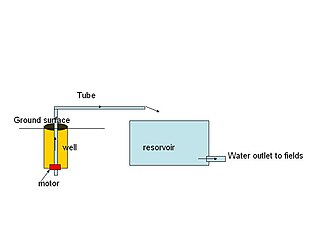
Once the water reaches the surface, it is often collected in a temporary reservoir. This small basin at the outlet allows the local population to access and use the water more conveniently for various daily needs.
Managing Sediment and Debris
Water extracted from aquifers in soft ground often contains silt or sand particles. If left unfiltered, these particles can cause rapid wear and tear on the pump's cylinders and valves, leading to mechanical failure and poor water quality. To combat this, engineers use two primary filtration strategies: screening and sand/gravel packing.
Screening Methods
Screening acts as a physical barrier to keep large particles out. In basic setups, this is achieved by cutting slits directly into the casing. For more demanding environments, commercial compact screens made of woven wire or man-made fabrics are used. These can be bolted to pump inlets or wrapped around the inlet assembly to ensure cleaner water intake.
Sand and Gravel Packing
While screens stop larger debris, sand/gravel packing is used to filter out finer particles before they even reach the screen. This involves placing graded sand and gravel from the top of the borehole. Modern installations may use pre-bonded commercial packs of sand or gravel that are integrated directly into the pump inlet assembly.
Summary of Tube Well Components
| Component | Primary Material/Type | Main Function |
|---|---|---|
| Casing | PVC Pipe | Supports borehole walls and houses pump internals |
| Sanitary Seal | Sealant/Plug | Prevents surface seepage into the bore |
| Screen | Woven wire or fabric | Blocks sand and silt from entering the pump |
| Packing | Graded sand/gravel | Pre-filters water before it reaches the screen |
| Reservoir | Small basin | Collects water for local community use |
Frequently Asked Questions
Why is PVC often used for tube well casing?
PVC is preferred because it is inexpensive and inert, meaning it does not react chemically with the surrounding environment or the water.
What is the purpose of a sanitary seal?
The sanitary seal prevents contaminated water or seepage from the ground surface from leaking down the borehole and entering the aquifer.
How do sand and gravel packs differ from screens?
Screens are physical barriers (like slits or fabric) that block particles at the inlet, whereas sand and gravel packing act as a filter bed surrounding the well to remove particles before they reach the screen.
What happens if sand and silt enter the pump?
These particles act as abrasives, causing rapid wear to the pump's valves and cylinders, which reduces the lifespan of the equipment and decreases user satisfaction.
Where is the temporary reservoir located?
The temporary reservoir is constructed at the outlet of the tube well to facilitate the collection and usage of water by the local population.