Tropical Rainforest Climate
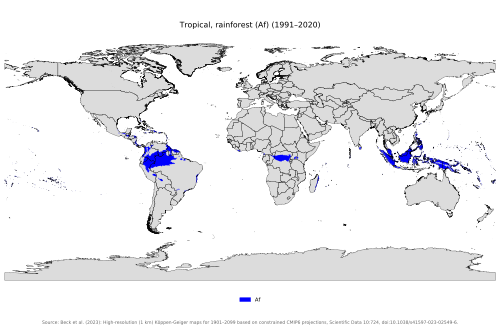
The tropical rainforest climate, often referred to as an equatorial climate, is a distinct meteorological pattern characterized by consistent warmth and abundant moisture. Typically found within 10 to 15 degrees latitude of the equator, this climate creates the ideal conditions for the world's most lush rainforests. While primarily equatorial, certain higher-latitude regions—such as Okinawa, Japan, and the coast of southeast Florida in the United States—also fall into this category.
Under the Köppen climate classification, a system used to categorize the world's climates based on temperature and precipitation, these regions are designated as Af. The defining traits of an Af climate are high mean annual temperatures, minimal seasonal temperature variation, and rainfall that occurs throughout the entire year.
Key Facts
- Temperature: High average annual temperatures with very small seasonal ranges.
- Precipitation: Heavy rainfall year-round with no distinct dry season.
- Humidity: Consistently high humidity levels.
- Diurnal Range: The temperature difference between day and night is often greater than the average temperature change across different seasons.
- Location: Primarily within 10-15° of the equator, though some outliers exist.
Equatorial vs. Tropical Trade-Wind Climates
Not all tropical rainforest climates are identical. Meteorologists distinguish between those dominated by the Intertropical Convergence Zone (ITCZ)—a belt of low pressure where trade winds from the Northern and Southern Hemispheres meet—and those influenced more by the trade winds.
Equatorial Climates
When the ITCZ is the dominant force and cyclones are rare, the region is termed an equatorial climate. In these areas, atmospheric pressure remains almost constantly low, resulting in a low horizontal pressure gradient. Consequently, winds are generally weak and rare, with the exception of localized sea and land breezes in coastal zones.
Tropical Trade-Wind Climates
Regions located at slightly higher latitudes are often more influenced by the trade winds than the ITCZ. These are known as tropical trade-wind climates. Because the wind is nearly permanent and often accompanies tropical disturbances, the rainforests in these areas are typically more impoverished than those in pure equatorial climates, as the vegetation must evolve to resist strong winds.
Global Distribution and Representative Cities
The tropical rainforest climate spans several continents, supporting diverse urban centers and ecosystems. Below is a summary of regions and cities that experience this climate.
| Region | Representative Cities/Locations |
|---|---|
| Asia | Singapore, Kuala Lumpur (Malaysia), Medan (Indonesia), Colombo (Sri Lanka), Ishigaki (Japan), Davao City (Philippines) |
| Americas | Belém (Brazil), Leticia (Colombia), Paramaribo (Suriname), Georgetown (Guyana), West Palm Beach (USA) |
| Africa | Kampala (Uganda), Kisumu (Kenya), Moroni (Comoros), Victoria (Seychelles), Toamasina (Madagascar) |
| Oceania | Suva (Fiji), Hilo (USA), Papeete (French Polynesia), Port Vila (Vanuatu), Honiara (Solomon Islands) |
Frequently Asked Questions
What is the main difference between an equatorial and a trade-wind climate?
The primary difference is the dominant weather driver. Equatorial climates are dominated by the Intertropical Convergence Zone (ITCZ) and have weak winds, while tropical trade-wind climates are dominated by permanent trade winds, which can lead to less lush vegetation due to wind resistance requirements.
Does a tropical rainforest climate have a winter?
No. These climates are characterized by high mean annual temperatures and very small temperature ranges, meaning there is no traditional winter season.
Is there a dry season in an Af climate?
By definition, a tropical rainforest climate (Af) has no dry season; rain falls throughout the year.
Why is the day-to-night temperature difference so significant?
In these regions, the solar angle remains relatively constant throughout the year, making seasonal changes minimal. Therefore, the daily cycle of heating and cooling (diurnal range) becomes more pronounced than the change between months.
Which non-equatorial regions have this climate?
Some areas at higher latitudes, such as Okinawa in Japan and the coast of southeast Florida in the United States, exhibit tropical rainforest climate characteristics.