Trophic Levels: How Energy Flows Through Food Webs
In every ecosystem, life is sustained by a complex network of feeding relationships. The trophic level of an organism is the specific position it occupies within a food web. Derived from the Greek word trophē, meaning nourishment, this concept allows ecologists to map how energy moves from the sun to the most powerful predators on Earth.
While we often think of food in simple chains—where one animal eats another—nature typically operates as a food web. This is an intricate network of intersecting and overlapping food chains. In communities with high biodiversity, these paths become increasingly complex, creating a resilient system of energy exchange.
Key Facts
- Trophic Level 1 is always occupied by primary producers (e.g., plants and algae).
- The ten-percent law states that only about 10% of energy is transferred from one trophic level to the next.
- Apex predators sit at the top of the food web and have no natural predators of their own.
- Decomposers recycle dead organic matter back into inorganic nutrients for producers.
- Human beings have an average estimated trophic level of 2.21.
The Hierarchy of Nourishment
Organisms are categorized into three basic roles based on how they acquire food: producers, consumers, and decomposers.
Primary Producers (Autotrophs)
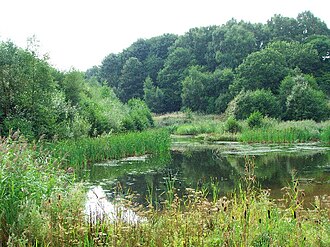
Producers are the foundation of almost every food chain. Most are autotrophs, meaning they manufacture their own food. Plants and algae use photosynthesis to convert sunlight, water, and soil nutrients into chemical energy. In rare environments, such as deep-sea hydrothermal vents where sunlight cannot reach, producers use chemosynthesis to create food from chemical reactions.
Consumers (Heterotrophs)
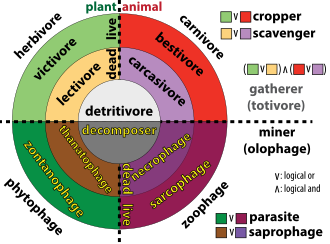
Consumers are heterotrophs, species that must eat other organisms to survive. They are divided into levels based on their diet:
- Primary Consumers (Level 2): Herbivores that eat primary producers (e.g., rabbits).
- Secondary Consumers (Level 3): Carnivores that eat herbivores (e.g., foxes).
- Tertiary Consumers (Level 4): Carnivores that eat other carnivores (e.g., golden eagles).
Apex Predators
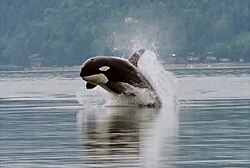
At the highest numbered level of a food web sit the apex predators. These animals, such as orcas or polar bears, have no natural predators in their adult stage, except perhaps members of their own species.
Decomposers (Detritivores)
Decomposers, such as fungi and bacteria, perform the essential task of breaking down dead plant and animal waste. By converting organic matter back into inorganic chemicals, they ensure that mineral nutrients are recycled and made available for primary producers once again.
Energy Pyramids and Biomass Efficiency
Energy does not move between levels with perfect efficiency. This relationship is often visualized as an energy pyramid, which illustrates the amount of energy required to support each successive level.
The ecological efficiency—the efficiency with which energy or biomass is transferred—is generally low. According to the ten-percent law, consumers convert only about 10% of the chemical energy in their food into their own organic tissue (biomass). Because so much energy is lost at each step, food chains rarely exceed five or six levels.
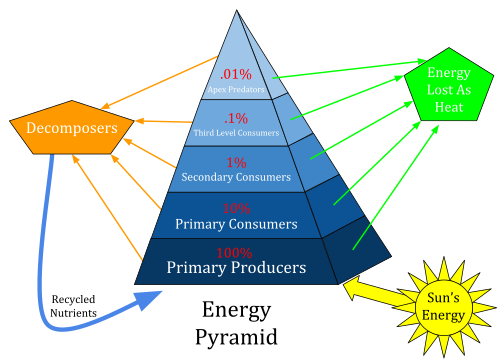
For example, plants convert roughly 1% of incident sunlight into chemical energy. By the time that energy reaches a tertiary consumer, only about 0.001% of the original solar energy remains.
Complexities in the Real World
Fractional Trophic Levels
In nature, trophic levels are rarely simple whole numbers. Many organisms are omnivores or change their diet as they age. For instance, a mountain lion might eat both rabbits (herbivores) and bobcats (carnivores), placing it across multiple levels. To account for this, scientists use a weighted average to calculate a fractional trophic level.
Measuring Trophic Positions
Beyond observing diet, scientists use stable isotope analysis of tissues like muscle, hair, or bone collagen. Nitrogen isotopic composition increases consistently (by approximately 3–4‰) at each trophic level, providing a chemical signature of an organism's position in the food web.
Trophic Levels in Global Fisheries
In marine ecosystems, the mean trophic level of fisheries catches provides insight into ecosystem health. Some researchers have noted a phenomenon called fishing down the food web, where high-trophic-level fish (like cod or tuna) are overfished, leading fisheries to target lower-trophic-level species like shrimp or herring.
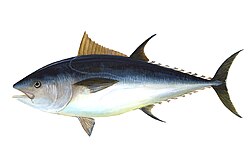
To monitor this, the Fisheries in Balance (FiB) index was developed. This index tracks whether changes in the mean trophic level of a catch are matched by appropriate changes in the total catch volume, helping scientists determine if a fishery is sustainable or collapsing.
| Trophic Level | Role | Type of Organism | Example |
|---|---|---|---|
| 1 | Primary Producer | Autotroph | Phytoplankton, Grass |
| 2 | Primary Consumer | Herbivore | Zooplankton, Rabbit |
| 3 | Secondary Consumer | Carnivore | Small Fish, Fox |
| 4+ | Tertiary Consumer / Apex Predator | Carnivore | Orca, Golden Eagle |
| N/A | Decomposer | Detritivore | Fungi, Bacteria |
Frequently Asked Questions
What is the difference between a food chain and a food web?
A food chain is a linear succession of organisms where each eats the one below it. A food web is a more realistic, complex network of many intersecting food chains within an ecosystem.
Why are there so few apex predators compared to plants?
This is due to the ten-percent law of energy transfer. Because 90% of energy is lost at each trophic level, there is significantly less energy available to support organisms at the top of the pyramid than at the bottom.
Can an organism have more than one trophic level?
Yes. Omnivores eat both plants and animals, and some animals change their diet as they grow. This is why scientists use fractional trophic levels (e.g., 2.21 for humans) to represent an average position.
How do decomposers fit into the trophic system?
Decomposers break down dead organic matter from all trophic levels and return nutrients to the soil or water. Because they recycle energy back to the primary producers, they are sometimes viewed as occupying their own unique level or marking the end of the chain.
What is chemosynthesis?
Chemosynthesis is the process by which primary producers in environments without sunlight, such as deep-sea hydrothermal vents, manufacture food using chemical energy instead of solar energy.