Trophée des Champions: History and Evolution of the French Super Cup
The Trophée des Champions is the prestigious annual association football match in France that pits the champions of Ligue 1 (the top professional league) against the winners of the Coupe de France (the premier knockout cup competition). Functioning as a super cup, this high-stakes encounter serves as a showcase of domestic dominance, bringing together the two most successful teams of the previous season.
Organized by the Ligue de Football Professionnel (LFP) and the Union Syndicale des Journalistes Sportifs de France (UJSF), the match has evolved from a sporadic event into a global spectacle, often hosted in international cities to promote French football worldwide.
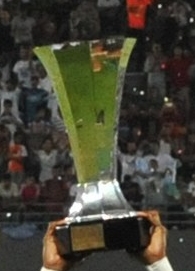
Key Facts
- Current Champions: Paris Saint-Germain (14th title).
- Most Successful Club: Paris Saint-Germain with 14 titles.
- Founding: The current format was established in 1995, though similar matches date back to 1949.
- Governing Body: Co-organized by the LFP and UJSF.
- Eligibility: Contested between the Ligue 1 champion and the Coupe de France winner.
The Evolution of the Competition
Early Beginnings and the Challenge des Champions
While the Trophée des Champions name was adopted in 1995, the concept of a champions' match in France began in 1949. In that inaugural unofficial match, Stade de Reims defeated RCF Paris 4–3. Between 1955 and 1973, the French Football Federation (FFF) hosted a similar competition known as the Challenge des champions. This version saw a brief revival in 1985 but was discontinued after two seasons due to a lack of popularity.
The Modern Era (1995–Present)
The competition was officially reinstated under its current name in 1995. The first modern match took place in January 1996, where Paris Saint-Germain faced Nantes. Since then, the match has generally occurred at the start or middle of the following season.
Interestingly, the match is not always played. If a single team wins both the league and the cup—known as winning the double—the match is typically cancelled, as seen in 1996 (Auxerre) and 2008 (Lyon). However, in 2008, the LFP modified the rules to allow the league runner-up, Bordeaux, to compete against Lyon, resulting in a 5–4 penalty victory for Bordeaux.
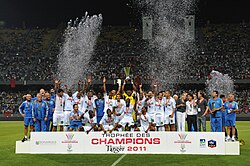
Global Expansion and Venues
For many years, the match was hosted in various French cities, including Marseille, Paris, and Lyon. However, in May 2009, the FFF announced a strategic shift to take the trophy abroad. The first international venue was the Olympic Stadium in Montreal, Canada.
Since then, the Trophée des Champions has been held in several countries, including Tunisia, Morocco, the United States, Gabon, China, Austria, Qatar, and Kuwait. A notable cultural milestone occurred during the 2024 final in Doha, where Paris Saint-Germain wore shirts featuring Arabic calligraphy designed by Fatma Al Sharshani.

Competition Statistics
The Trophée des Champions has been dominated by a few powerhouse clubs, with Paris Saint-Germain emerging as the most successful team in the competition's history.
| Club | Titles | Runners-up | Notable Winning Years |
|---|---|---|---|
| Paris Saint-Germain | 14 | 5 | 1995, 2013–2020, 2022–2025 |
| Lyon | 8 | 4 | 2002–2007, 2012 |
| Reims | 5* | 1 | 1949*, 1955, 1958, 1960, 1966 |
| Saint-Étienne | 5 | 1 | 1957, 1962, 1967–1969 |
| Monaco | 4 | 4 | 1961, 1985, 1997, 2000 |
*Includes unofficial titles.
Frequently Asked Questions
What happens if one team wins both the league and the cup?
Traditionally, the match is not played if a team wins the double. However, in some instances, such as in 2008, the LFP may invite the league runner-up to participate to ensure the match takes place.
Who has won the most Trophée des Champions titles?
Paris Saint-Germain holds the record for the most championships, with a total of 14 titles.
Is the Trophée des Champions always played in France?
No. Since 2009, the match has frequently been hosted internationally in countries such as Canada, Qatar, China, and Kuwait to promote the sport globally.
How is the winner decided if the match ends in a draw?
The winner is typically decided via a penalty shootout. In rare historical cases, such as in 1961, a lottery was used, and in 1971, the title was shared between two clubs.