Trenes de Buenos Aires (TBA): The Rise and Fall of a Railway Giant
Trenes de Buenos Aires (TBA) was a prominent private company that once managed the heartbeat of commuter rail travel in Argentina. Operating the broad gauge (5 ft 6 in / 1,676 mm) Sarmiento and Mitre lines, TBA served as a critical link for millions of passengers traveling within the City of Buenos Aires and the Greater Buenos Aires area.
Founded in 1995 by Claudio and Mario Cirigliano, the company expanded its reach beyond commuter services to include long-distance routes on the General Mitre Railway to central-western Argentina and the General Urquiza Railway to northern Argentina and Uruguay via the international Tren de los Pueblos Libres.
Key Facts
- Founded: 1995 by Claudio and Mario Cirigliano.
- Primary Lines: Mitre and Sarmiento commuter lines.
- Peak Volume: Approximately 1,000 trains per day, carrying 147.7 million passengers annually.
- Key Infrastructure: Introduced "Puma" coaches with air conditioning and ABS brakes.
- Dissolution: Concessions revoked in 2012 following the Once Station tragedy.
- Successor: Initially UGOMS, later integrated into Trenes Argentinos.
The Era of Privatisation and Growth
TBA was established during the administration of Carlos Menem, which privatised the national railway network. Under Decree N° 730/95, the company was granted the concession to operate the metropolitan Mitre and Sarmiento lines, officially taking control on May 27, 1995.
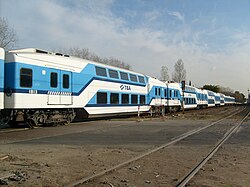
The early years of the concession were marked by significant investment and operational efficiency. By February 1999, the consortium had invested US$200 million, which funded the reconstruction of 220 Toshiba carriages and the modernisation of 13 workshops and stations. The company also streamlined passenger experiences by introducing automated ticket counters.
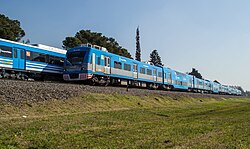
One of the most significant technical advancements was the deployment of "Puma" coaches on the Retiro-Tigre branch. Manufactured by the local firm Emprendimientos Ferroviarios (EMFER), these carriages featured computer-supervising systems, ABS brakes, and air conditioning.
Budgetary Shifts and Expansion
In 1997, the government proposed a US$2.5 billion modernisation plan that included the acquisition of 492 new electric multiple units and the refurbishment of over 100 km of track. However, under the subsequent administration of Fernando De la Rúa in 1999, the budget was reduced to US$1.3 billion. To offset this reduction, the state provided subsidies to TBA and other private operators.
Beyond its primary lines, TBA became a central player in the Unidad de Gestión Operativa Ferroviaria de Emergencia (UGOFE) from 2004 to 2012. This consortium, which included Metrovías and Ferrovías, managed the Belgrano Sur, Roca, and San Martín lines after previous concessions were revoked.
The Once Tragedy and Revocation
The decline of TBA culminated in a catastrophic event on February 22, 2012. A commuter train crashed at Once Station in Buenos Aires, resulting in 51 deaths and at least 703 injuries. In the immediate aftermath, the company was placed under federal intervention on February 28, and its concessions for the Mitre and Sarmiento lines were officially revoked on May 24, 2012.
Following the revocation, the lines were managed by the Unidad de Gestión Operativa Mitre Sarmiento (UGOMS) before eventually returning to state control under Trenes Argentinos.
Legal Fallout and Mismanagement
Investigations following the crash revealed a pattern of severe mismanagement. A 2015 report by La Nación exposed that while the railway infrastructure suffered, the company spent lavishly on luxury items, including champagne, jewellery, and trips to Dubai and Doha. It was also discovered that TBA had bribed former transport minister Ricardo Jaime and owed AR$ 70 million in unpaid fines.
The legal consequences were severe; Sergio Cigliano, one of the company's owners, was convicted of negligence regarding the Once tragedy and sentenced to nine years in prison.
TBA Operational Summary
| Category | Details |
|---|---|
| Owner | Grupo Plaza (Cirigliano Family) |
| Annual Passengers | ~147.7 Million |
| Daily Train Frequency | ~1,000 trains |
| Key Infrastructure | Toshiba carriages, Puma coaches |
| Net Income (1998) | US$135.1 Million |
| Employee Count | 4,340 |
Frequently Asked Questions
What were the primary rail lines operated by TBA?
TBA operated the broad gauge Sarmiento and Mitre commuter lines in Buenos Aires, as well as long-distance services on the General Mitre and General Urquiza railways.
What were "Puma" coaches?
Puma coaches were advanced carriages built by Emprendimientos Ferroviarios (EMFER) for the Retiro-Tigre branch, featuring air conditioning, ABS brakes, and computer-supervising systems.
Why was TBA's concession revoked?
The concession was revoked in May 2012 following a fatal train accident at Once Station that killed 51 people and injured hundreds, leading to federal intervention.
Who took over the lines after TBA?
The lines were initially managed by the consortium Unidad de Gestión Operativa Mitre Sarmiento (UGOMS) and were later absorbed by the state-run Trenes Argentinos.
What were the legal outcomes for TBA's leadership?
Owner Sergio Cigliano was sentenced to nine years in prison for negligence related to the Once tragedy, and investigations revealed systemic bribery and financial mismanagement.