Tidal Stream Energy: Key Companies and Turbine Technologies
Tidal stream energy harnesses the kinetic energy of moving water currents—similar to how wind turbines capture wind—to generate clean, predictable electricity. Unlike tidal barrages that require dams, tidal stream technology uses submerged or floating turbines to extract power from the natural flow of the ocean. Over the last two decades, a diverse array of global companies has experimented with various designs, from massive seabed-mounted rotors to innovative floating kites.
Key Facts
- MeyGen is currently the world's largest tidal-stream array, utilizing 1.5 MW turbines in Scotland's Pentland Firth.
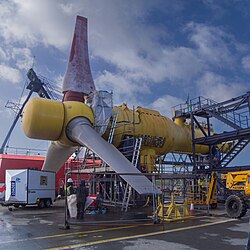
- Horizontal-axis turbines (like the AR1500) are the most common, though vertical-axis and helical screw designs exist.
- Floating platforms, such as those developed by Orbital Marine Power, allow for easier maintenance compared to seabed-mounted units.
- EMEC (European Marine Energy Centre) serves as a primary global hub for testing and certifying new tidal prototypes.
- Tidal Kites, developed by companies like Minesto, use a "flight" motion to increase the speed of water passing through the turbine.
Pioneers in Seabed-Mounted Turbines
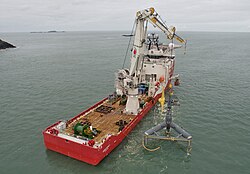
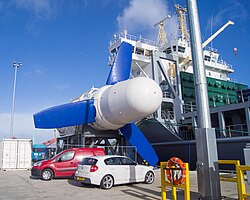
Seabed-mounted turbines are fixed directly to the ocean floor, often using monopiles or gravity bases to withstand powerful currents. Andritz Hydro Hammerfest has been a significant player, evolving from the 300 kW HS300 prototype in Norway to the 1.5 MW Mk1 turbines used in the MeyGen project, which have generated over 80GWh of electricity.
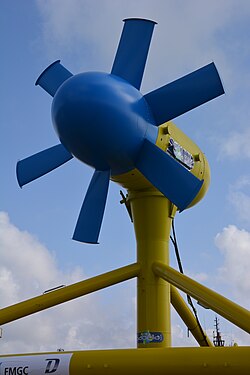
Similarly, SIMEC Atlantis Energy (now Ampeak Energy) developed the AR1500, a three-bladed horizontal-axis device. They also deployed the AR500 in Japan, which produced 10 MWh in its first ten days of operation in 2021.
Other notable seabed efforts include Marine Current Turbines, whose SeaGen turbine in Strangford Lough exported 11.6 GWh before its decommissioning, and Tidal Energy Ltd, which tested a 400 kW prototype in Ramsey Sound, Wales.
Floating and Innovative Designs
To reduce installation costs and simplify maintenance, several companies have moved toward floating structures. Orbital Marine Power utilizes a long tubular hull with twin rotors; their 2 MW Orbital O2 has been operational at the Fall of Warness since 2021.
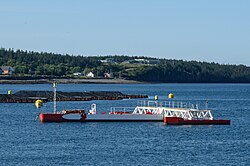
Magallanes Renovables tested a 1.5 MW ATIR device at EMEC, while Sustainable Marine Energy (SME) developed the PLAT-I series. The PLAT-I 6.4, featuring six rotors totaling 420 kW, provided the first floating tidal power to the Canadian grid in 2022.
Beyond traditional rotors, Minesto employs "tidal kites" that fly in a figure-eight pattern to accelerate water flow. Their Dragon 4 turbines (100 kW) are currently deployed in the Faroe Islands.
Specialized and Unconventional Technologies
Some developers have moved away from the standard three-blade design. Flumill utilizes counter-rotating helical screws made of fiberglass, while HydroQuest focuses on vertical-axis turbines, deploying units in both French rivers and the Paimpol–Bréhat tidal site.
In China, LHD New Energy Corporation and Zhejiang University have advanced the field. LHD's Zhoushan station features a mix of horizontal and vertical-axis turbines with a total capacity of 1.7 MW, while Zhejiang University has deployed turbines ranging from 60 kW to 600 kW.
Another unique approach was taken by Pulse Tidal, which developed an oscillating hydrofoil—a device with blades that move up and down—though the company was liquidated in 2014.
Industry Evolution and Corporate Shifts
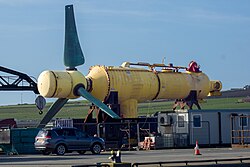
The tidal industry has seen significant consolidation. Tidal Generation Ltd (TGL) passed through the ownership of Rolls-Royce, Alstom, and General Electric before its assets were acquired by Sabella in 2021. Sabella itself developed the 1 MW D10 turbine, which is now operated by Inyanga Marine Energy.
Proteus Marine Renewables, formed via a management buyout from SIMEC Atlantis Energy, continues to support the MeyGen farm and is expanding into Japan with the 1.1 MW AR1100 turbine.
Summary of Key Tidal Technologies
| Company | Device/Project | Capacity | Type | Key Status/Achievement |
|---|---|---|---|---|
| SIMEC Atlantis | MeyGen (AR1500) | 1.5 MW | Seabed-mounted | World's largest array |
| Orbital Marine Power | Orbital O2 | 2 MW | Floating | Twin-rotor design |
| Minesto | Dragon 4 | 100 kW | Tidal Kite | Deployed in Faroe Islands |
| Andritz Hydro | Mk1 | 1.5 MW | Seabed-mounted | Over 80GWh generated |
| Sustainable Marine | PLAT-I 6.4 | 420 kW | Floating | First floating power to Canada grid |
| Proteus Marine | AR1100 | 1.1 MW | Seabed-mounted | Deployed in Japan (2025) |
Frequently Asked Questions
What is the difference between a horizontal-axis and vertical-axis tidal turbine?
A horizontal-axis turbine has a rotor shaft parallel to the flow of the water (like a traditional windmill), whereas a vertical-axis turbine has a shaft perpendicular to the flow, allowing it to capture water from any direction without needing a yaw mechanism.
Why are floating tidal turbines becoming more popular?
Floating turbines, such as those from Orbital Marine Power, are generally easier to install and maintain because they can be towed to shore for repairs, avoiding the need for expensive heavy-lift vessels required for seabed-mounted units.
What is a tidal kite?
A tidal kite, developed by companies like Minesto, is a tethered underwater wing that "flies" in a figure-eight pattern. This motion increases the relative speed of the water passing through the turbine, allowing for power generation in lower-velocity currents.
Which project is currently the largest in the world?
The MeyGen project in the Pentland Firth, developed by SIMEC Atlantis Energy (now Ampeak Energy), is the largest tidal-stream array worldwide, currently operating with four 1.5 MW turbines.
What happened to the OpenHydro and BigMoon Power projects?
OpenHydro ceased trading in 2018 after being acquired by Naval Energies. BigMoon Power (later Occurrent Power) filed for insolvency in September 2024 after failing to deploy its planned turbines in the Bay of Fundy.