Thyestes and the Curse of the House of Atreus
The saga of Thyestes is one of the most harrowing tales in Greek mythology, depicting a cycle of betrayal, incest, and gruesome revenge. At its core is the House of Atreus, a royal lineage plagued by a generational curse that transformed familial bonds into instruments of torture and death.
The Origins of the Curse
The tragedy began not with Thyestes, but with his parents, Pelops and Hippodamia. Pelops had betrayed Myrtilus, a servant of King Oenomaus. Despite promising Myrtilus half of his kingdom and the right to Hippodamia's virginity, Pelops denied these rewards and murdered Myrtilus by throwing him into the sea. With his final breath, Myrtilus cast a curse upon Pelops' descendants, setting the stage for the rivalry between the brothers Atreus and Thyestes.
The Battle for the Throne of Mycenae
The conflict between the brothers ignited over a divine omen. Atreus, the King of Mycenae, vowed to sacrifice his finest lamb to Artemis. However, he discovered a golden lamb in his flock and asked his wife, Aerope, to hide it from the goddess. Aerope, who was involved in an affair with Thyestes, gave the lamb to her lover.
Thyestes used the lamb to manipulate Atreus, convincing him to agree that whoever possessed the golden lamb should rule as king. When Thyestes produced the animal, he successfully claimed the throne.
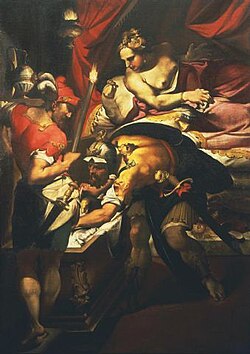
Atreus did not remain powerless for long. Guided by Hermes, a messenger of Zeus, Atreus tricked Thyestes into a pact: if the sun ever rose in the west and set in the east, the throne would return to Atreus. In a display of divine anger over Thyestes' deceit, Helios (the sun god) reversed his course, allowing Atreus to reclaim his kingdom.
The Thyestean Feast and Divine Retribution
Upon regaining power, Atreus discovered the adultery between Aerope and Thyestes. His revenge was calculated and horrific. Atreus murdered Thyestes' sons and cooked them, reserving only their heads and hands. He served the remains to Thyestes in a banquet, only revealing the truth after the meal was finished.
This event gave rise to the term Thyestean feast, which refers to a meal where human flesh is served. The narrative notes that Thyestes released a loud belch after the meal, symbolizing his satiety and a total loss of self-control before the horror was revealed.
The Birth of Aegisthus and the Cycle of Violence
Seeking a way to destroy Atreus, Thyestes consulted an oracle. The prophecy stated that a son born from Thyestes and his own daughter, Pelopia, would be the one to kill Atreus. Thyestes raped Pelopia to fulfill this prophecy, resulting in the birth of Aegisthus.
Ashamed of the child's origin, Pelopia abandoned the infant. A shepherd found Aegisthus and delivered him to Atreus, who raised the boy as his own son. It was only upon reaching adulthood that Thyestes revealed the truth: he was both the father and grandfather of Aegisthus, and Atreus was the boy's uncle. Driven by this revelation, Aegisthus murdered Atreus.
The Legacy of Blood and the End of the Curse
The fallout of this feud extended to the next generation. While Thyestes ruled Mycenae, Atreus' sons, Agamemnon and Menelaus, were exiled to Sparta. Under the protection of King Tyndareus, the brothers eventually returned to Mycenae to overthrow Thyestes, who died in exile in Kythira.
The cycle of violence continued when Agamemnon left for the Trojan War. Aegisthus seduced Agamemnon's wife, Clytemnestra, and together they murdered Agamemnon and his concubine, Cassandra. This bloodbath only ended years later when Agamemnon's son, Orestes, returned to Mycenae. With the help of his sister Electra and cousin Pylades, Orestes killed both Clytemnestra and Aegisthus.
According to Aeschylus' play The Eumenides, the gods eventually exonerated Orestes, declaring the curse on the House of Atreus finally broken. However, alternative accounts suggest further brutality, claiming Orestes later killed his half-brother Aletes and raped his half-sister Erigone, fathering a son named Penthilus.
Key Facts
- The Curse: Initiated by Myrtilus after being betrayed and murdered by Pelops.
- The Golden Lamb: The catalyst for the initial power struggle between Atreus and Thyestes.
- Thyestean Feast: A term derived from Atreus serving Thyestes' own children to him.
- Aegisthus: The product of incest between Thyestes and Pelopia, destined to kill Atreus.
- Resolution: The curse is traditionally said to end with the trial and exoneration of Orestes.
| Figure | Relation to Thyestes | Key Action/Role |
|---|---|---|
| Pelops | Father | Brought the original curse upon the line. |
| Atreus | Brother | Served Thyestes' sons to him in a feast. |
| Aerope | Sister-in-law/Lover | Helped Thyestes steal the throne. |
| Aegisthus | Son/Grandson | Killed Atreus to avenge his father. |
| Agamemnon | Nephew | Overthrew Thyestes and was later killed by Aegisthus. |
| Orestes | Grand-nephew | Killed Aegisthus and Clytemnestra. |
Frequently Asked Questions
What is a Thyestean feast?
A Thyestean feast is a term used to describe a meal where human flesh is served, originating from the myth where Atreus fed Thyestes his own children as an act of revenge.
How did the curse on the House of Atreus begin?
The curse began when Pelops murdered his servant, Myrtilus, after denying him promised rewards. Myrtilus cursed Pelops' descendants with his dying breath.
Who was Aegisthus?
Aegisthus was the son of Thyestes and his daughter Pelopia. Born from incest to fulfill a prophecy, he was raised by his uncle Atreus before eventually murdering him.
How did the conflict between Atreus and Thyestes end?
The immediate conflict ended when Agamemnon and Menelaus, with the help of King Tyndareus, overthrew Thyestes and forced him into exile in Kythira, where he died.
Did the curse ever truly end?
In the play The Eumenides by Aeschylus, the gods exonerate Orestes and declare the curse finished. However, other mythological versions suggest the violence continued through Orestes' actions against Aletes and Erigone.