Three-Wheeler Configurations and Lateral Stability
Designing a three-wheeled vehicle requires a careful balance between aerodynamics, cost, and safety. Unlike traditional four-wheeled cars, three-wheelers must manage their weight distribution and wheel placement to ensure they remain stable during turns and braking. The primary challenge lies in lateral stability—the vehicle's ability to resist tipping over when moving sideways or cornering.
Key Facts
- Tadpole layouts (two wheels front, one rear) offer superior stability during braking turns compared to delta layouts.
- Delta layouts (one wheel front, two rear) are more cost-effective for steering but are more prone to tipping and spinning out.
- Teardrop shapes are often used in three-wheelers to reduce wind resistance and improve fuel efficiency.
- Stability is maintained as long as the projection of the center of mass remains within the triangle formed by the tire contact patches.
- Safety engineering focuses on ensuring a vehicle slides (loses adhesion) before it reaches the point of tipping.
Tadpole Configuration: Two Wheels in Front
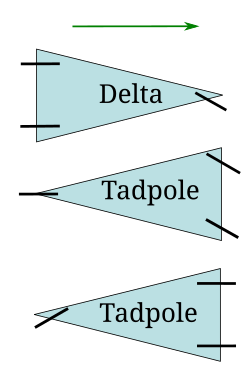
The tadpole configuration, also known as a reverse trike, places two wheels at the front and one at the rear. This layout is highly valued for its improved aerodynamics and its ability to accommodate small, lightweight motorcycle powerplants and rear wheels, as seen in the BMW Isetta and Messerschmitt KR200.
Depending on the engine placement, these vehicles can vary in performance. A front-engine, front-wheel-drive setup improves transversal stability by moving the center of mass forward and increasing traction. Conversely, some designs use a front engine to drive a single rear wheel, though this can make managing traction and lateral forces during turns more challenging. A modern variation, the Dragonfly Three Wheeler, proposes a rear engine that drives the front wheels to combine stability with a unique driving experience.
From a safety perspective, tadpole designs are far more stable during braking turns. However, they can still be more prone to overturning in normal turns than four-wheeled vehicles unless the center of mass is kept low or shifted forward. This is a particular challenge for motorcycle-derived designs, where the majority of the weight is concentrated at the rear.
To maximize fuel efficiency, many tadpole vehicles employ a teardrop shape—wide and round at the front and tapering at the back. The two front wheels create the necessary width for the round front, while the single rear wheel allows for the narrow taper. Examples of this design include the Myers Motors NmG and the solar-electric Aptera.
Delta Configuration: Two Wheels in Rear
The delta configuration, similar to a child's pedal tricycle, features one wheel in front and two in the rear. The primary advantage of this layout is a reduced cost for the steering mechanism. However, this comes at the expense of lateral stability.
Delta vehicles are inherently unstable during braking turns. Because the tipping forces from both turning and braking can quickly move the center of mass outside the triangle formed by the tire contact patches, the vehicle is at a higher risk of tipping. Additionally, if the vehicle does not tip, it has a greater tendency to "swap ends" or spin out when handled aggressively.
The Mechanics of Lateral Stability
Lateral stability is determined by the relationship between the vehicle's center of mass and its contact patches (where the tires touch the ground). Imagine a line projecting from the center of mass to the ground. When stationary, this line is vertical. As the vehicle moves, the line shifts: it tilts backward during acceleration, forward during braking, and sideward during cornering.
If the point where this line intersects the ground moves outside the boundary formed by the tires—a rectangle for four-wheeled cars or a triangle for trikes—the vehicle will tip over. To prevent this, engineers employ several strategies to ensure the vehicle slides before it tips:
- Lowering the center of mass closer to the ground.
- Positioning the center of mass closer to the axle with two wheels.
- Increasing the track width (the distance between the wheels).
- Limiting tire grip so the vehicle loses adhesion before reaching the tipping point.
- Implementing tilting mechanisms for the vehicle during corners.
- In the case of three-wheeled ATVs, allowing the rider to lean into the turn.
| Feature | Tadpole (Two Front) | Delta (Two Rear) |
|---|---|---|
| Braking Stability | High | Low |
| Steering Cost | Higher | Lower |
| Aerodynamic Potential | Excellent (Teardrop) | Moderate |
| Tipping Risk | Lower in braking turns | Higher in braking turns |
| Handling Tendency | Stable tracking | Prone to spinning out |
Frequently Asked Questions
Why is the tadpole configuration more stable than the delta configuration?
The tadpole configuration is more stable during braking turns because the two wheels in the front provide a wider base of support where the most significant tipping forces occur during deceleration and turning.
What is a teardrop shape in vehicle design?
A teardrop shape is an aerodynamic form that is wide and round at the front and tapers to a point at the back. This reduces wind resistance, which in turn increases fuel efficiency.
What happens when a vehicle's center of mass moves outside its contact patches?
When the projection of the center of mass moves outside the boundary formed by the tire contact patches (the stability triangle or rectangle), the vehicle will tip over.
How do engineers prevent three-wheelers from tipping?
Engineers prevent tipping by lowering the center of mass, widening the track width, shifting weight toward the two-wheel axle, or ensuring the tires lose grip and slide before the tipping point is reached.
Which three-wheelers use the tadpole layout?
Examples of vehicles using the tadpole layout include the BMW Isetta, Messerschmitt KR200, Aptera, and Myers Motors NmG.